

by Irena Karshenbaum, Local Journalism Initiative Reporter
(AJNews) – On August 17, 1916, when Mrs. Rosenburg sang and Mr. McGregor gave a recitation on “the occasion being the dedication of the Montefiore Institute building… on the North West 30-29-2 of the 4th,” near Sibbald, in eastern Alberta, the thought never would have crossed their untamed imaginations that a theatrical production would be staged based on their dedication ceremony, one hundred and ten years in the future.
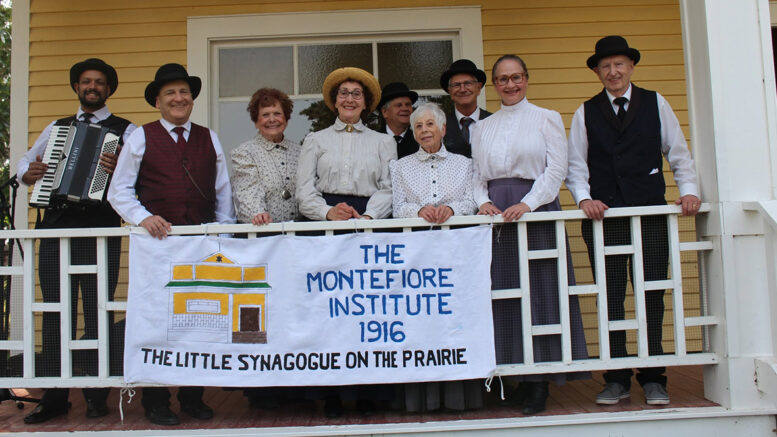
The re-enactment was performed by musicians and actors, most of whom are Synagogue interpreters, on the front porch of the Montefiore Institute at Heritage Park, and was produced and directed by Gary Silberg, a Synagogue interpreter himself and a community theatre actor. The script, the original author of which has been lost to time, was originally performed at Heritage Park on August 21, 2016, and was expanded for the latest production with input from some of the new cast members.
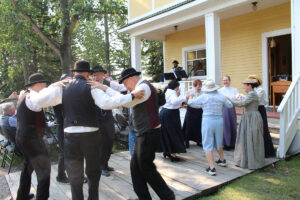
Dancing and merriment at the Montefiore Institute dedication re-enactfment. Photo by Carol Abbott-Wolfson.
The production was inspired by two newspaper articles published by The Oyen News. The first, a notice appearing on August 9, 1916, invited “neighbours, more particularly our Christian friends” to attend the dedication. The second was a post-event article, published on August 20, 1916, describing the joyful event, “After the concert a very enjoyable dance was given and continued until the small hours of the morning.”
Both articles were found by the late Calgary historian, Jack Switzer (1937-2012), while a board member with The Little Synagogue on the Prairie Project Society that had gifted the 1916 Montefiore Institute to Heritage Park in 2008.
They proved to be gems, not only because the stories served as a record of the 1916 dedication ceremony, but they also gave a glimpse, however grainy, into the life of the tiny Jewish farming community in this remote part of Alberta.
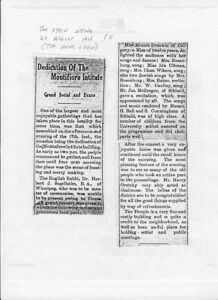
The archival newspaper article that inspired the re-enactment performance.
When Jack Switzer found the newspaper articles, he could not have imagined that years later they would also inspire a theatrical production.
In looking back, it is also hard not to look forward into the future and ask the question, how will history be preserved in 2126? In 2136?
I asked Deborah Shatz, publisher of Alberta Jewish News, this question and she explained their process for preserving the newspaper for future generations, “Alberta Jewish News mails a hard copy each month to Library and Archives Canada and also to The National Library of Israel. Prior to its closure in 2020, [Calgary’s] Jewish Free Press also sent a hard copy each month to Library and Archives Canada at https://www.canada.ca/en/library-archives.html.”
Shatz further explained that Alberta on Record, a database for the archival holdings of the Archives Society of Alberta, at https://archivesalberta.org/, holds digital issues of the Edmonton Jewish News from 1991 to 2009. The Alberta Jewish News website, under the Archives tab https://albertajewishnews.com/archives/, stores digital editions of Alberta Jewish News and Edmonton Jewish News from December 2014 to the present day.
I tried searching for these newspapers and am embarrassed to admit that I could not find electronic issues of the Jewish Free Press on the Library and Archives Canada or on Alberta on Record websites. I wish I had the super research skills of the late Jack Switzer.
So for future historians and script writers, who are currently reading board books, or may not even be born, yet, here is what happened on August 16, 2026. It was a warm Sunday. The sun was shining, the sky was a clear blue and a large audience gathered in front of the Montefiore Institute. We staged two performances, the first at 11:00 am and the second at 2:00 pm.
Gary Silberg played Mr. Harry Oretzky, the Secretary-Treasurer of the Building Committee, and was the master of ceremonies for the production. As Mrs. Dunford, I played a familiar role, a journalist who typed a notice on a Remington typewriter inviting guests to the Montefiore Institute opening ceremony. (A typewriter is a mechanical writing device used before brain implants that I am imagining you are now using to transcribe your thoughts directly to a Liquid-crystal display panel).
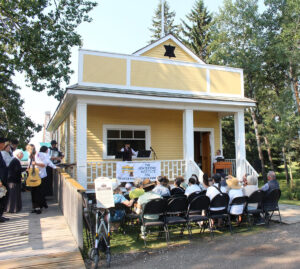
Montefiore Institute dedication re-enactment. Photo by Carol Abbott-Wolfson.
Everyone in attendance stood up for the singing of God Save the King. David Sussman, as the homesteader Mr. Leon Ullman, played the oboe and Joseph Fernando, as Mr. Ben Berezovsky, played the guitar performing the Yiddish classic, Oyfn Pripetchik. (If you are unfamiliar with this melody, ask AI to find a good version for you and add it to your GarageBand Sound Library, or whatever app you are using in 2136. Or is an app like a Remington typewriter in your time?)
Bob Pearson, was Mr. James McGregor a dairy farmer who lived close to Sibbald, and recited with such powerful feelings the poem, A Summer Storm, by Canadian poet, Duncan Campbell Scott. Reva Faber, as Mrs. Lillian Rosenburg, sang the Yiddish classic, Tumbalalaika, accompanied on guitar by Sandy Kogut, who was Mrs. Ethel Segal, while Eli Kogut, as Mr. Saul Segal, sang.
Zena Drabinsky was the most delightful Mrs. Minnie Ginsberg and sweetly recited the poem, Harvest Time, by Emily Pauline Johnson, which captures the spirit of the transition from summer to autumn in our little colony of Jewish farmers, as Mr. Harry Oretzky explained to the audience.
Mr. Ben Berezovsky performed, Tanz Yidelekh, on the accordion and also accompanied Mr. and Mrs. Oretzky singing, On Moonlight Bay, a popular song from 1912, and By the Beautiful Sea, another popular song, from 1914.
Mel Ksienski, as Mr. Louis Novikoff the President of the Building Committee, unveiled the mezuzah attached to the doorpost at the front entrance of the Montefiore Institute and recited the Shema prayer while his lovely wife, Mrs. Rose Novikoff, played by Leslie Levant, explained the meaning of the prayer.
The performance concluded with men and women dancing, separately of course, to the favourite folk song, Hava Nagila, which means, let us rejoice.
A small note to future historians. Hava Nagila was not written until 1918, two years after the opening of the Montefiore Institute. We slipped up in our historical fact-checking, but the song was just too perfect not to include in our re-enactment, as confirmed by the group of happy Sikh young men who formed their own circle and danced with joy to the melody in the field facing the Montefiore Institute.
Have I given you enough material in my story to write your own script in 2136?
Irena Karshenbaum is the founder and served as president of The Little Synagogue on the Prairie Project Society that gifted the 1916 Montefiore Institute to Heritage Park. Today, she volunteers as an interpreter in the exhibit and writes. irenakarshenbaum.com

Be the first to comment on "1916 Montefiore Institute Dedication re-enacted at Heritage Park"