

by Fida Nara-Tabony
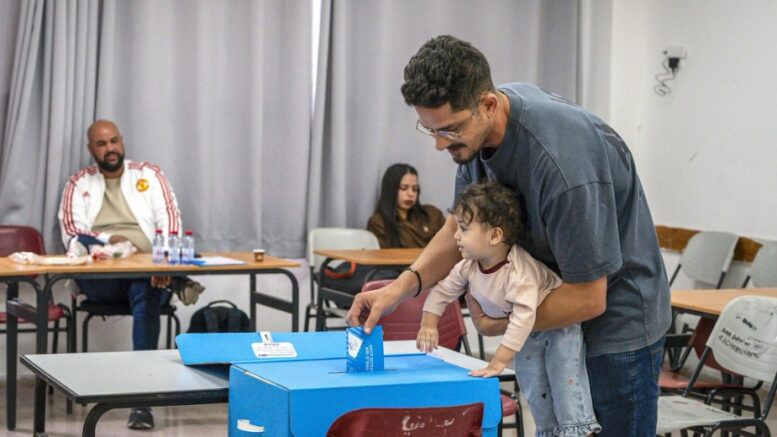
(JTA) — My youngest daughter voted for the first time on Oct. 27. She is a Palestinian citizen of Israel, 20 years old, raised in Nazareth and debates politics at my kitchen table.
She was far from alone. Arab voters came out in record numbers, with turnout estimates topping 77%, up dramatically from 53% in the last election. Exit polls show the Arab parties likely to nearly double their seats in the Knesset.
My daughter and I voted at a school near our home. As we waited in the long line, we talked with the people around us, and all of us felt, in this small act, a tingling of power and a sense of agency in the knowledge that we were demanding a saner place to live.
Arabs turned out on Israel’s election day because they are afraid of what another government like this one would mean for Palestinians everywhere. We want cabinet members Itamar Ben-Gvir, who has ignored the violence on our streets and brags about starving Palestinian prisoners in Israeli jails, and Bezalel Smotrich, who has undertaken a massive land grab in the West Bank and given a strong tailwind to violent settlers, out. We want an end to the murders in our streets by criminal syndicates, to the government demolitions of our homes, to the beatings of Arab bus drivers by violent racists. We want an end to the fear that, if we post expressions of sympathy for Palestinians in Gaza, we could be picked up by the Shin Bet and spend the night in jail.
And yes, we want Israel to end the occupation of the West Bank and the destruction of Gaza. All of this and more is why Arab citizens turned out.
Election results gave neither Prime Minister Benjamin Netanyahu’s bloc nor the opposition a clear path to the 61 seats needed to form a majority government. The opposition can reach that number only with the support of the Arab parties. The choice is simple: They can partner with the representatives of a minority that makes up a fifth of Israel’s citizens, half of its pharmacists and more than a quarter of its nurses and doctors, and in doing so replace the current government. Or they can refuse, and restore leaders who have tried to curb the power of the judiciary, presided over the failures of Oct. 7 and the devastation of Gaza and failed to stop a horrifying rise in settler violence in the West Bank.
Before the election, the leader of the opposition, Gadi Eisenkot, said that partnering with the Arab parties was “against my principles.” I did not vote for Eisenkot, but any democrat’s principles should begin with the idea that every citizen has an equal stake in the state. And that every human being between the Jordan River and the Mediterranean Sea deserves to live in safety, security and democracy.
On election night, Eisenkot told his supporters, “We are one people that deserves a government that respects and sees all of its parts.” Arab citizens are one of those parts. We want our voice heard, without being asked to stop being who we are — Palestinians.
Netanyahu, for his part, spent election day posting video after video warning his base that Arab voters were voting in high numbers. Cars flying flags of his Likud party drove through Jerusalem blaring the Muslim call to prayer and urging Jewish residents to vote. Now,even after all the ballots have been counted, Netanyahu is accusing my community of “trying to steal the election.”
Ben-Gvir, the far-right national security minister who oversees Israel’s police, was less tame. He filmed himself in the Arab city of Kafr Qasim urging supporters to counter the Arabs’ “crazy voting rate.” Adalah, an Arab civil rights legal center, alleges that Border Police officers, under Ben-Gvir’s jurisdiction, checked voters’ identification at polling stations in Bedouin towns, a task reserved by Israeli law for polling officials.
This was all happening while the lines at Arab polling places stretched for long hours. Arab citizens stood in them anyway. First, because they wanted to send Ben-Gvir, Smotrich and Netanyahu home. But also, after so many years during which the state has shown them how little they count, with chronic underfunding, heavy-handed policing and a near-total failure to confront the organized crime and killings that plague our communities, they were — I was, my daughter was — fed up.
That is why the turnout last Tuesday moved me so deeply. It meant that so many people had not been deterred. They had been persuaded that their votes could matter. I co-direct programs at the New Israel Fund, and since spring much of my work has focused on encouraging Palestinian citizens of Israel, especially young people, to participate. Qadaya, one of the organizations we support, sent students door to door with a goal of reaching 160,000 homes in Arab towns.
This kind of political engagement can change the equation, as precedent has shown. In 2021, Naftali Bennett, a right-wing politician and no dove, brought Mansour Abbas’s Arab Ra’am party into his government. In 1992, Arab parties acted as a “safety net” and supported Prime Minister Yitzchak Rabin’s minority government, enabling him to pass the Oslo Accords. Jewish-Arab political partnership can take many forms. Public opinion will follow.
According to polling by social psychology research center aChord, most centrist Jewish voters opposed partnership with Arab parties in early 2020. By March 2022, nine months into the Bennett government, more than 40% supported it. aChord called it the fastest positive shift in Israeli public opinion since the peace treaty with Egypt. Leaders went first, and the public followed.
In Israel, if there is political will, there is a political way. The question in this election was never only whether Netanyahu would lose. It was whether the political camp that calls itself “democratic” could finally see Arab citizens like me and my 20-year-old daughter as political equals. The coalition negotiations underway may not settle this question, but they might be the first step toward a day when both peoples, Jews and Palestinians, can look ahead and see a truly better future.
The views and opinions expressed in this article are those of the author and do not necessarily reflect the views of JTA or its parent company, 70 Faces Media.

Be the first to comment on "Arab voters like me showed up for democracy. Will Israel stand up for us?"