
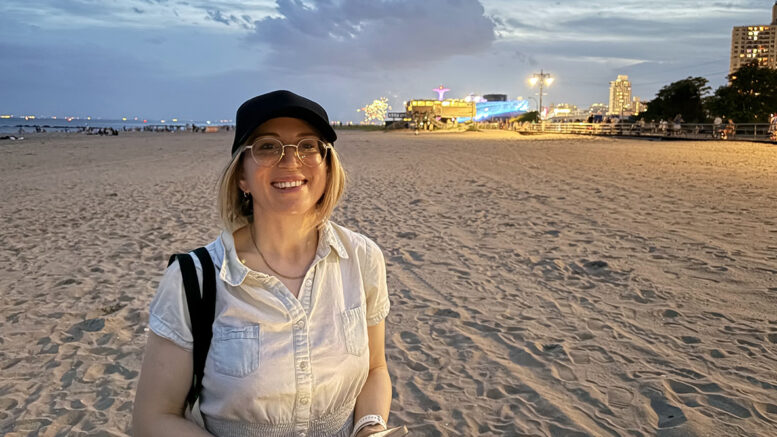

by Regan Lipes, Local Journalism Initiative Reporter
(AJNews) – In an age of ‘doom scrolling’ and teens aspiring to become ‘influencers’ it is easy to feel jaded. As we sit in front of words and images pondering their authenticity, gen-AI or not, it can feel like the brightness of human connections has dimmed, or even been extinguished, taking a backseat to algorithms and predictive software. I, like many of my fellow Millennials, enjoy social media; I keep up on the seasonal adventures of my friends and their children, and ‘react’ to cute pictures of cats, but I have not fallen in with the trend of ‘following’ online personalities as many younger generations have. This being said, it would take a truly exceptional online personality to captivate my curiosity, and recently, I got to speak with one such ‘content creator’ for an exclusive video-chat interview direct from her headquarters in Brooklyn, New York.
Frieda Vizel first caught my attention on Facebook, because everyone loves a good video about Jewish food. I became interested in her work and have begun to respect it tremendously since I started learning more about her efforts to introduce the outside world to the vibrance and beauty of Williamsburg’s Satmar Chasidic community. Even for broader Jewish circles, generally familiar with Chabad-Lubavitch, the Satmar community may be a bit more of a mystery. Prior to the Shoah their civilization flourished in Hungary, in a place called Satu Mare, now part of Romania. Their cuisine still boasts a fabulously Hungarian flare paired with universal Ashkenazi favorites.
“I don’t really cook, but I love Jewish food,” said Vizel. “I love sharing Jewish food with my friends and introducing them to my favorite dishes.”
Popular media portrayals often trivialize Satmar devotion and exoticize their ways of life, most recently in the German-made Netflix mini-series unorthodox starring Israeli actress Shira Haas. Misinformation has saturated entertainment, and misunderstanding abounds.
What makes Vizel’s work as a content creator particularly moving is both the tenderness and love with which she portrays Satmar Williamsburg, but also that she does this after leaving her community at the age of twenty-five.
“I felt as though I needed to play a role – to perform. It was like I found myself on stage dancing with the Rockettes, but I wasn’t a Rockette,” explained Vizel. “I was a tomboy as a child, and always curious.”
She recalled that on one occasion, a local public-school auditorium was rented by her community to put on a play with girls. “I found a book under the chair. I wish I remembered what book it was.” After turning its pages countless times, the long-forgotten title may be lost to time, but the experience of reading with intrigue and imagination is a sensation that resonates with Vizel.
“I also had an encyclopedia. Remember the bound encyclopedias, and they’d try to sell you the set by giving you one as a promotion? I had the ‘B’ section.”
Having grown up in Kiryas Joel, a small Satmar village in Orange County, New York, Vizel was married at eighteen in the same building where she went to school as a child. By twenty, she and her husband were blessed with a son, and it may have seemed as though Vizel’s life was on the right track in so many ways.
“We had internet, and I started to read blogs written by other Chasidic people.” Vizel had always been drawn to writing even from a young age. “When I was in school, I wrote a creative writing essay where I said I was a writer. I wasn’t specific about what kind of writer, but I was a writer.” Perhaps this love of the written word propelled Vizel’s path in another direction entirely. With the knowledge of her husband, she began her own blog under a pseudonym. “I wouldn’t say that I had any early thoughts that I wouldn’t live my life in the Chasidic community. The fracture point was years in the making. It’s like a marriage that you think will last forever. I can look back and say I saw facture points early on, but leaving was unfathomable because I was so invested.”
What some would call the ‘secular’ world, Vizel terms as ‘modern,’ and along with her husband she began to consume the entertainment media of this modern world. As she felt pulled towards a different life, her husband remained within the embrace of their traditions. In a truly exceptional piece of literature titled The Get, Vizel recounts her divorce with compassion, tender nostalgia, and raw emotion.
“You ask me quietly for forgiveness, and I nod tearfully. I look at you for the last time. I want to tell you I’m making fleish and ferfel for supper for us tonight, that we should go for a walk around Keiv Road when Shloimele is asleep, but you won’t be home for supper or for our son’s bedtime. […] I’ll continue to mourn you, Yoelish, as you’re alive in my child, you’re alive in the Satmar Hasidic child in me. But eventually I’ll be alright. You know I’m stubborn. Slowly, you’ll become a stranger to me too.”
Although she first published The Get anonymously, at the urgings of a friend, Vizel eventually took public ownership of the gripping piece, and a captivating video recording is available through her YouTube channel. She added reflectively during the interview: “That marriage was a gift. It was the right thing at the right time. It helped me become accepting of the tomboy weirdo in me, and I’m grateful to him.”
What sets Vizel’s story apart is that although she chose a different direction in life, her love and respect for the Satmar community is reflected in the valuable work she does. “The first tour of Williamsburg I gave was to a group of PhD candidates,” she recalled. “A professor of mine recommended me while I was in grad school.”
Vizel found the experience so positive that this catalyzed a full-blown business. She now takes Jews and non-Jews on walking excursions through the fragrant and colorful streets of Williamsburg so that everyone can appreciate a taste of the Satmar world. When asked if she has ever received criticism for this guiding being perceived as cultural exploitation, she responded candidly: “I’ve had some very positive responses from business owners and the community. Those that want to share their lives are generous in doing so. I’m a very sensitive person, and sometimes when someone isn’t happy, it stings.” In reality, what Vizel does is a tribute to the Satmar way of life, and a service to the community.
“I’m deeply connected to Judaism,” she explained. “Our rituals are nourishing to the soul, but even though I’m in Brooklyn, I’m not immersed in them the way I once was.” Vizel remains close to her family and joins them for simchas whenever she can. “Kiryas Joel is far, so I can’t be there for every celebration; I have a big family.”
What needs to be emphasized here is that despite the difficult journey Vizel underwent to become the person she is today, she is not shunned by her family, and her Satmar community has not rejected her as portrayals in mainstream entertainment would suggest. “My grandmother gave me a needlepoint that I put up in my apartment. I told her she should come visit me to see where I’d hung it, and my mom laughed a bit.” Perhaps her family does not stop by regularly, but they are very much a part of Vizel’s life. “Some of my family see my videos on YouTube, and some don’t use the internet in that way, but they know what I’m doing.”
Vizel’s YouTube channel is an extension of her work as a tour guide, and she has 139,000 dedicated subscribers, and millions of views. She explores some of her favorite eateries in Williamsburg along with viewers, speaks to members of the community, and gives her audience her own analyses of issues and topics related to the Chasidic world. Through writings, her guiding, and her videos Vizel is doing something truly commendable; she is dismantling stereotypes.
The guests on her tours gain insights informed by love and sincere appreciation, making the joy and radiance of Chasidism more tangible for outsiders. For those not walking along the streets of Williamsburg with Vizel, her videos reach wide audiences that are treated to a sneak peak of what it is her business offers. She may not have set out to dismantle entrenched prejudices with her work, but what Vizel has achieved is an important contribution to cultural bridgebuilding. I asked Vizel what she thinks about some of the portrayals of Satmar life perpetuated by the media, and she answered with elegance, and generosity: “We people are like narratives, and we fit ourselves into them. Hearing about departure is a way to process enormous pain. It’s not to say it’s incorrect. Narratives can flatten the complexity of stories.”
In a world where it is increasingly difficult to proudly wear a Jewish identity for all the world to see, Frieda Vizel is a content creator who gives us all a valuable reminder that we should love where we come from, even if it is not the place we want to be. The term ‘Jew-fluencer’ has started to make its way around the cybersphere, but what Vizel has accomplished is so much more; she is an intellectual, a scholar, a cultural ambassador, and a creative spirit.
My recommendation, for all those like me who crave a bit more substance with their internet consumption: follow Frieda Vizel on Facebook, Instagram, and YouTube. If you are lucky enough to find your way to Williamsburg, you would be remiss not to book a tour with her; you would be in the most capable of hands.

Be the first to comment on "Frieda Vizel: Jewish tour guide, content creator and creative spirit"