

By Jana Zalmanowitz, Local Journalism Initiative Reporter
(AJNews) – You may have encountered Rimon Calgary without knowing it.
They’re the people sewing historically accurate sails for the Seniors’ model ship-building club. They’ll rent you a chuppah for your upcoming wedding. They designed and stitched an entire felt alephbet for the Calgary JCC’s Book Nook. You may have even purchased one of their treasures at the Jewish Film Festival
I’d been hearing whispers of Rimon throughout my forays into Jewish Calgary and I had to find out: Who are these people quietly sprinkling our community with skillfully crafted creativity?
So I went to a meeting of Calgary’s Judaic needlepoint guild. I had never been to an official needlepoint guild meeting before. I went with an open mind.
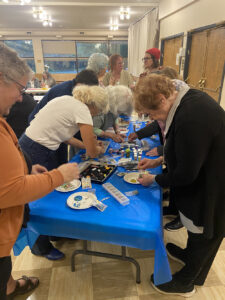
Standing up “heads together”: Rimon Calgary members socialize and put their heads together for creative decisions before beginning their projects.
Rimon brings together members of the community to create and preserve traditional methods of fibre and textile art. I wasn’t aware there was enough to differentiate Judaic textile arts from secular ones. My mind was quickly changed by the d’var Torah that begins every meeting.
Today, member Elka, delivers an interpretation of the Torah reading for the first day of Rosh Hashana. She talks about how God wove together elements from the unformed and void, and how sewing reflects Jewish values such as the power of connection, embracing imperfection and finding patience in the details.
I had arrived wondering how a needlepoint guild could be specifically Jewish. My takeaway from Elka’s talk is, “Of course, textile arts are inherently Jewish.”
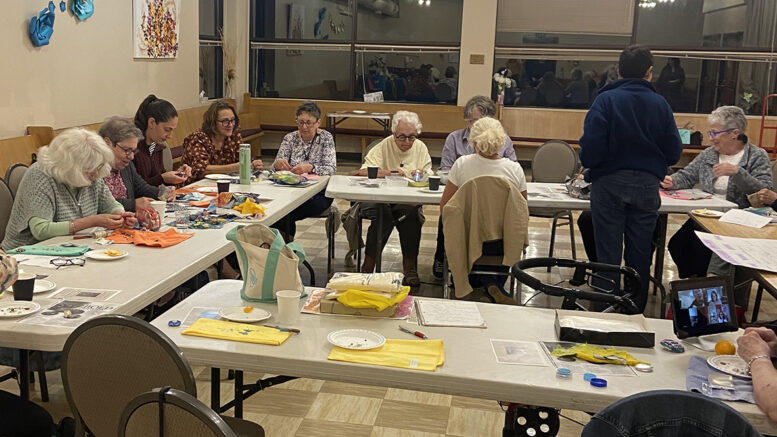
There’s a careful structure to the meeting. Everyone goes around the tables and introduces themselves for the benefit of any new members, or visitors like myself. Contrary to what I expected, there isn’t a specific age or obvious type amongst the group. But there are three Susans.
Members make motions, second motions and set aside time for new business. A secretary records minutes. There are snacks, arranged by this evening’s host, and a good chunk of time set aside for that month’s creative project.
Don’t let the official business of Calgary Rimon mislead you. The structure of the evening quickly gives way to something more free-flowing.
Long-time member and fibre artist, Marilyn, begins passing out materials while explaining the focus of the evening: hand beaded buttons. Her sample beaded projects are passed around and fabric scraps are selected.
“Put fabric on the button form and play!” Marilyn encourages. “Don’t stress over it.”
That seems to be the philosophy.
My initial connection to Rimon is Trudy, one of the original members and an award-winning textile artist. She fills me in on how Rimon works, how the projects come to life and who leads each meeting. On the tables I see a flyer for her upcoming exhibit. It features a work that is so intricately detailed it’s hard to believe it’s fabric and thread. Trudy is the real deal. Her art is currently on exhibit at Temple B’nai Tikvah.
While everyone dives into their project, it’s my opportunity to circulate.
I start with Elka, asking whether she gives d’var Torahs for fun. It seemed like just another evening at the pulpit for her. I learn she’s the ritual chair for Temple B’nai Tikvah. She joined Rimon three years ago when other women from synagogue caught wind that she was a quilter and brought her into the fold.
“I like to study Torah. I do executive training and coaching so I’m comfortable with public speaking,” she adds.
I ask about her quilting skills. “I can tinker a bit with that,” she says.
That modesty seems to be another common thread.
Tal is one of the younger members of the group. She had never heard of Rimon until two days ago when she encountered some members at an event. She had just returned to Calgary after completing a fine arts degree and was looking for inspiration and work in textile arts. How could they not recruit her?
Seated next to Tal is Therese who identifies herself as, “Possibly the oldest member of the group, but not the wisest.”
I later learn from Marilyn that Therese is indeed the wisest, and a very talented stitcher and knitter. Marilyn references an “amazing fascinator” Therese created for a challenge in the past.
Therese explains she’s been coming for years to admire other people’s skillsets and for the camaraderie.
The members span many generations. There’s Phyllis and Carly, a mother-daughter duo who have been coming together for the last year. Carly initially came because Phyllis doesn’t like to drive at night. She handily also has a fine arts degree and an interest in painting so she fit right in.
Then there’s Carolyn who teaches me what a milliner is. Having finished her button, she’s working on something different.
“I have a beading project I have to finish for work,” she tells me. Her work is intricate hat-making for film, television and theatre costumes. Carolyn has been coming to Rimon since the beginning, almost 20 years, noting her first encounter was a lecture on preserving textiles.
Nearby, one of the Susans tells me about her craft of sewing. She started out self-taught and after taking lessons, realized she had much to learn. She keeps coming back for the wealth of talent around the tables. “it’s a great way to learn stuff with talented people who want to share their skills by teaching others,” she says.
That seems to capture something fundamental about Rimon. The members aren’t all professionals. Some are serious hobbyists. Some are artists. Some are simply creative people looking for an outlet.
Each has a different story about how she arrived at Rimon, what she makes and how textile arts intersect with the rest of her life.
The crafts bring them into the room, but the relationships are what keep them coming back.
As I talk to the women, they describe their fellow members as “prolific in her artwork,” “mind-blowingly inspiring” and possessing “invigorating energy.” They are teachers, psychologists, financial planners, mothers, grandmothers and artists in their own way.
They’re also cheerleaders for one another.
In new business, a younger member, Megan, shares the new project she’s working on.
“I’m growing a human!”
The announcement is met with a chorus of excited well wishes.
Rimon is about much more than the objects being created. The buttons, quilts, sails, chuppahs and alephbet letters are the visible products. The less visible work is happening around the tables. They are skills being passed down, friendships being formed, new members being welcomed and generations learning from one another.
Elka’s words from the beginning of the evening come back to me: connection, embracing imperfection, patience.
They seem to describe more than the craft.
Each member contributes something: a skill, a story, a little advice, a piece of fabric. Each one adds another thread.
I wondered how to truly describe the meaning of a Jewish needlepoint guild. Elka sums it up. “It’s the people that bring me here. It is the kindred spirits. A way to create community.”
One stitch at a time.
You can purchase one-of-a-kind artwork made by Rimon’s members at the Calgary Jewish Film Festival starting November 7, 2026 at Beth Tzedec Congregation. For more information on Rimon, contact calgaryrimon@gmail.com.

Be the first to comment on "Rimon Calgary: Where Craft Meets Community"