

(Toronto) – The Canadian Jewish Literary Awards recognizes and rewards the finest Canadian writing on Jewish themes and subjects. This year, with a record number of submissions in several categories, the jury has selected nine exceptional books for recognition. The writers of these outstanding books will be presented with their Awards and prize monies during the in-person gala ceremony in Toronto on Sunday, October 25, 2026. Admission is free and everybody is welcome with pre-registration.
The 2026 winning books showcase excellence across genres and formats, capturing big ideas and small moments. Especially significant is the Irving Abella Award in History given annually in honour of Irving Abella z”l. Celebrating the best Canadian writing on Jewish history, the Irving Abella Award is supported by the friends of this giant of scholarship who left an indelible imprint on Canadian Jewish studies.
Also, this year the Canadian Jewish Literary Awards will pay tribute to Adam Fuerstenberg z”l, a visionary founder of the Canadian Jewish Literary Awards whose collected essays -Transplanting Roots: The Adam Fuerstenberg Reader, was recently published.
“The quality of all the submissions this year was exemplary, and the Jury had tough decisions to make to honour these exceptional books,” Canadian Jewish Literary Awards founder and Jury Chair Edward Trapunski said. “We are proud of what these books mean to both the Jewish and the literary community and we are pleased to boost their visibility through our Awards program.”
Winners were selected in eight categories. Contemporary Jewish Issues and Graphic Literature are new categories represented this year. Each title was chosen by the Jury to represent an exceptional quality of work in its category. The Canadian Jewish Literary Awards is proud to share the Jury’s praise for why each title was selected.
Honourees of the 12th annual Canadian Jewish Literary Awards
The Irving Abella Award in History
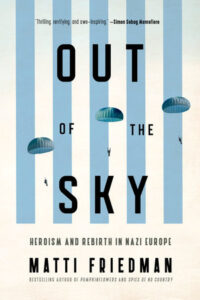 Out of the Sky: Heroism and Rebirth in Nazi Europe by Matti Friedman (Signal) is a story of Jewish resistance. Hannah Senesh, Israeli’s legendary poet-warrior, the author of the beloved Hebrew song “Eli, Eli”, was one of a cadre of young Zionists who had fled Europe for Palestine, committed to building the Jewish state. In 1944, a small group parachuted into occupied Europe ostensibly on a British military intelligence mission, but with secret orders from the nascent Mossad to try to save Jews. In this propulsive, nuanced narrative, Matti Friedman revisits their audacious leap of faith which ended up saving no Jews and killing no Nazis but nevertheless leaving an indelible imprint on the history of the Jewish people and the State of Israel in the process of being born. With a journalist’s eye and a novelist’s gift, Friedman follows Hannah Senesh and her three idealistic compatriots, only one of whom survived. Mining declassified documents, memoirs and letters and retracing their steps through contemporary Europe, Friedman brilliantly chronicles their unfolding fate while celebrating the literary legacy they left and the founding myth they wrote with their actions.
Contemporary Jewish Issues
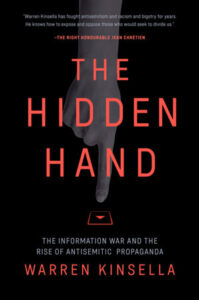 The Hidden Hand: The Information War and the Rise of Antisemitic Propaganda by Warren Kinsella (McLelland & Stewart). Since October 7, 2023, and arguably for decades before that, Israel had been in two wars, both over the very existence of the Jewish State. The first is a war with bullets and explosives. The second is a war about information about that first war. The Hidden Hand makes clear that the second front has a plan and a strategy that animates it with alarming consequences for antisemitism worldwide. Warren Kinsella details how so-called spontaneous protests are in fact meticulouslyplanned and actively financed by known state actors. Clear, direct and well-written, The Hidden Hand shows how the media and communicators are not neutral observers but often willing collaborators spinning anti-Zionist and outright antisemitic cliches as though they were facts. This is essential reading for placing the information war into its historical and geopolitical context.
Fiction
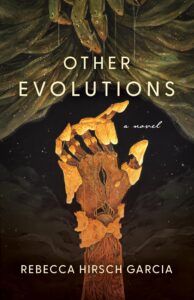 Other Evolutions by Rebecca Hirsch Garcia (ECW Press) introduces a fresh and distinctive voice to the landscape of Jewish fiction. This debut novel is the first-person narrative of Alma Alt, the younger of two daughters of an interfaith, interracial Jewish-Mexican family in Ottawa, brought to vibrant and loving life by the author. With the steel of her Mexican mother, and the perpetual sadness of her Jewish father, Alma is possessed of a deep soul and a spirit of defiance. Instinctively, she runs from what she cannot tolerate— at age four, her beloved bubbe’s funeral; at age fourteen, an unspeakable betrayal by her older sister. Only this time, the consequences of flight are tragic and life altering. How do we live with irreparable loss? Can we repair what we ourselves have torn apart? These questions, together with themes of identity, assimilation and loss, drive this beautifully observed and mysterious novel that, for all its thematic heft, is a poignantly funny read.
Graphic Literature
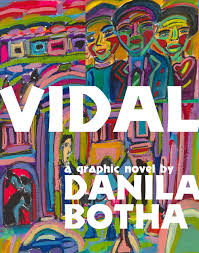 Vidal by Danila Botha (At Bay Press) transcends classification. It is more than a graphic novel. It is a family history told with words and with pictures, underlined by the irony of being a fictionalized true story. The story traces Vidal Ben Soussan’s life from his vibrant Sephardic upbringing in Tiberias, the freedom and glamour of his artistic life in Paris, the Nazis arriving in Paris, Vidal’s work with the resistance, his arrest, the terror of his time in Auschwitz, and finally a reunion with his daughters in Canada who barely remember him. Told in Vidal’s voice, the story feels intimate and immediate and it is a surprise to find out that some of the details are invented. The expressionistic paintings accompanying the text, reminiscent of Chagall, become part of the narrative itself, conveying emotion through colour and composition. The palette changes from warmth and hope to darkness and despair, mirroring Vidal’s journey through life. The artwork takes the form of journals, family albums, street posters, and painted recollections.
Vidal honours memory and family and the experiences of Sephardic Jews during the Holocaust through the story of one remarkable man.
Children and Youth
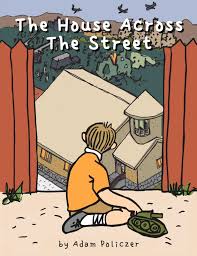 The House Across the Street by Adam Policzer (Dirty Water Comics) is a memorial and a work of love – for his family and for the brave neighbors who risked their lives to save a five-year-old boy from death. Eighty years after he survived the Holocaust in Hungary, 87-year-old Adam Policzer has written and hand-drawn a graphic novel telling his gripping story. Policzer’s father had fled Hungary before the Nazis invaded, and his mother arranged to hide Adam with a Christian family living across the street in the city of Miskolc. Policzer is one of the few child survivors who could still vividly remember the Holocaust. The simplicity of his drawings and the language and his candour about the harrowing experiences that a child had to endure will engage young people for whom the Holocaust is distant and remote. It is a harrowing and emotional story beautifully told that will connect with older readers as well.
Holocaust
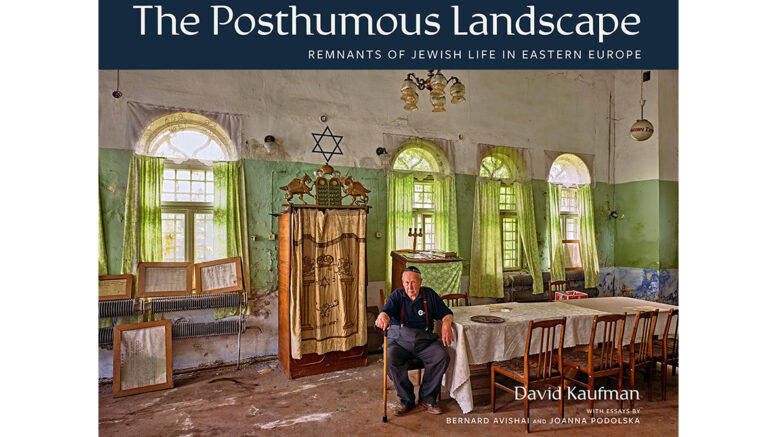
The Posthumous Landscape: Remnants of Jewish Life in Eastern Europe by David Kaufman (Figure 1 Publishing) is more than an act of preserving memory, it is a visual landscape that bears witness to the vitality and creativity of Eastern European Jewry before its destruction. The book is a masterpiece. It is the work of a wonderful photographer working as a visual historian. This book does not dwell on the Holocaust as a primary subject, yet that history is on every page. The haunting photographs and accompanying texts describe a historic community that played a major role in the development of eastern European society and left behind half-destroyed synagogues, community buildings and grand industrial complexes, as well as vast cemeteries, and haunting memorials. The landscapes of death speak silently of the drama that engulfed Poland and surrounding countries during the Shoah. The Posthumous Landscape is a tribute to a community that met a tragic end, and a testament to how we are inextricably bound to the places of our past.
Yiddish
Boom and Chains: A Yiddish Novel Set in Israel/Palestine by Hanan Ayalti translated by Adi Mahalel (Wayne State University Press), occupies an unusual place in Yiddish literature. Based on the author’s own experience on a kibbutz in the late 1920s and early 1930s. First published in serial form in 1936, the novel offers a vivid picture of life in Mandate-era Palestine from both the Jewish and Arab perspectives. Amidst the tumult of that period, Ayalti explores the conflicting ideologies and practices, and resulting clashes, within each community. The area around the kibbutz is populated by Arab workers barely able to subsist on land they lease from local Arab owners only too happy to sell their properties to Jewish organizations eager to establish settlements there. The author’s disillusionment with the Labor Zionist movement led him to leave the kibbutz after four years, to turn to Communism, and to reject writing in Hebrew in favour of Yiddish. With his eventual loss of faith in Soviet Communism, he repudiated the novel itself. As translator Adi Mahalel notes in his informative and thoughtful introduction, the tensions and contradictions Ayalti depicts in the novel remain relevant today. Mahalel’s translation of this significant yet overlooked work, supplemented by Mahalel’s in-depth research greatly, enriches our understanding of a crucial period in the history of pre-State Israel.
Scholarship
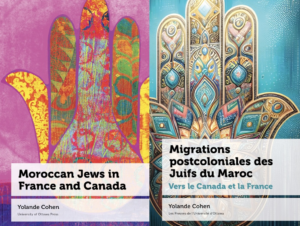 This year the Canadian Jewish Literary Awards recognizes two companion publications in English and in French by the same author. Moroccan Jews in France and Canada and Migrations postcoloniales des Juifs du Maroc vers le Canada et la France by Yolande Cohen (University of Ottawa Press) offer a groundbreaking exploration of the post-colonial migrations of Moroccan Jews to France and Canada. After the establishment of Israel and the uneasy situation for Jews in Arab-dominated Morocco, most Moroccan Jews migrated to Israel. Yet a significant minority, more westernized, settled in France and Canada. With these two books, Yolande Cohen gives a brilliant and clear analysis of the tribulations encountered by Moroccan Jews in resettling in France and Canada.
The English and French versions of these two books, though distinct, complement each other to offer a comprehensive look at the deep traumas underlying this historic migration.
The Canadian Jewish Literary Awards will be presented on Sunday, October 25, 2026, 2 p.m. at a gala ceremony at the Al Green Theatre, Miles Nadal JCC, 750 Spadina Avenue in Toronto. The ceremony will be available for later viewing on the Canadian Jewish Literary Awards YouTube channel. Winning authors will be in attendance to discuss their books and sign copies. The Canadian Jewish Literary Awards welcomes everyone to attend the Awards ceremony at no cost. Registration links and more information are available on the Award’s website.

Be the first to comment on "The Canadian Jewish Literary Awards Announces The 2026 Winners"