

by Rabbi Daniel Greyber
(JTA) — “Rabbi Greyber, you can’t hide — we charge you with genocide.”
Those were the words shouted at me in front of Hebrew school students outside my synagogue two years ago. In the months and years since Oct. 7, I have stood with my community in grief, in fear and in a fierce commitment to Israel’s right to defend itself despite the vitriol thrown my way.
And yet, after our synagogue supported a recent fundraiser for the Gaza Children’s Village, I have been asked — sometimes with genuine concern, sometimes with anger — how such a decision could possibly align with that commitment. Some of those questions have come from within my own community.
Let me begin here: My Zionism is not theoretical. It is existential.
Just a month after Oct. 7, I visited Israel with local leaders. I’ve returned three times since to express solidarity and see beleaguered family and friends. Our mid-size synagogue in Durham, North Carolina, raised $175,000 for Magen David Adom, Israel’s emergency response service. We advocated for the hostages, prayed for them week after week, and, after they were freed, brought Keith and Aviva Siegel — who have ties to our community — to share their story.
We raised tens of thousands of dollars to support the rebuilding of Kfar Aza, a kibbutz in southern Israel. And like so many Jewish communities, we have carried the ongoing pain of a war whose reverberations have not ceased — whether in the trauma of Oct. 7, the anguish of hostage families or the continued threat of Hezbollah rocket fire in Israel’s north.
That commitment has not wavered.
So when people ask whether I am concerned that money raised for Gaza could end up in the hands of Hamas, my answer is simple: Of course I am.
Hamas has systematically corrupted Gaza’s humanitarian infrastructure, diverting vast sums of aid to build tunnels, stockpile weapons and entrench its control. Anyone who cares about Palestinian life must reckon honestly with that reality.
But here is the deeper truth: If we only know how to say “no” to what is dangerous, and not “yes” to what is hopeful, we will forfeit the future we claim to seek.
The Gaza Children’s Village is one of those hopeful efforts. Guarded by the clans of southern Gaza, who are playing a security role following Israel’s battle against Hamas, it is leading a high-risk, high-reward initiative working to usher 19,000 children into a future shaped not by hatred, but by the possibility of peace with their neighbors. Rooted in Palestinian heritage, its Academies of Hope teach a new, unique curriculum aligned with the long-term security of the region — including the stated goals of Israel’s own security establishment.
For that very reason, its teachers, staff and leadership live under constant threat. They are not aligned with Hamas, and because they are not, they risk intimidation and even fear for their lives. And yet they remain committed to a simple principle: a better life for both sides.
Beyond the Jewish moral imperative articulated by Rabbi Lord Jonathan Sacks (z”l) that “your enemy is also a human being,” supporting this project is not naïve. It is a way of strengthening those who are quietly, courageously building a different Palestinian future.
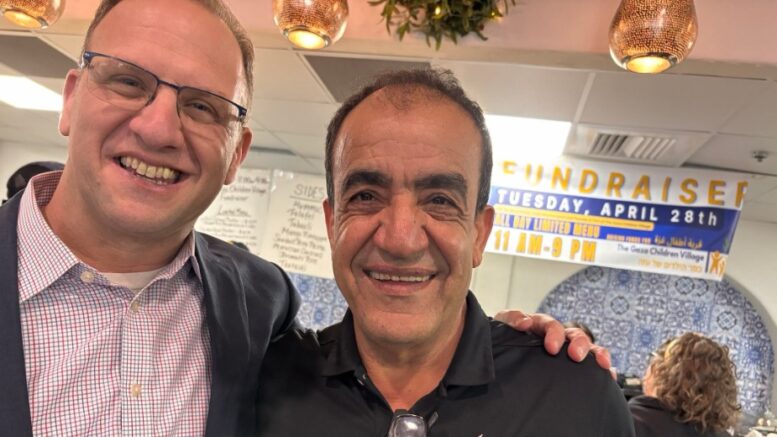
Dr. David Hasan, the organization’s founder and our neighbor in Durham, is one such person.
The Gaza Children Village has been approved by the Israeli unit responsible for implementing civilian policy in Gaza, COGAT, and recognized by Israel’s Ministry for Diaspora Affairs. Dr. Hasan has been personally targeted by Hamas, in part because he sought to provide information that contributed to the rescue of Israeli hostages. And he has built an educational environment that teaches peace and does not demonize Israel — an almost unthinkable act in today’s Gaza.
At the fundraiser, Dr. Hasan made a remarkable commitment: that the funds raised would support both Israeli and Palestinian orphans. In the days that followed, he traveled to Israel to meet with families from the kibbutzes attacked on Oct. 7. He is now working to create a short experience that will bring Israeli and Palestinian children together in Italy — not to debate politics, but to encounter one another as human beings.
We should not only support people like Dr. Hasan. We should celebrate them.
Because if there is to be a different future, it will be built by people who are already risking everything to create it.
Some have asked me: When have Palestinians raised money for Israelis?
The honest answer is: not often enough. But in this case, it happened.
And when something rare and good emerges in a broken system, our responsibility is not to stand back in suspicion, but to step forward in support.
It is also important to be clear about what this event was. It was not a Jewish-led initiative. It was a Palestinian fundraiser, hosted at Mediterranean Deli, Bakery & Catering by Jamil Kadoura, who is from Qalqilya, in the West Bank. Our synagogue was honored to stand with a trusted, longtime friend and support a Palestinian effort to build something better from within Palestinian society itself.
For me, this decision was not in tension with my Zionism. It was an expression of it.
If we are serious about Israel’s future — not only its survival, but the kind of future it will have — then we must be serious about strengthening those who stand against Hamas and everything it represents.
The large-scale fighting in Gaza may have ebbed, but the deeper struggle has not ended. Hamas remains committed to Israel’s destruction. Israelis continue to live under threat. Military strength is necessary for Israel’s survival. But it is not sufficient for Israel’s future.
Israel can defend itself. It cannot, on its own, create the partners it will need for peace.
Those partners — Palestinian leaders and institutions capable of choosing life over death, coexistence over annihilation — are fragile. They are rare. When they appear, they must be strengthened, encouraged and yes, celebrated. And when they do not present themselves as readily as we are lucky to have had happen in Durham, they must be cultivated wherever possible.
The Gaza Children Village is not a solution to the conflict. It is something smaller — and, in its own way, more important.
It is a fragile seed of a different future, planted in extraordinarily difficult soil.
We did not support this effort because we are indifferent to Israel’s suffering. We supported it because we are committed to Israel’s flourishing.
To be a Zionist today is to hold more than one truth at once: to stand firmly with Israel in its need for security, and to actively seek out and lift up those on the other side who are trying to build something different.
Our task is not to pretend those people are everywhere.
Our task is to find them, to strengthen them — and to help ensure that they are not alone.
The views and opinions expressed in this article are those of the author and do not necessarily reflect the views of JTA or its parent company, 70 Faces Media.

Be the first to comment on "Yes, I’m worried that giving to Gaza could benefit Hamas. But Zionism today demands hope."