

by Irena Karshenbaum, Local Journalism Initiative Reporter
(AJNews) – The night before Goldie Morgentaler’s lecture in Calgary, she, her husband and I are having dinner in the restaurant of the hotel where they are staying, the federal by-election playing on the TV suspended on the ceiling. Goldie wants to talk politics, and judging by how she speaks about certain issues, I can tell instantly that she and I live on opposite ends of the political divide. Our time is so limited, I steer the conversation towards our mutual interest, her mother’s, Chava Rosenfarb’s, literary work.
Goldie steers the conversation back, “But I want to talk politics!” she exclaims in a manner only a native-Yiddish speaker can with that mysterious power to pull at the heart strings. Then she recounts how growing up, politics was a big topic of conversation in her home and would lead to heated discussions. My home was similar growing up, but I don’t say anything.
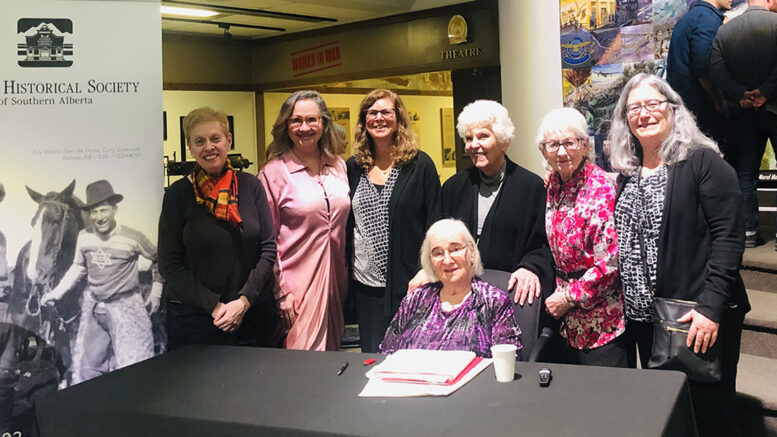
It is the evening of April 13 and Dr. Goldie Morgentaler and her husband, Dr. Jonathan Seldin, have just driven in to Calgary where the following evening she will be presenting a lecture, The Canadian Afterlife of the Great Yiddish-Language Holocaust Novelist, Chava Rosenfarb, as told in Letters and Stories. The lecture will be hosted by the University of Calgary Centre for Military, Security and Strategic Studies and presented in a first-time partnership with the Jewish Historical Society of Southern Alberta and the University of Calgary Jewish Community, a committee of Jewish faculty and staff that formed as a response to October 7.
Goldie mentions she is nervous about her lecture, which I tell her is natural, and as I leave the couple for the night, I also leave behind my copies of her mother’s books for her to autograph, which she says she is “honoured” to do.
Goldie Morgentaler is the daughter of Dr. Henry Morgentaler (1923-2013) and Chava Rosenfarb (1923-2011), one of the most important writers – as a poet, fiction novelist and essayist – in the Yiddish language after the Second World War, and she is also her mother’s literary translator, from Yiddish to English, having translated most of her mother’s works.
I first met Goldie two years ago when I conducted an oral history interview with her, since she lives in Lethbridge, that will be held in the oral history collection of the Jewish Historical Society of Southern Alberta for use by future researchers and historians. The extensive interview was transcribed by Laura Shuler, one of the vice-presidents of JHSSA, and the chair of JHSSA’s Oral History Committee.
On the evening of April 14, I pick up Goldie and Jonathan at the hotel and we drive to The Military Museums where her lecture will be held. At the entrance, there are happy hugs and greetings by members of the event’s organizing committee and as soon as the museum doors open, the guests start arriving, and keep coming, until the Atrium is almost full.
Then the best part of the evening, the lecture. There is no movement, no fidgeting, everyone’s attention is on Goldie Morgentaler. She explains her talk is not about the Holocaust, per se [the lecture falling exactly on Yom HaShoah], but, “On the aftermath of the Holocaust as it appears in the fiction and letters of my mother.”
Using the latest work, published in June of 2025, Letters from the Afterlife: The Post-Holocaust Correspondence of Chava Rosenfarb and Zenia Larsson [McGill-Queen’s University Press] and the 2023 collection of short stories, In the Land of the Postscript [White Goat Press], Goldie explains that her mother’s work encompasses the Holocaust as well as the immigrant experience, “Specifically, what it was like to settle in Canada after having experienced and survived the horrors of the Łódź ghetto, Auschwitz and Bergen-Belsen.”
Goldie recounts how her parents arrived in Montreal in February of 1950, from Brussels, after travelling in the steerage section of the boat, Samaria. The couple landed in Pier 21, in Halifax, then travelled by train to Montreal where they were welcomed by members of that city’s Yiddish literary community including, Harry Hershman.
Hershman, Goldie describes as, “a big macher,” and who, in 1948, published her mother’s first book of poetry, The Ballad of Yesterday’s Forest. Hershman also sponsored to Canada Chava and her husband, and later Chava’s mother and sister because, as Goldie explains, “He knew how to pry open the very reluctant jaws of the Canadian immigration system,” after persuading the Canadian government to accept Jewish orphans from Ukraine in the 1920s.
Goldie continues, “It was in Montreal that Chava finally settled down to writing in earnest.” Her work first included poetry, then a play, “All on the subject of the Holocaust,” then her masterpiece, The Tree of Life. Written as a trilogy, the novels covered the four years of the Łódź ghetto and were, “Based on her own experiences of incarceration in the Łódź ghetto.” This extensive work was followed by novels, Bociany and Of Lodz and Love.
Rosenfarb also wrote short stories that were never published in a single volume during her life, and were based on her early years living in Canada. This collection, In the Land of the Postscript, was assembled by Goldie who also named the book, explaining, “For many Holocaust survivors, their after-lives in Canada served as a certain postscript to the main event of their lives, which was the Holocaust.”
One of the most complicated stories in the collection, Edgia’s Revenge, was inspired by an incident Chava experienced with a kapo during her incarceration in Sasel. The story delves into the dual lives of the characters who outwardly lead vibrant lives, “But inwardly, they have never left the Europe that tortured and rejected them.” She explains this story is, “An indirect tribute” to Chava’s childhood best-friend, Zenia Marcinkowska (1922-2007), who later became Zenia Larsson after marrying her Swedish husband, Per-Axel Larsson.
Goldie recounts how the two women were “inseparable” in Łódź before the Second World War and during the Holocaust. Soon after Bergen-Belsen was liberated in April of 1945, Zenia accepted an offer of asylum by the Swedish government and left for the Scandinavian country where she lived for the rest of her life.
This perpetuated a separation of the two friends where they did not meet for almost twenty-five years, yet maintained their friendship through letter writing. These letters were gathered by Goldie and published in, Letters from the Afterlife. Goldie admits that she published the letters with “trepidation” since the practice of handwritten letters is nearly extinct now and she “thought that no one would be interested in reading the book.”
The letters, beginning in December of 1945 and ending in December of 1971, are personal, while still being literary, where the two women discuss their inner lives, their loves, their heartbreaks, their work struggles, and their love for each other.
Goldie reveals that the correspondence actually continued beyond the timeframe of the book well into the 1990s.
After the lecture, I drive Goldie and Jonathan back to the hotel. When I return home, I look through my personal Chava Rosenfarb library now made precious with each book being autographed: Letters from the Afterlife, Confessions of a Yiddish Writer and Other Essays, In the Land of the Postscript, Bociany, and Of Lodz and Love.
Every note moves me. Like her mother, Goldie Morgentaler has the power to touch hearts.
The complete recording of this lecture will be uploaded in the near future to the Jewish Historical Society of Southern Alberta website: https://jhssa.org/. Better yet, I recommend reading Chava Rosenfarb’s books.
In addition to the presenting partners mentioned in this story, the lecture received generous funding from the KSW Calgary Holocaust Education & Commemoration Endowment Fund held by The Jewish Community Foundation of Calgary.
Irena Karshenbaum is a board member with the Jewish Historical Society of Southern Alberta and she writes in Calgary. irenakarshenbaum.com

Be the first to comment on "Goldie Morgentaler, speaks in Calgary about the great Yiddish writer, Chava Rosenfarb"