

by Irena Karshenbaum, Local Journalism Initiative Reporter
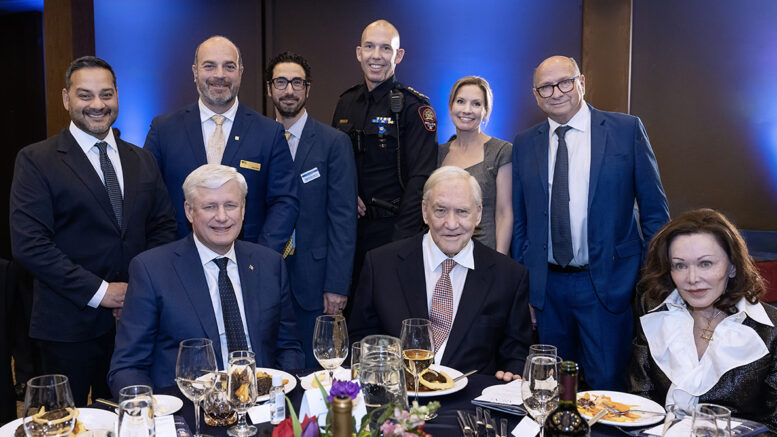
(Calgary) – If readers are looking for proof about the popularity of Canada’s 22nd prime minister, The Right Honourable Stephen Harper, they need only to have attended the 73rd Annual B’nai Brith Calgary Dinner on April 23 and witnessed the number of people circling the head table looking for a photograph with the former prime minister.
The gala was not only sold out six weeks in advance, an unprecedented occurrence for B’nai Brith Calgary Lodge #816. It was also the first time in the charity’s long history that an honouree was invited back as an honouree, with Stephen Harper having been honoured in 2017, the other sold-out dinner in recent memory the success of which was attributed to his presence.
 The lead honourees of the 73rd annual dinner were Conrad Black, historian, biographer and frequent columnist for the National Post, a newspaper he founded in 1998, and his wife, Barbara Amiel, author of numerous books and a columnist for Maclean’s, and other top-tier publications, with a reputation for being a staunch supporter of Israel.
Black and Amiel continue to shape the public discourse in Canada and their presence at the 2026 B’nai Brith Calgary dinner was greatly anticipated, as reflected by the brisk early ticket sales. Then with the relatively late-stage announcement that Stephen Harper would attend, and also be honoured as Special Moderator, the dinner was quickly sold out.
Former Federal Minister of Defence and Premier of Alberta, Jason Kenney, known for his sense of humour, introduced the “extraordinary Canadians” by beginning with, “Imagine Barbara Amiel, Conrad Black and Stephen Harper walk into a shul.”
Kenney described Amiel as, “One sparkling exception to the rule” of the “boring and grey, predictable, a monolithic opinion” of the Canadian media he encountered in his formative years, and Black as, “One of the most compelling figures in Canadian commerce, but really more responsible than anyone for creating diverse voices in Canadian media.” He noted that a recent poll measuring “the most popular and effective modern Canadian prime minister” showed that Stephen Harper was “ranked first.”
Amiel responded to Harper’s opening question about what worries her most and what she would do about it by explaining that she currently sees everything, “Through the lens of Israel.”
She continued saying she, “Fears the end of our tribe, of the Jews, not through the outside world, throwing bombs or bullets, but what we are doing to ourselves.” She explained that there is social exclusion and Jews become frightened, “They want to be liked, and I think we should stop wanting to be liked. We should look after ourselves for a change. It’s very nice to give a lot of money to hospitals, to universities, except if you give them to universities, at the moment, you’ll find it in the faculty of English as well as Middle East studies, where they are teaching people how to dislike Jews. So stop giving to those sort of philanthropism and start looking after your own as B’nai Brith does with all its trips to Israel. And stop worrying about anti-Semitism. It’s not Israel’s fault. There’s been anti-Semitism for three thousand years, with the most ghastly being the Holocaust. But somehow we’ve managed to come back, and that may be one of the reasons we are disliked, because we do always come back.”
Black opened his thinking, “The crisis in the West, of our determination as a society and as a civilization to continue, is the failure to control our borders.” He confirmed that he does not oppose legitimate immigration, “I am talking about people swarming into our countries as in the southern border of the United States, until recently, and parts of Europe.”
He stated that a country that has, “Devoted itself in public policy terms to commercially self-destruct with a dedication to an irrational notion of ecology that if we didn’t abandon – and no jurisdiction has been a greater victim of it than Alberta – if we didn’t abandon fossil fuels, we would all die. This is what all sorts of charlatans in the academic world have been telling us.”
Black continued, “All of these trends were aggravated in the U.S., when its only surviving rival, the Soviet Union, fell like a soufflé, and all the forces of self-hate that had been cowed prior to that by the consensus of the ethos of America as a great civilization promoting liberty and its advance from strength to strength in record time to a level of influence unequal by any jurisdiction in history, since the Roman Empire.”
He observed that the United States was, “Flagellating itself, and this is stopped. And it is caught up in the complexities of the vagaries of the personality of the present president, but he is repulsing those forces.”
Black concluded, “My fear is that the progress he [Trump] has made, stopping this nonsense that we have 227 genders and stopping biological men from destroying women’s athletics, stopping this hysterical madness about the environment, the open borders, and asserting America’s rightful place in the world. That because of objections to him as a person, the sound policy he is executing could be rejected because what happens in the United States influences incomparably the whole world. And if the United States isn’t going to lead the West, the West could actually lose its pre-eminence in the world to a civilization that has no respect for democracy, no respect for human rights and no sympathy at all for what we in the West, including the Jews prominently among us, have been struggling to establish unevenly, but unceasingly, for thousands of years.”
Mayor of Calgary, Jeromy Farkas, received a standing ovation for his powerful speech that acknowledged that Jews are living in the most dangerous moment in history beyond the Holocaust stating, “Anti-Semitism is loud, it is no longer hidden, it is organized and it is spreading.” Farkas said that anti-Semitism is now seen in the streets, students are intimidated, and slogans like “Globalize the Intifada” are regularly chanted. He stated that this is, “Not a call for peace or for co-existence. It is a call that is tied to the violence against Jews,” repeating twice to emphasize his point, “It has no place in our city, none.”
Darren Bondar, immediate past president of B’nai Brith Calgary Lodge #816, served as emcee.
Bill Lister, who was introduced by his wife, Lily Lister, brought levity to the gala through personal storytelling prior to receiving the Ben Docktor Award of Excellence for his contributions to the growth and development of Calgary’s Jewish and broader community.
Dinner co-chair, Joel Grotsky – working with co-chairs, Bev Sklar and Howard Silver – attributed the evening’s success to the troika combination, “Aside from all the hard work from the volunteers, the exceptional honourees that were kind enough to accept our invitation and attend our dinner, and the continued support of our wonderful community.”
Irena Karshenbaum is a Local Journalism Initiative Reporter who writes in Calgary. irenakarshenbaum.com

Be the first to comment on "Exceptional honourees were warmly welcomed at the B’nai Brith Calgary Dinner"