

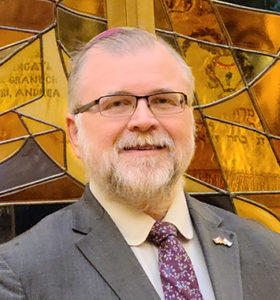
Rabbi Russell Jayne
by Rabbi Russell Jayne
Who shall live and who shall die?
Who by fire and who by water?
Who by sword and who by beast?
Who by hunger and who by thirst?
These are not comfortable words. And I would go so far as to hypothesize that they were never meant to be.
For generations, we Jews have wrestled with the Unetaneh Tokef, the climactic poem of the High Holiday liturgy to which these words belong. For many of us, they paint an image of Divinity that is both theologically and spiritually unhelpful. Do we really relate, anymore, to a God who determines with precise calculation who will live and who will die in the coming year? Is it spiritually fulfilling to imagine a heavenly ledger in which our fate is written and then sealed?
I believe that there is a better way to approach the Unetaneh Tokef. I believe there is a way of relating to the themes of the poem that can help these powerful words speak to us with a relevancy that can be easily lost in the deluge of the High Holidays.
But first, we have to name and acknowledge the reality of our present moment. We live in an anxious world.
Here in Canada, we have watched a summer marked by wildfires and communities threatened by extreme weather. We live with economic uncertainty and concern about the kind of world our children and grandchildren will inherit. Canadian Jews also continue to experience an unprecedented rise in antisemitism and an unsettling change in the tone of public discourse about Jews and Israel.
 Perhaps that is why these poetic words from centuries ago can speak to us even today. Because the message at the heart of the Unetaneh Tokef is something modern life often encourages us to forget. We are vulnerable.
We spend so much of our lives constructing the illusion that we are in control. We plan our careers, our retirement, and our vacations. We monitor our health. We insure our homes. We follow the news, hoping that if we know enough about what is happening, perhaps we can prepare ourselves for whatever comes next. Much of this is sensible. Judaism does not ask us to abandon responsibility or prudence. But eventually, all of us will encounter the limits of our control.
The Unetaneh Tokef brings us face to face with that truth. Yet remarkably, the poem does not leave us there. After its terrifying catalogue of uncertainty, the poet proclaims, “Uteshuvah, utefillah, utzedakah ma’avirin et roa hagezeirah.” Repentance, prayer and charity avert the severity of the decree.
Now, you could understand these words in a magical sense. If I perform enough mitzvot, pray fervently enough, and give sufficient charity, perhaps God will change what has been written. But there is another way to understand them. Teshuvah, tefillah and tzedakah may not give us control over what happens to us, but they can give us something equally important, a way to decide how we will live in a world we cannot control.
Teshuvah asks, “What can I change in myself?”
Not everything can be repaired by us. But there are relationships we can mend, apologies we can offer, habits we can change, and priorities we can reconsider.
Tefillah asks, “What am I connected to that is larger than myself?”
Prayer interrupts the illusion that we stand alone at the centre of the universe. It reminds us that we belong to a story, a people and a covenant stretching across generations. Prayer may not change our circumstances, but it can change the person who must face them.
And tzedakah asks, “Who needs me?”
When the world feels frightening, our instinct can be to turn inward. Judaism, however, sends us in the opposite direction. Visit someone. Support a community. Defend someone who is vulnerable. Give generously. Do something that makes another person’s world less precarious.
These three responses are how we, as Jews, answer a profoundly unsettling and chaotic world.
We cannot know what 5787 will bring. No government, technology, expert or rabbi can promise us a year without upheaval. And the High Holidays themselves offer us no such reassurance. But, maybe this is the deep wisdom of the Unetaneh Tokef. Not that we should be terrified of what God and God’s world might do to us, but that our days matter precisely because we can respond to the anxiety of this moment and help to make life more livable for all.
Perhaps that is what it means to ask to be written in the Book of Life.
L’Shannah Tovah Tikateivu v’Teichateimu! May we, and all humanity, be written and sealed for a year of life, blessing and peace.
Rabbi Russell Jayne is Senior Rabbi and Cantor of Beth Tzedec Congregation in Calgary.

Be the first to comment on "Rabbi Russell Jayne: Help make life more livable for all"