

by Regan Lipes, Local Journalism Initiative Reporter
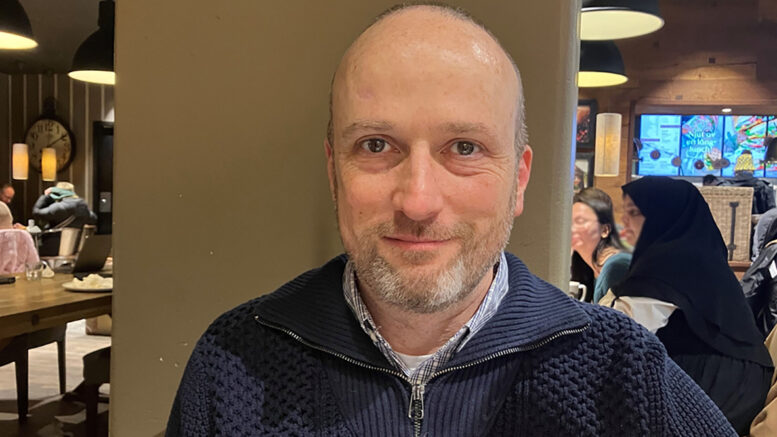
(AJNews) – The annual Tova Yedlin Lecture, hosted by the Wirth Institute for Austrian and Central European Studies, is a notable occasion merging scholarship and community during Jewish Studies Week. On Thursday, March 12, Dr. Oren Cohen Roman, Associate Professor of Yiddish at Lund University in Sweden, delivered this year’s Tova Yedlin Lecture in the auspicious Senate Chambers of the Old Arts Building at the University of Alberta to a packed audience.
The annual Tova Yedlin Lecture addresses European Jewish topics before the Holocaust, and Dr. Cohen Roman spoke about the melody that often, traditionally, accompanied Yiddish literature. “I grew up in Israel in the 1980s and Yiddish was very much present, but mainly as part of my grandparents’ generation, many of them Holocaust survivors,” explained Dr. Cohen Roman. “It was a familiar language spoken between older family members and acquaintances, often used to convey wise sayings, jokes, and secrets,” he elaborated. “With us children, it was never spoken. Only Hebrew. I was fascinated by this language, associated with a distant culture and existence. Jewish life in Eastern Europe before the Holocaust fascinated me, and I dreamed of learning this language.” With Canada’s own rich Yiddish traditions from the early twentieth century immigration wave and post Shoah Yiddish literary scene of Montreal, many millennials within the Jewish community of Edmonton will relate to his youthful memories of the language.
Almost thirty-years ago, Bruce Mitchell observed Israeli attitudes towards Yiddish revival in his article “Yiddish and the Hebrew Revival: A New Look at the Changing role of Yiddish” in Monatshefte. He wrote that “Those upperclass Ashkenazim who had formerly held their own vernacular in contempt, and even suffered a linguistic handicap to suppress it in their private lives, are now committed to ensuring the survival of Yiddish as an essential part of Jewish,” (195). In a 2025 article in Forward commemorating the centennial anniversary of YIVO, PJ Grisar noted that: “The idea for the institute came at a unique inflection point in history. After World War I, diaspora nationalist movements anticipated new government resources from minority treaties, international agreements granting rights to minority populations in countries looking to join the League of Nations. There was an urgency to documenting a way of life that seemed to be fading.” Yet the institution’s continued visibility as a scholarly and cultural reservoir of knowledge, speaks to the nostalgia that drives a current revival, for love of Yiddish.
Dr. Cohen Roman, like so many of his generation, for whom the sounds of Yiddish still lived, perhaps muffled, but alive, opted to seize the opportunity to learn the language more formally at university. He admitted that he had not planned for Yiddish scholarship to become his career path, but “I just took one class, and then I realized that I was waiting all week for that one class. So I followed my heart and ended up writing a PhD in Yiddish literature.” With funding to the Humanities being cut at so many universities, not only in Canada, rich languages, like Yiddish, can struggle to maintain standing within their departments. As senior faculty retire, they are not always replaced, and such is the ongoing battle for resources within academia. Dr. Cohen Roman’s prognosis for the future of Yiddish studies is more optimistic than some of his counterparts in Canada.
“Specifically for Yiddish studies, it has never been a large subject at any university, to the best of my knowledge. But it does attract students regularly, and some excellent scholarship is being pursued in this field. Like other small subjects, some universities take pride in nurturing Yiddish studies, recognizing the value of its authentic voice of a European minority culture. Moreover, some people love and appreciate Yiddish culture so much that they have provided private funding to allow its study at universities,” he explained. “In Sweden, where I work, Yiddish has been recognized as one of the country’s five minority languages. This implies state funding for both university studies and activity within the community, such as cultural activity, children’s education, and book publication. This is a very exciting chapter in the history of Yiddish culture, and I am happy to be a part of it.”
With this established and well supported discipline thriving at Lund University, it is interesting to know what kinds of students are attracted to the study of Yiddish language and literature. “Some of my students have a Jewish background, while others do not. Some have heard Yiddish at home, from their parents or grandparents, and connect with their cultural heritage, like I myself did. By contrast, other students are total beginners. Each student has her or his own background, interests, and aspirations that bring them to Yiddish. Some have married into a Yiddish speaking family, others are interested in the Jewish religion, Hasidic thought, modernist literature, or the history of the Holocaust. Some German-speakers are also intrigued with Yiddish because of it similarity to the German language. You see people from various religions and religious backgrounds – from secular to very observant Jews, as well as Christians, Muslims, Hindus, along with atheists. Everyone is welcome to study Yiddish and brings their unique perspective to class.” One need not be of Jewish heritage to love Yiddish. In fact, the editor of the Russian Federation’s only Yiddish newspaper Birobidzhaner Shtern, with a circulation of around five thousand copies per month, Yelena Sarashevskaya, is not Jewish.
A 2025 article in The Conversation, “What Yiddish Literature Reveals about Canada’s Diverse Canon and Multilingual Identity” noted that Yiddish literature has become multinational and can no longer be regarded solely within the European context. In fact, the presence of Yiddish literature being composed from the diversified spaces of non-European countries means that the language and its stories have the potential to gain more visibility on the world literary stage. “Yiddish literature, even in translation, carries many relevant voices to readers,” noted Dr. Cohen Roman.
The audience for the 2026 Tova Yedlin Lecture was an interesting turnout of mainly members of the Edmonton Jewish community, a few U of A professors, and a small handful of graduate students. Seeing so many community members present, on that blisteringly cold Thursday, was a powerful signal that Yiddishkeit thrives in the northern City of Champions. Dr. Cohen Roman’s lecture focussed on the lyrical musicality of Yiddish literature, and the distinction between private and public reading. For a population no longer used to reading aloud, this was an intriguing discussion to be certain.
Dr. Cohen Roman began by contextualizing vocalized reading for his listeners: “It’s comparable to the engagement of an audiobook or going to a public event where an author reads a portion of their book, or even the joy of reading animatedly for children.” He then proceeded to connect this to the oral traditions of storytelling and demonstrated how a hazzan would melodically recite a passage of Devarim. He explained that the melodies of Yiddish texts would be indicated, not with notes, but with reference made to established songs. This made for a lively, and highly engaging lecture, some portions sung, that exemplified the vibrance and robustness of traditional Jewish storytelling traditions.
Dr. Cohen Roman explained to Alberta Jewish News: “A popular misconception is that Yiddish is a ‘funny’ language. For sure, there is great humour written in Yiddish, witty proverbs, great jokes, and incredible funny stories (I must mention the great writer Sholem Aleichem here). But there is so much more, too: drama, lyrical poetry, memoirs, political thought, religious-mystical revelations – you name it! I always try to showcase the wealth of Yiddish literature.” He added thoughtfully and poignantly: “Yiddish is also a Jewish language, so you sometime encounter anti-Jewish prejudice, which is a good opportunity to ‘grab the bull by its horns,’ expose the prejudice for what it is and debunk it.”
If the audience’s enthusiasm for Dr. Cohen Roman’s topic were not enough, the snaking line to speak with him after his lecture made being a Yiddishist seem more like being a music celebrity than bookish scholar. People had questions – and plenty of them. According to the World Population Review, the United States has 360,000 Yiddish speakers, Israel 188,000, Ukraine 169,000, and Canada 41,000. If Sweden, not even in the top five countries for Yiddish-speaking populations can nurture this flourishing discipline, then perhaps Canadian education has lost sight of the diversity true scholarship should strive for. There is enthusiasm for Yiddish in Edmonton, as was evident during Dr. Cohen Roman’s lecture. Perhaps, in time, this enthusiasm will inspire something of a Yiddish Renaissance within the Jewish community and within local academia. Hopefully this will not be Dr. Oren Cohen Roman’s last visit to Edmonton.
Regan Lipes is a Local Journalism Initiative Reporter

Be the first to comment on "Dr. Oren Cohen Roman delights his Edmonton audience – with Yiddish"