

By Regan Lipes, Local Journalism Initiative Reporter
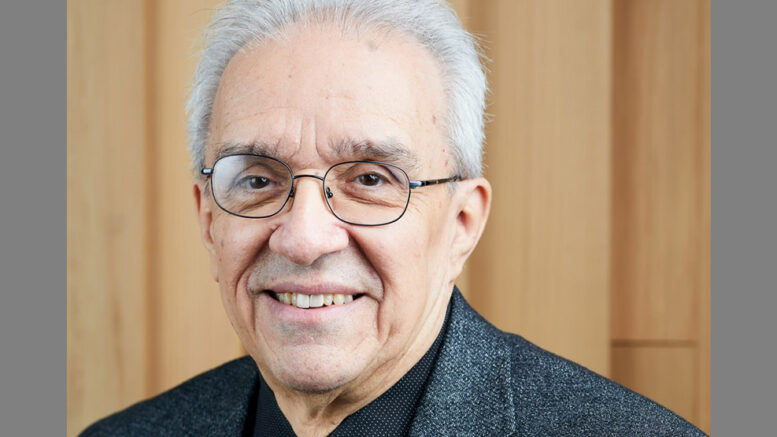
(AJNews) – Harry LaForme has the unique, and commendable distinction of Canada’s first appellate court judge with First Nations ancestry. Admitted to the bar in 1979, LaForme has dedicated his career to protecting the rights of Indigenous people, not only in Canada, but throughout the world. As a jurist of the utmost reputation, LaForme’s career has not just been about shattering the glass ceiling for First Nations peoples but holding society accountable to its own espoused ideals of equity and integrity.
On June 10, in a piece published in The National Post, LaForme boldly stated: “On June 6, I stood before Toronto’s Jewish community on the treaty lands of my ancestors. Days earlier, Prime Minister Mark Carney had stood at Toronto’s Holy Blossom Temple and acknowledged a painful truth: Canada is failing its Jewish citizens. He recognized that antisemitism has reached levels unseen in generations. He acknowledged that Jewish Canadians are disproportionately targeted by hate. He acknowledged the fear felt by families whose schools, synagogues, businesses and communities have become targets. He named the statistics. He named the suffering. But he did not name the ideology driving it.”
LaForme asks what use is it to acknowledge a societal malignancy without naming the disease? He continued: “So, I will. I stand before you on the land of my ancestors to say what the prime minister should have said: ‘Anti-Zionism is a libel-driven hate movement that incites violence and the targeting, exclusion, and marginalization of Jews in the diaspora and has as its ultimate goal wiping Israel off the face of Mother Earth and the death of all beings within it.’ There. That is what should have been said, and now it has.” Comparisons of tragedies and injustices do not often yield results other than to exacerbate already frayed tensions, but LaForme’s words resonate in such a profound way that they demand to be heard and reflected upon. Canadians will collectively own their inherited legacy of colonial tyranny and confront the generational trauma that follows in its wake nationally, yet, like the Prime Minister, shy away from speaking out when the inalienable rights of others further away to simply exist, are infringed upon. The colonial infrastructure is being challenged at home, and Canadians work as a society to dismantle the unconscious prejudices of previous generations.
This is not a matter of communal self-congratulations for Canadian efforts to unlearn racialized behaviours and practices, but a moment to, without qualification, assert that forcible occupation is wrong, and subjugating a group for their religion, culture, beliefs, or traditions is inhumane. Being anti-Zionist is, simply put, denying that Israel and the Jewish people have a right to exist. Anti-Zionism can be repackaged and dressed up but is a straightforward concept; it is the belief that Israel, the traditional home of the Jews, does not have the right to exist as a sovereign nation. LaForme calls this a “libel-driven hate movement.”
He wrote, “That does not mean Israel, like any country, is beyond criticism. But criticism of a government is not what’s happening here. We are witnessing something much darker.” He noted further: “Islamist extremists are weaponizing Indigenous culture, our shared history, and reconciliation efforts led by Indigenous peoples against Jewish Canadians, Zionists, their allies, and Israel. It is cultural appropriation of the highest order. It is colonialism. It is not only antisemitic. It is racist toward Indigenous peoples as well.”
The Jewish people are an indigenous population of Israel. From a secular vantage point this is proven archaeologically, and from a religious perspective all three Abrahamic faiths hold this portion of scripture sacred. Even the Holy Qur’an states in Surah Al-Isra “”And We said thereafter to the Children of Israel, ‘Dwell securely in the promise land” (17.104). Anti-Zionism has become the sanitized politically correct way of rebranding antisemitism – the same kind of antisemitism that fueled the Nuremburg Laws. “For Indigenous peoples, this moment feels painfully familiar. We know what happens when governments speak of reconciliation while avoiding uncomfortable truths. We know what happens when institutions choose carefully crafted language instead of moral courage,” wrote LaForme. Canada’s new Advisory Council for Rights Equity and Inclusion has been criticized heavily for not adequately representing people of colour. Shira Li Bartov reported on June 6 for The Times of Israel, that B’nai Brith Canada saw Carney’s efforts as hollow, noting: “Absent was a clear commitment to mobilize all levels of government, law enforcement, prosecutors, security agencies, educational institutions, and civil society around a coordinated national response,”
LaForme, as an accomplished jurist is delicate with his words, but remains a man of action: “Canada’s Jewish community does not need another expression of concern. It needs honesty. And honesty begins by confronting the lie at the centre of this moment: the claim that Israel is a colonial project and Zionism is a movement of oppression. As an Anishinaabe man, a member of the Mississaugas of the Credit First Nation, and someone who spent almost 25 years as a judge interpreting the laws of this country, let me be clear – Canada is a colonial country. Israel is not.” LaForme’s words seem to be that definitive declaration that Canadian Jews, and B’nai Brith would have hoped for from the highest levels of national leadership. “Indigenous peoples know colonialism because we lived it. Colonialism means language suppression. It means forced religious conversion. It means population displacement, foreign governance, economic exploitation, imposed legal hierarchies and cultural erasure. Canada’s Indigenous peoples experienced these things. The Jewish people experienced these things. They do not describe Israel,” LaForme elaborated.
This is not a matter of measuring societal injustices for comparative purposes but learning from the mistakes that collective humanity aims to correct. Canadians, as products of colonial power injustice should be more attuned to what a colonial imposition looks like. “Jewish and Indigenous peoples share two powerful life-affirming characteristics that have ensured our survival: hope and resilience. Hope allowed Indigenous peoples to survive policies designed to erase us. Hope carried the Jewish people through exile and the darkness of the Holocaust. Hope launched the rebirth of Israel in 1948. Hope is determined resilience. But hope does not mean silence. Hope and resilience are sacred obligations we owe the seven generations who came before us and the seven generations who come after us. They are moral imperatives.” When Canadians erroneously refer to Israel within a colonial paradigm it is doubly problematic. This illustrates not only a lack of historical literacy but exacerbates the issue by highlighting that they cannot accurately identify what colonialism is. “Indigenous peoples in Canada are well versed in being let down by governments and the failures of elected leaders. Our current prime minister profoundly disappointed many of us. With or without him, we will move forward. Because governments do not decide whether ancient peoples survive. We do.”
Harry LaForme may not be winning any popularity contests with his recent piece in The National Post, but he has shown himself to be a courageous leader who holds himself to the same principles and ethical standards that he safeguarded throughout his legal career. As a man of integrity, and a guardian of the law he concluded his text: “The Jewish people are not alone. I stand with them. Miigwetch. Shalom. Am Yisrael Chai.”

Be the first to comment on "Former Justice Harry LaForme explains that Israel is not a colonial country – Canada is"