

by Regan Lipes, Local Journalism Initiative Reporter
(AJNews) – Historical revisionism is dangerous and has become a troubling reality with the rise of antisemitism globally. Holocaust denial is not a new phenomenon, but as the cyber connectivity of hateful discourse needs no passport, the proliferation of misinformation, historical revisionism, and outright denial of the Holocaust and its legacy spread their malignant tentacles outside of fringe groups and into the mainstream with shocking receptivity. This raises the question though, of how national narratives frame discussion around the actions and attitudes of local citizens during the Holocaust. Is there acknowledgement and the owning of culpability, or disassociation and distortion?
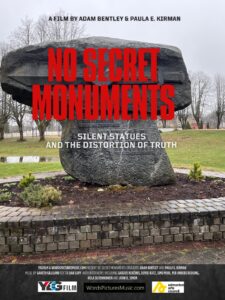
On September 16th from 1:00 to 2:30 pm, the film will be screened at the Robertson Wesley United Church (10209 – 123rd Street) in Edmonton.
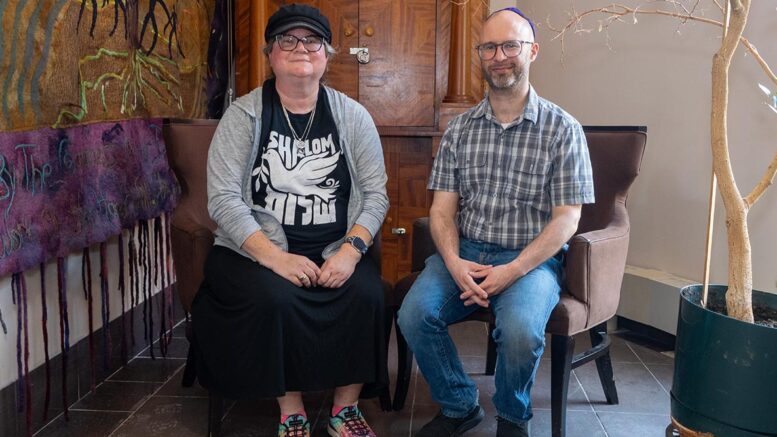
On Sunday, August 23, Beth Israel Synagogue hosted the soft launch of No Secret Monuments, a documentary and labour of love by local Jewish documentarists Paula E. Kirman and Adam Bentley. “This is the first time the film will be screened for an audience. It’s our soft launch and world premiere,” mused Kirman during her opening remarks. The BI sanctuary filled quickly and transformed into a mini movie theatre, just without popcorn. The subject matter was serious, but the atmosphere was supportive and excited
Internationally renowned scholar Deborah Lipstadt noted in her 2020 work “Holocaust Denial” in Modern Judaism, that: “Generally speaking, people differentiate between facts and opinions—you can have your own opinions, but not your own facts” (47). Many Eastern European countries, especially those that once struggled for autonomy, suffocated behind the Iron Curtain, are now adjusting their national narratives to distance themselves from inconvenient, and unflattering, historical truths.
The international community was outraged when Poland instituted harsh laws prohibiting any reference to “Polish death camps,” contending that since the country was under Nazi occupation during the Second World War, it therefore bore no responsibility for the six extermination centres that operated on its soil. Critics cited the prominence of Polish collaboration to rid the country of Jews as a reason to rescind the law, but even when amendments were introduced in 2019, they were strictly in relation to referencing Ukrainian Nationalism. Despite the law still being in effect today, those found guilty no longer face prison sentences following conviction.
For countries that suffered under Nazi occupation, and under the heavy hand of the Soviet Union, redefining and establishing a narrative of their national identity has proven to be a challenging, and often problematic endeavor. As members of the European Union, Lithuania, Latvia, and Estonia have managed to distance themselves from their Soviet pasts, but the veneration of those who fought to liberate their homelands from the Soviet Union has resulted in heroic status being bestowed upon historical figures whose hands are unclean.
Countries like the United States have begun to dismantle monuments dedicated to Confederate soldiers, and those who were actively involved in supporting Slavery; Canada is also engaged in reevaluating its memorialized figures. For countries like Lithuania, Latvia, and Estonia, that were part of the Soviet Union until its dissolution in 1991, current generations are more focussed on affirming a strong sense of nationhood, often celebrating leaders who collaborated with the Nazis as a part of their stand against Communism.
Kirman and Bentley’s film chronicles a 2024 European voyage that most definitely takes a detour off the beaten path. The Baltic countries are known for their beautiful amber jewelry, picturesque Old Towns lined with cobblestones, and charming rural scenery, but in fact, it was these forests that troubled the team of filmmakers most of all. Kirman noted in a recent phone interview with the Alberta Jewish News that there were mounds in the earth that covered mass graves. These remain public forests, where civilians walk for leisure, gather mushrooms, and children play. But beneath the surface, thousands upon thousands of humans remains are all that is left of once vibrant Jewish civilizations, said Kirman.
The film assumes more of a vlogger’s perspective with Kirman speaking in the first-person as the two interrogate history in painful and necessary ways. The more personal tone helps to draw in viewers to the journey itself in a voyeuristically experiential way. Shots from the flight from Toronto to Frankfurt allow the audience a sense of departure, while the interspersing of shots of countryside from the window of a moving vehicles provide for a feeling of perpetual movement to uncover larger truths. Kirman explained: “We tried to travel light.” She elaborated that the equipment they used was predominantly handheld, and that for the most part, onlookers likely labeled them merely as ‘tourists.’
Perhaps the most haunting scene was the pair’s visit to a museum in Lagedi, not far from the Estonian capital of Tallinn. The private museum is the current home of a problematic monument which was first unveiled in 2002 and decommissioned in 2004 resulting from the protestations of the public. The statue was originally located in Lihula as a tribute to Estonians who fought to free the country from Soviet aggression. Framed within the context of Estonian sovereignty, the monument might at first sound legitimate. Yet, the figure is emblazoned with Nazi medals and a full uniform complete with insignia. Kirman and Bentley traveled to this so-called museum, only to find that it was a private home boasting chilling war memorabilia, and a basement bunker full of guns, many of them used by the Nazis. “You can hear me in the film quietly telling Adam, ‘we’ve got to get out of here’ while we’re in that room full of weapons.” The two did not openly film the museum, but their surreptitious camera-work showed enough of the house of horrors to emphasize why current trends to reshape national narratives are harmful and dangerous. “He didn’t know we are Jews,” said Kirman with relief. “I was wearing a hoodie and zipped it up all the way so my Star of David didn’t show.”
The filmmakers purposefully chose not to name the museum operator, or his translator in the documentary, and are still haunted by the experience. This was one significantly valuable moment in the work where the lingering antisemitic undertones of some local inhabitants even today, showed through. Instead of the antisemitism being simply repackaged as nationalism, the preservation of such troubling memorabilia illustrated one Estonian man’s indifference to the deportation of Jews and mass genocide in an open and unapologetic way.
The team of filmmakers had originally been interested in three Finnish Jews who had fought alongside the Nazis to thwart Soviet attempts for conquest. Leo Skurnik, Salomon Klass, and Dina Poljakoff all were awarded the Iron Cross for their valour and refused the honour outright. They were Jews who fought for Finland, but this also meant allying with the Nazis. This original project quickly evolved to include the Baltic countries too, despite Finland not having been part of the Soviet Union.
Kirman and Bentley, two wandering Jews, unearthed veiled truths across four counties, many in heavily trodden places. As they meaningfully and purposefully filmed prominent monuments, tourists snapped photos haphazardly, likely without an understanding of the layers of antisemitism immortalized before them. Despite also showcasing memorials to victims of the Holocaust, like the Hands Begging for Mercy tribute to eight Jewish refugees in Finland deported into the hands of the Nazis. The memorial, located on Observatory Hill, preserves the names of eight Jews, one of whom was a baby, who sought safety in Finland; all but one surviving man were murdered. These victims were rumored to be minor criminals, but these claims are tenuous at best.
Lithuania’s capital, Vilnius, once dubbed ‘Jerusalem of the North’ no longer buzzes with the sounds and smells of flourishing Yiddishkeit. The country, to date, is recognized as having 924 Righteous Among the Nations, yet the most prolific rescue of the country’s Jews, was in Kaunas by a Japanese diplomat. Latvia records 138 Righteous, and Estonia 3. On the streets of their capitals now it will only be older generations that still speak Russian, and even those that do will only do so in hushed whispers. The national narratives paint the Soviet Union, and now the Russian Federation, as the enemy, dismissing their own participation in the Second World War. Aside from Lithuania, the Baltic countries still issue passports acknowledging identities, but denying citizenship to select minorities, mostly Russians, further demonstrating that ideologies of xenophobia are still alive and well in the name of national solidarity.
During the question-and-answer session following the screening of the film, the audience had no shortage of ideas and queries for Kirman and Bentley. Such enthusiasm, even for such an excruciating topic, truly demonstrates the need for larger discussions around how history is chronicled, and the additional narratives that can blur the divide between fact and fiction. Kirman and Bentley, who have previously examined the troubling antisemitic layers of some of Edmonton’s own monuments, hope to extend their research further, and travel to Ukraine once geopolitical conditions allow.
A second screening of ‘No Secret Monuments” will be held in Edmonton on September 16 from 1:00 to 2:30 pm, at the Robertson Wesley United Church (10209 – 123 Street). Admission is free of charge and there is complimentary parking available on the north side of the building. This screening is provided thanks to the Edmonton Interfaith Centre.
Be the first to comment on "Edmonton filmmakers launch the world premiere of ‘No Secret Monuments’"