
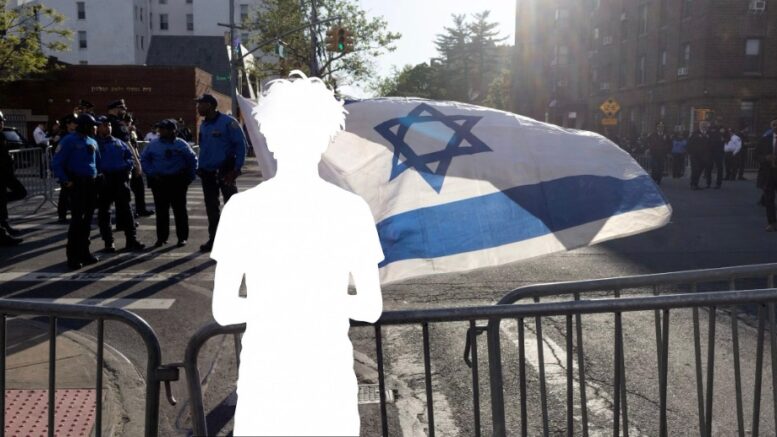

by Aaron Schwartz
This article was produced as part of JTA’s Teen Journalism Fellowship, a program that works with Jewish teens around the world to report on issues that affect their lives.
(JTA) – This past year, I have been asked by several adults, who may see the Magen David I wear, about my opinions on a contentious topic in the Jewish community: Israel. Specifically, people are asking me if I feel close to Israel or if I am a Zionist.
If a couple of years ago you had asked me, a 17-year-old Reform Jewish kid who lives about 30 miles north of New York City in Westchester County, I would have shared my support of Israel. Now, however, I say that Israel has gone way too far in its response to Oct. 7 and their actions are not justifiable. I no longer identify as a staunch Zionist as I did in the aftermath of Hamas’ attack on Israel.
Before Oct 7, I knew very little about the relationship between Israel and Palestine. The snippets of history I learned in Hebrew school left me with a lopsided understanding of what was happening. While I learned plenty about the importance of Israel to the Jewish faith, I knew little about Israel’s complex relations with its Arab neighbors. Even when discussion surrounding Israeli-Palestinian tensions surged in the wake of the 2021 crisis, with unrest in Jerusalem and simmering violence in Gaza, I still didn’t really understand the conflict because I was 12.
After Hamas attacked Israel on Oct. 7, I felt it was part of my duty as a Jew to stand with Israel. I saw it as an attack against my own people and thought it was right to fully stand with them.
During the first few months of the conflict, my TikTok page was ablaze with commentary, mostly from Zionist influencers such as Lizzy Savetsky. Through videos like hers, I was being told it was important to defend Israel as the sole Jewish state. During this time I had no trouble calling myself a Zionist. Her videos and others made sense to me because I wasn’t able to accept or see the credible accusations that Israel had been starving and killing innocent civilians in Gaza and I was in the mindset that any criticism of Israel was antisemitism.
By the time January rolled around, I began to notice that on social media most pro-Israel messaging came from Republican voices, such as Sen. Ted Cruz and far right conspiracy theorist Laura Loomer. The opposite was true of anti-Zionist rhetoric, most of which came from left-wing voices such as Hasan Piker. As a Democrat, this disconnect was a hard concept for me to grasp.
On social media, I found many Palestinian voices such as Hamza Howidy and the co-director of the peace organization Standing Together, Rula Dawood, who showed that they didn’t just hate Israel and instead, genuinely wanted peace. Knowing that these accounts were anti-Hamas and run by people who do not hate Jews, it made it more comfortable for me to listen to them. They made me aware of a lot more issues. These voices showed me that they really wanted to make a change and help their people. They also showed me a huge problem in settler violence in the West Bank, a topic that I notice many pro-Israel accounts avoid.
Once I found these activists, their voices and social media posts made me specifically aware of the problems facing Palestinians in the West Bank. They were a catalyst for my change and shaped my current views.
I was also put off by the rhetoric of many Zionists on social media platforms, mainly Instagram and TikTok. This rhetoric included going after American politicians, including former President Joe Biden. Despite the support he gave Israel before and after Oct. 7, they falsely called him anti-Israel or pro-Hamas or claimed that he betrayed Israel over some disagreements with how Israel was handling the war in Gaza — essentially labeling someone pro-Hamas for not completely aligning with the policies of the current Israeli government. Many Zionists online also said things I found hateful, such as “‘’there are no innocents in Gaza,” or calling all Gazans terrorists.
I additionally was opened up to a man named Meir Kahane and his ideology. The late American-born rabbi held an ideology so extreme — Jewish supremacy, expulsion of Palestinians from all of Israel and the Palestinian territories and enforced separation between Jews and non-Jews — that it led to his party being banned in the Knesset. I learned that many on the pro-Israel side supported these terrible beliefs, including people in the Knesset such as Itamar Ben-Gvir. I knew it was something I could not align with.
I don’t know what the best solution is to this conflict. What I do know is children shouldn’t starve and homes shouldn’t be taken. I believe Israel has done heinous, unjustifiable acts which I cannot under any circumstance support.
I am not alone among my peers in this. Recent polling shows that many young Jews are growing disaffected with Israel. That doesn’t mean they are anti-Zionist — although an increasing number of them are – but instead that while they may support the idea of a Jewish state, and feel an attachment to its citizens, they don’t feel they can support the policies of the current government.
I talked to another young person whose experience was similar to mine. Noah Wislocki-Wasecki, a Jewish sophomore at American University, told me he was “disappointed” in Israel. He said the country “is not reflective of the Jewish faith, values and culture I was brought up around.”
Like me he said he hadn’t always felt this way and wasn’t aware of everything going on. While in the aftermath of Oct. 7 he was “more sympathetic towards Israel,” he experienced what he called a “more of a gradual change the past two years with the continuous efforts on attacking Gaza.”
I don’t call myself a Zionist because today’s Zionism feels too right-wing and too extreme, and is used to justify atrocities that I cannot support. It seems like it’s gone beyond “Israel’s right to exist” to instead focus on kicking out as many Palestinians as possible.
But I also cannot call myself anti-Zionist, because some anti-Zionists have justified a lot of antisemitism or called for Israel to not exist in any capacity at all. This can be shown by the likes of Guy Christensen, who justified the killing of the Israeli Embassy staffers and has said “Israel has no right to exist and never did.”
As this conflict keeps going on, I find myself increasingly politically homeless. I have been able to recognize both the good and the bad from both sides. I am able to see the good in Israel by looking at the many peace-loving Israelis and their desire to get rid of their government. At the same time, I see a government and its supporters that ignore violence in the West Bank, and continues to attack and displace civilians, first in Gaza and now in Lebanon, without offering a peaceful or humane alternative and without a real opposition party to stop them.
In the same way, I am able to recognize that there are Palestinians who don’t feel represented by Hamas and just want to survive but their homes are being destroyed.
Over and over, I am being asked to “pick a side,” as if there is no alternative to the right-wing policies of the Israeli government or the eliminationist rhetoric of the anti-Zionists.
But I’ve learned what side I am on: the side that wants to end this conflict for good, with security, peace and justice for all.
The views and opinions expressed in this article are those of the author and do not necessarily reflect the views of JTA or its parent company, 70 Faces Media.

Be the first to comment on "Why teens like me feel politically homeless in the debates over Israel"