

by Maxine Fischbein, Local Journalism Initiative Reporter
(AJNews) – At a time when the Jewish community is feeling a particularly urgent need to harness Jewish pride, the Jewish Historical Society of Southern Alberta has given us a kvell-worthy publication.
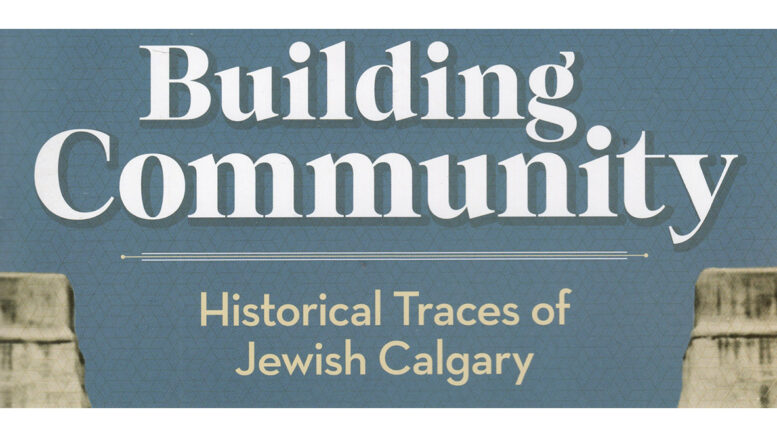
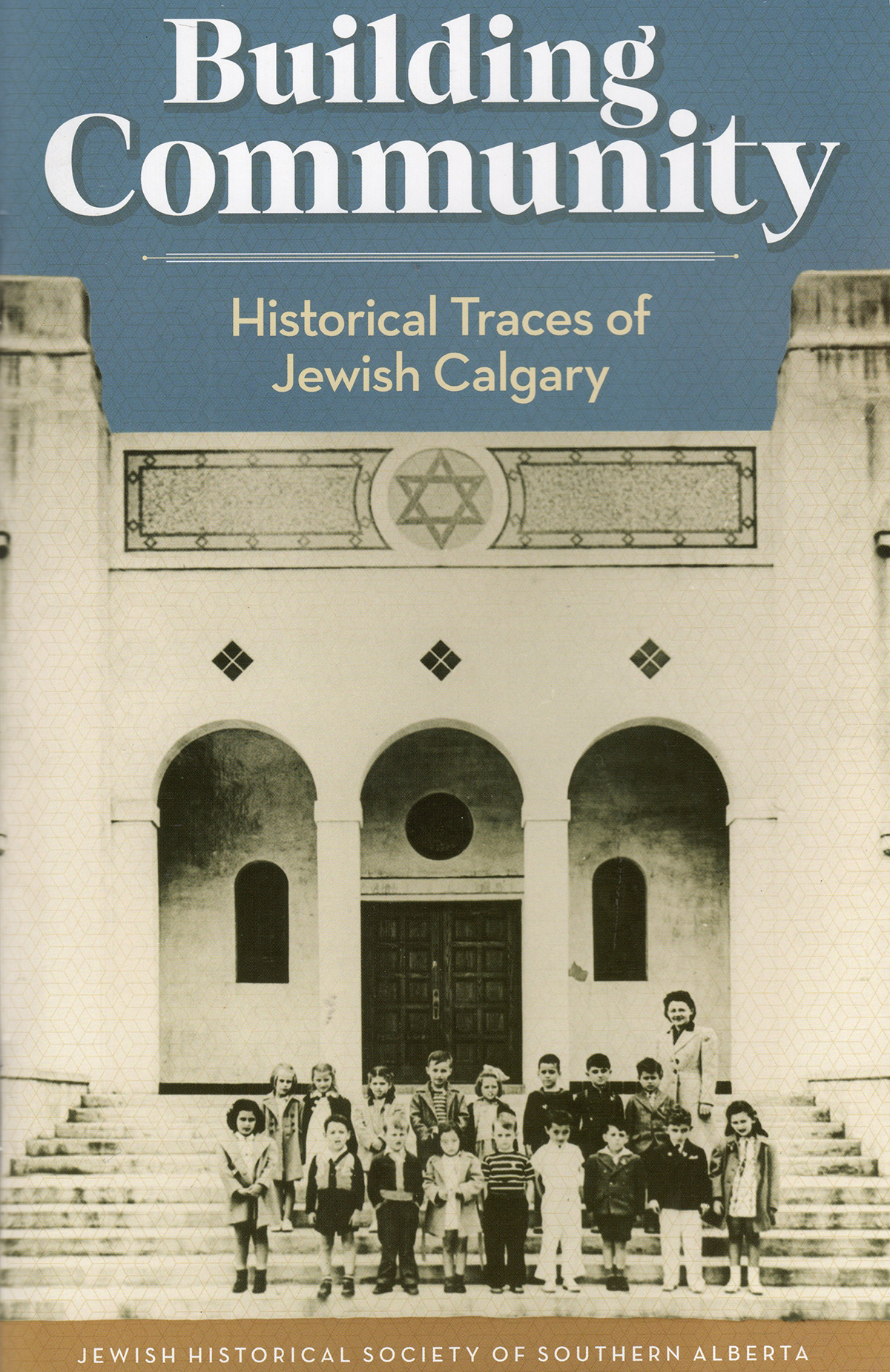
Like the community it showcases, Building Community: Historical Traces of Jewish Calgary is small but mighty. Only 62 pages, the geographical telling is packed with evocative details about the “historical places” and “memorable traces” of Jewish Calgary from the 1889 arrival of Stampede City’s first permanent Jewish settlers, Jacob and Rachel Diamond, through to approximately 1950.
The official launch of the book will take place at the Paperny Family JCC on Sunday, April 26 at 2:00 pm when copies will be available for purchase.
“Through exploring various locations that housed community organizations, businesses and people, we hope you will gain a sense of how the community grew and developed,” writes JHSSA President Saundra Lipton in the foreword of Building Community.
The project – which celebrates the double-chai (36) anniversary of the JHSSA – was funded by the Jewish Community Foundation of Calgary (JCFC) and Alberta’s Heritage Preservation Partnership Program.
The official launch of the book will take place at the Paperny Family JCC on Sunday, April 26 at 2:00 pm when copies will be available for purchase.
For JHSSA Librarian and Archivist Roberta Kerr – who edited Building Community together with Judy Shapiro – a photo of the Gerlitz Block was an exciting addition to the book.
Kerr’s Alte Zaide (great-grandfather) Jacob Karasik ran a grocery store during the 1920s, but the exact location of the store was no longer recalled by his descendants.
Fast forward to the mid-2020s when Kerr’s eldest daughter was living with her husband in an apartment on the upper level of an historic building in Bridgeland. While flipping through a community newsletter, Kerr’s son-in-law spotted an article about the history of the Gerlitz Block. In it, another name popped. It was that of Jacob Karasik, who had once operated a grocery store on the building’s ground floor.
The Kerr clan knew that Karasik had owned a grocery store in Bridgeland. But they did not know that it was the Gerlitz Block, the very same building in which his great-great granddaughter and her husband were living.
Remarkably, Roberta Kerr’s grandson was born in his parents’ apartment one century after his great-great-great grandfather had operated his grocery downstairs.
Because this dor l’dor (generation to generation) story has a contemporary punchline, it is not included in Building Community. But Kerr is thrilled that a historical photo of the Gerlitz block – now proven to have had a Jewish connection – is helping to tell the story of Jewish Calgary’s formative years.
Most of the photographs and archival documents in Building Community have been shared in other JHSSA publications, most notably the books Land of Promise (1996) and A Joyful Harvest (2007) and the journal Discovery, published three times a year and distributed to the Jewish community as an insert to AJNews. Yet, in Building Community, everything old is new again, thanks – in large part – to the geographical organization of the book.
Based on research historian Harry Sanders did for his popular walking tours, Building Community is a perfect launchpad for one or more self-guided tours in the Calgary core.
If that sounds like too much work, readers can engage in delightful time travel without moving more muscles than it takes to flip the pages.
Brief chapters about each site lend themselves to bedtime reading…and sweet dreams of a bygone era when the Calgary Jewish community was, as Shapiro puts it, “more tightly knit and interdependent than it is today.”
The softcover book, a bargain at the symbolically significant price of $18, will certainly resonate with those who have deep roots in Calgary and fond memories of some of its early institutions; it will likewise appeal to history geeks, though it is written for a much broader audience.
Kerr and Shapiro have taken great care to ensure that the information is easily understood by newcomers to the Jewish community, converts to Judaism, and family, friends, and neighbours of other faiths.
“We were very cognizant of the fact that we didn’t know who was going to use this, so we wanted to make it accessible to anybody,” Shapiro said. “Non-Jewish people will have terms explained…. For many other people who haven’t been members of the Jewish Historical Society, this is a really nice taste of the history.”
Building Community is full of interesting – sometimes astonishing – insights into the places that defined Jewish Calgary from its establishment through its boom years. Along the way, readers will encounter notable personalities that put the hey (chai?) in this community’s heyday.
Small enough to slip into a purse or backpack and containing a sturdy but unobtrusive fold-out map on which are plotted 44 sites of Jewish interest, Building Community evolved from a self-guided walking tour the JHSSA added to its website back in 2017 due to popular demand.
“That was a Harry project,” recalled Kerr, lauding the significant contributions that “Harry the Historian” (a moniker Sanders earned during his frequent spots on the popular CBC Calgary radio show The Homestretch) has made in documenting both Jewish and Calgary civic history. A prolific writer and historical consultant, Sanders was honoured in 2012 as Calgary Heritage Authority Historian Laureate.
“Anytime you want to do something on the Jewish history of Calgary, you go to Harry,” said Shapiro, adding that many of the historical tidbits in the book also came from the entertaining and informative anecdotes Sanders has shared over the years during his countless walking tours for Historic Calgary Week and the JHSSA.
Sanders once again served as historical consultant for Building Community. Additional consultants and proofreaders included JHSSA Office Manager Katie Baker and JHSSA Director Irena Karshenbaum, President Saundra Lipton, Archivist Emerita Agi Romer Segal, and Past President Betty Sherwood.
For the book, Kerr and Shapiro re-evaluated sites that had been included in the 2017 walking tour. Fewer were chosen, with preference given to sites where historical buildings remain or where places associated with the Jewish community had morphed into notable civic sites.
Though they combined or dropped some of the sites, Kerr and Shapiro were keen to preserve interesting stories connected with them. Many are shared in “Historical Tidbits” liberally sprinkled throughout the book. The tidbits add tam (flavour), painting pictures of colourful individuals and events connected with various sites.
“They’re the best because they really bring you into the book,” Kerr said.
“Living in the Jewish community of Calgary in 2026, everything is in the south,” said Shapiro. “There are a lot of very established institutions, but there are no kosher bakeries and no kosher butchers. If you read [Building Communities], you discover that when the community was tiny and downtown…it was a whole different community in terms of the amenities they had and the amenities they didn’t have and had to build.”
“There was much more of a sense of people being in the same boat,” explained Kerr, adding that antisemitism (such as restrictions against Jewish membership in country clubs) often created the impetus for local Jews to develop even their own leisure institutions.
“I think [Building Community] gives a really good sense of how the community grew,” Shapiro said, adding that she was fascinated by details of early community milestones, like the purchase of land for the original Jewish cemetery at Erlton.
“It was $160 bucks. I didn’t know that!” said Shapiro, who also loves a historical tidbit about a fundraising event held at the Elks Hall for the construction of the House of Israel Jewish community building on 18 Avenue SW.
Members of the Jewish community have made extraordinary contributions to the local arts scene in every generation. Shapiro was captivated by details shared in Building Community about the Jewish roots of Calgary’s film industry, from the Allen family who established the Allen and Palace theatres, to the Film Exchange where some notable Jewish Calgarians booked and distributed films, to the Barron Building (still extant), home of the Uptown Theatre.
The caringly curated photos, archival treasures and stories featured in Building Community are enhanced by the skilled work of graphic designer Daniel Blais.
“I think he did a masterful job,” said Shapiro, “It’s a clean, simple, clear, and pleasing design.”
No single publication can convey the totality of the Jewish experience in Calgary and Southern Alberta, and, as Saundra Lipton points out in her foreword, the story told in Building Community is, thus, “representational rather than exhaustive.”
The JHSSA wants all community members to add their family stories to the Jewish historical record, says Roberta Kerr. Those who have not already done so can submit brief family biographies, photos, and documents for the JHSSA Southern Alberta Jewish Family Histories Exhibit. The JHSSA also looks forward to hearing from families who have shared their story in the past and wish to provide updates.
To view the online exhibit and guidelines for submitting your family’s story, go to https://jhssa.org/southern-alberta-jewish-family-histories/.
To purchase your copy of Building Community: Historical Traces of Jewish Calgary go to https://jhssa.org/building-community-historical-traces-of-jewish-calgary/ or call the JHSSA office at 403-444-3171.
Spring is coming! Just in time, the JHSSA has provided a book that will lead to many pleasurable walks down memory lane!

Be the first to comment on "New book chronicles historical traces of Jewish Calgary"