


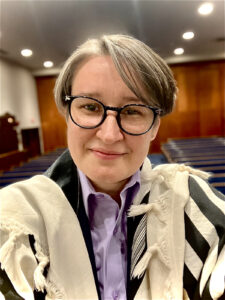
Rabbi Alisa Zilbershtein
By Rabbi Alisa Zilbershtein
(Edmonton) – What did the Maccabees hope would happen after they won?
We spend a great deal of time telling the story of their struggle. We remember the persecution under Antiochus and the courage of those who fought for the freedom to practise Judaism. Then our attention turns to the Temple, where a small supply of oilburned for eight days. We light our candles in memory of that miracle. But it is worth pausing over what their victory made possible: people could live Jewish lives again.
Imagine being able to teach your children Torah after that teaching had been forbidden. Imagine the approach of a Shabbat you could observe freely. Practices that had been dangerous could become part of ordinary life again. There must have been enormous happiness in recovering the freedom to do something familiar and beloved.
A festive meal, as on Rosh Hashanah or Pesach, would seem a natural way to celebrate such happiness. Why, then, did the sages establish Hanukkah without making a festive meal an obligation?
Rabbi Mordechai Yaffe, the sixteenth-century scholar known as the Levush, explains that Hanukkah celebrates deliverance from spiritual destruction. The persecution sought to force Jews to abandon our faith and stop practising Judaism. The sages therefore required Jews to celebrate by praising and thanking God. The form of celebration reflects what had been saved: their religious life. A festive meal is not obligatory because the holiday centres on this spiritual deliverance (Levush, Orach Chayim 670:2).
The spiritual survival at the heart of Hanukkah is also part of what we are working to preserve today.
We devote considerable energy to the question of how Judaism will survive. We worry about antisemitism and about whether younger generations will remain connected to our communities. Those concerns come from love. Helping people find meaning and happiness in Jewish life is part of that work. What will make them glad to be part of it?
We each have an answer worth sharing. Someone loves studying a passage of Torah because an ancient argument nourishes their mind. Another person treasures Shabbat dinner, when the week finally gives way to rest. For someone who has recently joined a synagogue, the discovery may be the comfort of being a part of the Jewish family and feeling free to be themselves among people like them. These experiences are among the reasons we are glad to be Jewish.
While the candles burn, we might share with one another what we love about being Jewish. Which practice would we miss? What have we learned that we are grateful to know? We may have celebrated together for years without knowing how each of us would answer. Hearing those answers can help us appreciate the Jewish lives of the people celebrating alongside us.
Our relationship with Judaism can continue to grow throughout our lives. There is happiness in finally understanding a prayer we have recited for years, or beginning a Jewish practice we once thought was beyond us. We have more to receive from this tradition, and our communities can help us find it.
This Hanukkah, I wish our Alberta Jewish community the pleasure of rediscovering what we love about being Jewish and celebrating it together. As we thank God for the miracles of the past, we can appreciate what those miracles have placed in our hands.
We have a tradition to study and a Jewish future in which we can take part.
Happy Festival of Lights!
Rabbi Alisa Zilbershtein is the Rabbi and Spiritual Leader at Congregation Beth Shalom in Edmonton.

Be the first to comment on "Rabbi Alisa Zilbershtein: The joy of being Jewish"