

By Regan Lipes, Local Journalism Initiative Reporter
(AJNews) – A new publication, with ties close to home, showcases the spiritual wisdom of a rabbi, and the intellectual scholarship of an academic. Rabbi Dr. Guy Gavriel Tal, of Beth Israel Synagogue in Edmonton, has not only impressively published his innovative synthesis of the realms of theological studies and the social sciences, but he has done so in English, Hebrew, and Spanish translations of A Portion of Silver: The Gold of That Land is Good. This is a two-volume undertaking, and the first installation, which applies a geopolitical-economic analytical lens to Bereshit and Shemot, will certainly spark inquisitive debate in university lecture halls, among Torah scholars, and across dinner tables. The second volume deals with Vayikra, Bamidbar, and Devarim. Although the work would certainly catch the eye of a Jewish reader, the insights also find their footing in the tangible realm – a world where too often money prevails where G-d’s teachings should stand supreme. It is this multifaceted approach to discussion that distinguishes the text as uniquely Jewish, and universally relevant.
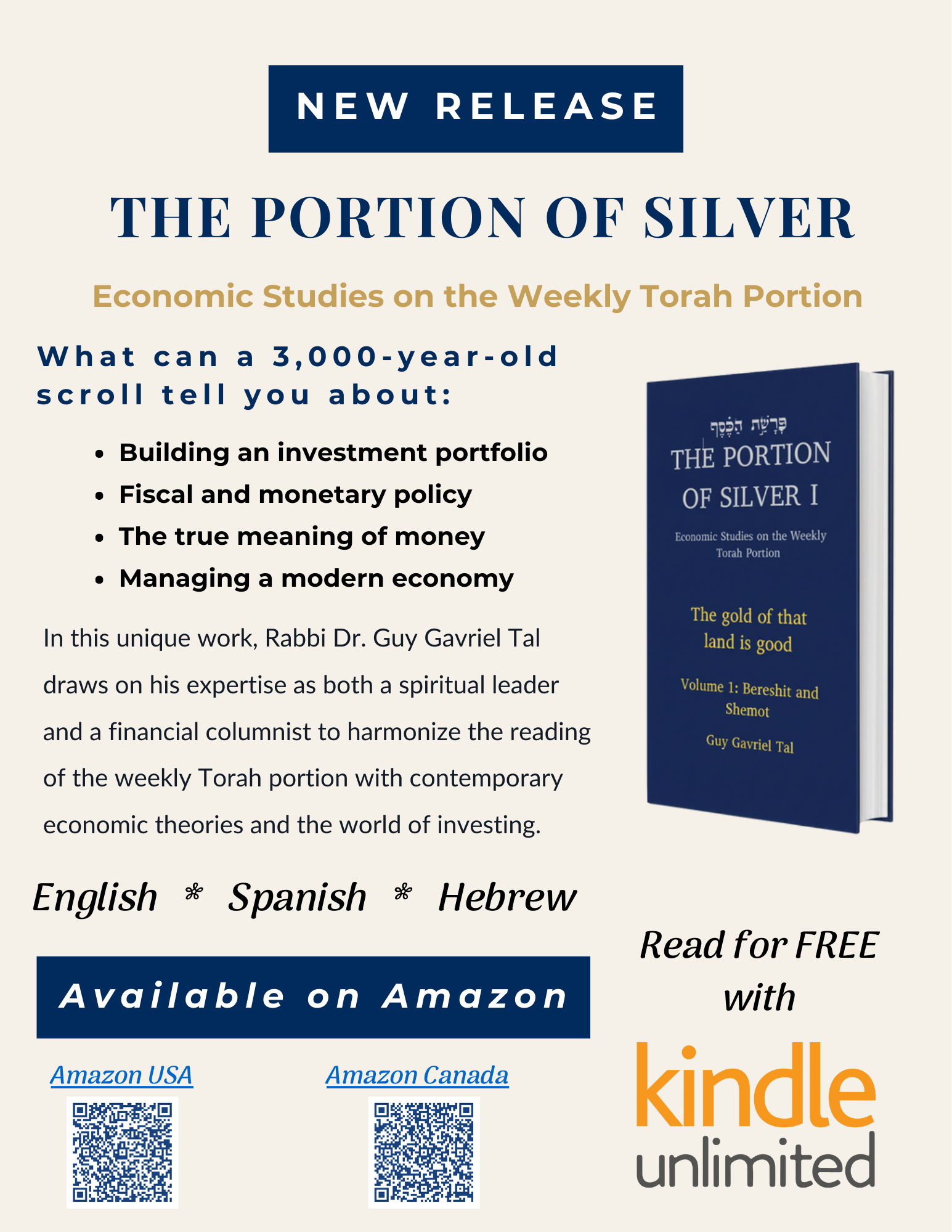 Rabbi Tal articulates this, noting in a recent interview with the Alberta Jewish News: “I believe the text remains highly accessible for two main reasons: First, many non-Jewish readers hold the Bible in high regard and can readily identify with the analysis of its verses and stories. Second, the intellectual and ethical principles explored in the book are universal. By addressing broad public issues and global dilemmas, the work offers a perspective that I believe is worthy of discussion and reflection for anyone, regardless of their background or religious affiliation.” Additionally, the English version of the book assumes an accessible tone that helps to engage a diverse readership; one need not be a Torah scholar to extrapolate Rabbi Tal’s meaning, nor a Wall Street ‘captain of industry.’
Rabbi Tal’s two volume project found its inception in a more incremental approach. “The book was originally written as a series of columns for Bizportal, a leading Israeli investment news site catering to the general public rather than a specifically religious audience.” As Rabbi Tal himself puts it: “…the writing style inherently assumes that not every reader is intimately familiar with the details of Torah narratives or necessarily holds a belief in its divine origin. This approach was carefully preserved in the English translation, keeping in mind that non-Jewish readers would also find interest in the work.”
The text integrates a refreshingly modern perspective. In his first chapter Bereshit: Who is Suitable for Independent Trading in the Stock Market Rabbi Tal writes: “Psychology has a tremendous influence on stock market trading. Fear of loss on one hand, and the FOMO (fear of missing out) phenomenon, along with a sense of hope and desire to profit on the other, drive people to act or not, often not in a rational manner. The desire to make large profits in a short time leads people to take irrational risks, while the fear of significant losses prevents them from engaging in sensible and profitable actions” (Tal 12).
While some would be reminded of the dangers of greed, broader audiences engage with pop-cultural relatability. Putting aside the whimsical use of colloquialism, there is a deeper observation being made about the human experience. “If we could enjoy the journey as much as we do when we achieve goals, we would be much happier for a much longer time, because during the majority of our lives, we are on a path to a destination. There are cases where satisfaction and joy can be derived from the journey, and there are fortunate people who indeed enjoy the means, whether it is in studies or in a chosen profession. These are the truly happy ones who have overcome the sin of the earth. But most people, at least most of the time, do not achieve that” (Tal 18). Indeed, there is a spiritual lesson here, as well as a practical observation around long-term investment. Rabbi She’ar Yashuv Cohen echoes that Jewish teachings and the observable physical or economy-driven world cannot be examined in isolation in his article Modern Economics in Light of Halakha where he states: “The Torah ascribes great importance to socio-economic matters” (Cohen 64).
The social sciences as a reflection of foundational Torah teachings are showcased in Rabbi Tal’s chapter Why Did G-d Decide to Thwart the Development of Communism? where the ever-constant obstacles of injustice and inequity propel an earthly desire for revolution without the consideration of the nature of man. The author notes that both The Flood and Tower of Babel should act as reminders when ruminating on the disastrous impacts of the Communist experiment. “The underlying ideas of Communism may seem enlightened and progressive – questioning why some should have more than others and whether it is better to share all means of production and the fruits of human labor. However, the implementation of these ideas, which contradict human nature and the free initiative that enables the world’s development, created rivalries, class warfare, and battles against human freedom. This brought destruction to entire nations, poverty and suffering to many communities, and the murder of countless innocent individuals” (Tal 25).
Certainly, if even examined from the Jewish perspective alone, the aftermath of Communist doctrine has left an unquantifiable number of people with Jewish heritage estranged from a connection to their identity. From an economic vantage point, the failure of Communism has left social turbulence in its wake, and fertile ground for corruption and exponential greed. When the Soviet Union collapsed, splintering the fifteen republics under its occupation, new borders fractured the perceived unity of a corrupt regime. Rabbi Tal notes: “Without delving into the nature of these sins, we can understand that ‘violence’ and ‘corruption’ are serious matters, justifying G-d’s harsh reaction that eradicated the entire world and essentially initiated a universal ‘reboot’ for creation” (26). As any scholar of the Former Soviet Union would attest, this ‘reboot’ may still be underway, but as Rabbi Tal concludes optimistically: “Creating competition and diversity and developing unique cultures and national characters are preferable over the uniform universality that erases identity. The construction of the new world after the flood encourages diversity and differences, not forced and degenerate uniformity, and creates healthy competition that leads to human development” (35). Rabbi Cohen supports this with his observation that “… trading in good faith in the central, overall principle in ethics generally, and in economic areas particularly” (66).
In Canada, where Socialist idealism often tries to unsuccessfully overtake the natural human compatibility with Capitalism, it is worth noting that the equity and justice sought for in non-economically-driven societal models, should be spoken to by the ethical lessons and morality of faith. “The book is a staunch advocate for the free market, capitalism, and the principles of liberty and faith in the human spirit. It is an attempt to apply logic and a realistic reading of our world through the lens of Torah principles. While some may disagree with specific conclusions –which is perfectly legitimate, as the tradition of Torah study is built upon diverse perspectives – the core lesson is that the Torah is vibrant, illuminating, and profoundly relevant. The fundamental laws by which the world operates, including those of economics, are reflected in the infinite wisdom contained within the Torah. My hope is that this book contributes, even in a small way, to that understanding,” Rabbi Tal noted in his interview. “I believe that because the Torah’s principles are divine and eternal, they are inherently relevant to every aspect of human existence. Uncovering a new field where the Torah applies – such as economics – reveals a hidden light within the Torah that was previously obscured. Every insight derived from the Torah is a form of study; it expands the Torah’s presence in reality and reveals its hidden light.”
Contemporary society is plagued with cries for justice. The Humanist would ask whose definition of ‘justice’ is being applied to the evaluation, while a person of faith would cite that there really is only one ‘justice’ with myriad human interpretations. Rabbi Tal explains: “State power is essential for the preservation of law and order, yet it is also prone to becoming a corruptive and overbearing force. Therefore, it is imperative to use it sparingly. Caution must be exercised to ensure that the laws of the state are never turned into the laws of Sodom” (56). Readers of the book might take this moment to ponder the profound simplicity of trumpeting justice, because the global community relies on it being maintained. Later in his book, Rabbi Tal expands on this: “Jealousy, especially of successful people, is a familiar human trait. Sometimes, it leads to behaviour that does not benefit the envious individual, where they try to harm others’ success even at their own expense” (71-71).
In the fast-paced competition of the professional ‘rat race’, people have become plagued by anxiety, depression, and any number of vocationally specific ailments. The need to rest is not only a spiritual one, but a biological one that when ignored, slowly debilitates the corporeal form. Rabbi Tal writes: “bodily rest on Shabbat is also, and perhaps primarily, intended to provide the space and time for a person to engage in matters beyond daily existence. This is also a human need: In daily life, under the burden of work, it does not receive proper priority. A healthy person in body and spirit knows how to set boundaries to the pursuit of livelihood, even if he loves his work and it fulfills his world, and even if it is an important and urgent economic need, and finds space in his life for rest, for family, for hobbies, and also for spiritual life” (246). What is meaningful here applies not to a religious reader, or a secular one, but to the human experience, reminding audiences that the teachings of Torah are for all to be uplifted and bettered by. Rabbi Tal brings these lessons of Torah to a modern Japanese context, citing a contemporary term that came about as Japan’s economy rose like a phoenix from the ashes of Hiroshima and Nagasaki.
‘Karoshi’ is a Japanese term meaning ‘death from overwork.’ “In Japan, it is a real epidemic, which causes hundreds of deaths each year. The Japanese government has mobilized to combat this phenomenon through education, hotlines, and legislation. Japan represents an extreme example of overwork, stemming from cultural and economic factors, but the phenomenon is more widespread and common worldwide to some degree. Sometimes overwork stems from a genuine financial need, when wages are insufficient and people must work extra hours to make ends meet. In other cases, it arises from excessive demands of employers or an employee’s exaggerated personal commitment to his work. In other, more positive cases, the worker simply enjoys the work and prefers to spend his time doing what he loves rather than engaging in other activities. Either way, it is a troubling phenomenon” (240). While readers may chuckle at the pessimism of the Japanese language, the existence of such terminology does indicate a harmful societal trend with physical, psychological, emotional, and spiritual implications. The Stock Market may close on weekends, but after-hours trading ensures that money never sleeps. A day of rest is a Commandment for a reason, and humans would be wise to remember this.
Rabbi Dr. Guy Gavriel Tal has done something special with this book; he has seamlessly constructed a bridge between mainstream global readers and the sacred wisdom of Torah study. During his interview, he explained that: “The divine and eternal nature of the Torah is uniquely expressed through the principle that timeless truths can be applied to ever-changing realities. This is a central theme of the book, demonstrating how the analysis of past events described in the Torah remains profoundly relevant in providing solutions to contemporary challenges. I am confident that the principles presented in the book –even when discussed in current contexts or as answers to specific modern questions – are inherently universal and eternal. Future generations will find them equally valid as they look back to learn from our experience and from our method of interpreting reality through the lens of the Torah.”
Rabbi Tal is certainly correct that this delicate balance of disciplines has indeed yielded a provocative and insightful analysis of universally relevant topics and issues. As he illustrates through his nuanced and highly textured exploration, what may seem ancient is the substance of current debates, and what may seem like breaking news is in fact a tale as old as time. To recommend this book solely for economists, or only for scholars of Torah would be shortsighted as this is a universally human discussion.

Be the first to comment on "New book by Rabbi Guy Tal will spark inquisitive debate"