
By Danielle Dolgoy
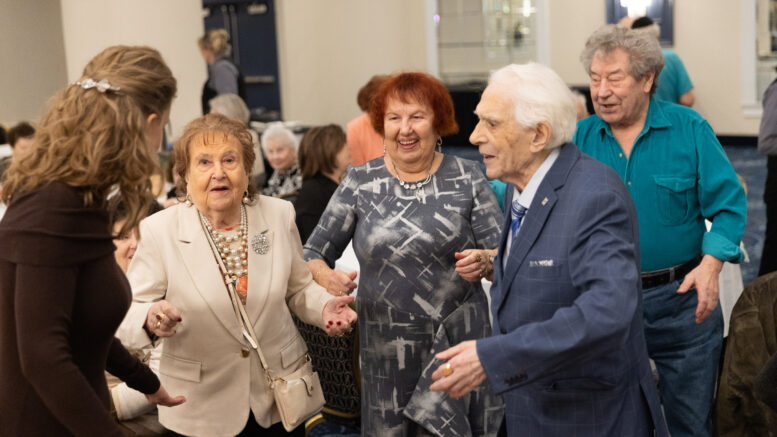
(Edmonton) – Last week, I stood in a room filled with living history. More than fifty Holocaust survivors gathered in Edmonton for Café Europa, a program of Jewish Family Services. There was music, conversation, and laughter. There were also memories that cannot be separated from the people who carry them.
As Executive Director of Jewish Family Services, I have the privilege of working closely with the team that supports Holocaust survivors in our community. I also feel a responsibility to name what this moment requires of us.
Our survivors are still here. They are aging. Many are now in their late 80s and 90s. They rebuilt their lives after devastating loss and helped shape Jewish life in Edmonton. Today, they face the vulnerabilities that come with advanced age layered on top of experiences of persecution, displacement and profound trauma.
As people grow older, early memories often resurface with new intensity. For Holocaust survivors, that can mean the return of fear and grief that were set aside for decades in order to survive and rebuild. Aging can narrow social circles and increase isolation. Health challenges can threaten independence. Trauma does not simply fade with time.
Jewish Family Services exists to ensure that our survivors age with dignity, safety, and connection. With support from Claims Conference and the Azrieli Foundation, we provide in-home supports, counselling, system navigation, financial assistance, and social programs such as Café Europa, where survivors gather with peers who share language and lived experience. These services are practical. They are also an expression of communal responsibility.
At this year’s gathering, what struck me most was not only the testimony of survival, but the strength in the room. Survivors danced. They laughed. They sang songs from their youth. Joy and memory existed side by side. That resilience is part of their legacy.
But the story does not end with those who lived through the Holocaust.
At events like Café Europa, we often observe that standing alongside many survivors are their children and grandchildren. Beyond them are families who fled Europe before the Holocaust, escaping pogroms, state violence and systemic discrimination. The dates differ. The wounds are connected.
I am a third-generation survivor of the Russian pogroms that terrorized my baba when she was a small child. She rarely spoke about what she experienced. She did not need to. The vigilance and fear lived quietly in her body and shaped how she moved through the world. Like many descendants of survivors, I have come to understand that trauma can be transmitted across generations.
This is not simply metaphor. For decades, psychiatrist and researcher Dr. Rachel Yehuda and her colleagues have studied Holocaust survivors and their children. Their work has documented higher rates of anxiety and altered stress responses among some descendants. In research published in journals such as Biological Psychiatry, Dr. Yehuda identified epigenetic changes in a stress-related gene known as FKBP5 in Holocaust survivors and in their children. Epigenetics refers to changes in how genes are expressed rather than changes to the DNA sequence itself. These findings suggest that extreme trauma can leave biological imprints that influence how the next generation responds to stress.
Additional studies examining cortisol regulation, the body’s primary stress hormone, have found measurable differences in some adult children of Holocaust survivors. While research continues to evolve, there is growing scientific support for what many families have long sensed: trauma can shape both psychological and physiological patterns across generations.
There is also encouraging evidence that resilience can be transmitted. Strong attachment, community belonging, and access to mental health support are protective factors. Intergenerational trauma is not destiny. It is influence. And influence can be redirected.
For those of us who are second and third generation, that understanding carries responsibility. We inherit both wound and strength. Breaking cycles of silence, hypervigilance, and unresolved grief requires intention. It requires investing in mental health, building secure communities, and choosing connection over isolation. It requires teaching our children not only what happened, but how we heal.
This is why survivor support remains urgent decades after the war. As survivors age, their needs become more complex. They require coordinated care, culturally competent services, and consistent social connection. They also require a community that understands their wellbeing affects the generations that follow.
Jewish Family Services serves Holocaust survivors, newcomers fleeing contemporary conflict, seniors living alone, families in crisis, and individuals seeking counselling. Our work is rooted in Jewish values of kavod, chesed, and tzedek. When we support survivors, we are not only addressing history. We are strengthening the future of our community.
Danielle Dolgoy is Executive Director of Jewish Family Services Edmonton

Be the first to comment on "Holding Survivors close and carrying their legacy forward"