

by Andrew Silow-Carroll
(JTA) — In January 2011, I wrote my first entry in a five-year diary. It seems I watched “No Country for Old Men” and had “anxiety over … board meeting.” I don’t remember the details of that meeting, but I remember the anxiety.
Five years later I started another five-year diary on New Year’s Day, which began with a bang — literally. “Wake late to sound [of] car crash.” Someone had rear-ended a parked car across the street, pushing it into the back of the car belonging to my son’s friend (no one was hurt). Later that day we went on a two-hour hike in the woods near Mahwah, New Jersey.
This week, I finished my third five-year diary — the latest installment in what is now a 15-year record of the often mundane, sometimes meaningful and occasionally dramatic moments of my middle age. On New Year’s Day I started my fourth diary, which will take me well into — oh, let’s just say what my father would say when someone complained that they were getting older: “Consider the alternative.”
I started keeping the diaries on a whim. It was a milestone birthday year, and I suppose my thoughts had begun to turn to the parts of my life I’d already lost, either through the death of loved ones or as a result of my own crumbling or highly selective memory. Like most parents (especially in the pre-Facebook era), I wished I had kept a better record of my kids when they were young. Yes, we took photographs and shot videos (now trapped on 8-millimeter cassettes), but gone are the conversations, the routines, the little things that made us laugh.
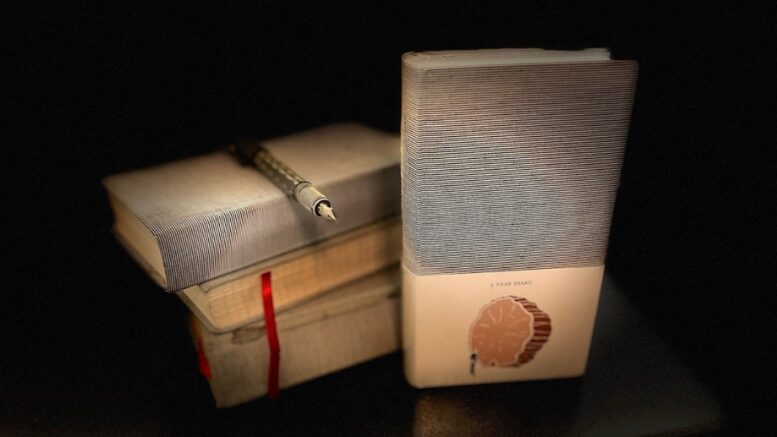
There’s not much room for reflection in the tiny spaces allotted in my five-year diary, which was designed by the graphic artist Tamara Shopsin. It’s set up so that entries on the same date line up one beneath the other. For every entry you write, you can scan up to see what you did on that date one, two, three and four years ago.
But even in telegraphic form the diary helps me preserve big moments and the humdrum things that I might otherwise forget. In the very first year there was a Very Big Moment — a health crisis that kept me away from the diary for a week. The handwriting changes abruptly as my wife takes over, chronicling my hospital stay and my recovery. My chicken-scratching returns in early May of that year. I have almost no memory of the time I was “away”; in more ways than one, my wife brought back my life.
In the years to come there were other Big Moments. Our parents passed away. Our middle son was married. I held three different jobs (four, if you count two separate stints at JTA). There were four presidential elections and a pandemic. But in some ways what I like most about the diary is the way it captures the boring, everyday stuff. What we ate for dinner. What we watched on television. Who we chatted with at kiddush. It’s something I learned from Irving Howe’s “World of Our Fathers,” when he describes how the old Forward newspaper took an interest in the ordinary goings-on among its immigrant readers. “Nothing seemed too mundane for the Forward staff,” Howe writes, and as a result back issues of the paper are a record of the everyday lives of real people.
If you’re typically lucky, a five-year diary can remind you how little has changed over the years. My Shabbats, for example, are almost eerily identical. A typical Saturday in 2011 is not that much different than a typical Saturday in 2025. (If I wrote a self-help book, I could call it “Eat, Pray, Nap.”) Considering the alternative, there is comfort in this sort of consistency. (What’s the supposed Chinese curse: “May you live in interesting times”?)
But monotony can also seem like a judgment and a goad to shake things up a little. Psalm 90:12 says, “Teach us to count our days [limnot yameinu], that we may get a heart of wisdom.” There are various interpretations of the verse, but the one I like most suggests that we’re being told to make each day matter — or, as it says in the old Silverman prayer book, “May no day pass without bringing us closer to some worthy achievement.”
Shopsin, I’ve since learned, was inspired to design her diary after reading a New York Times article about Florence Wolfson Howitt, who kept such a diary from 1929 through 1934, when she was a privileged Jewish teenager growing up on the Upper West Side. In 2003, a Times reporter, Lily Koppel, discovered the diary among the trash at a building on Riverside Drive. Koppel found Howitt still living in Florida; her story about a slice of recovered personal history and the passage of time became a book, “The Red Diary,” published in 2008. (Howitt died, at 96, in 2012.)
“You’ve brought back my life,” Howitt told Koppel at one point, as she thumbed through the crumbling diary.
My previous diaries are dog-eared and stained, and dotted with stickers that I’ve picked up over the years at museums and events (including one I got at a vigil days after the Oct. 7 attacks). My new diary is fresh and the spine is stiff. It’s daunting to hold a book of mostly blank pages without knowing how they’ll fill up. But that’s just the objective correlative for how humans experience the future. And it’s exciting, puh puh puh, to imagine what these next 1,825 days will bring.
Our metaphors about time are mostly about what’s lost. Time slips away. We lose time, or we waste it. “Every second we live can never be recovered,” Ezekiel Emanuel writes, alarmingly, in his new self-help book “Eat Your Ice Cream.” My diary is a small hedge against this kind of loss. Each entry is like a receipt for a day that’s been stored away: I may never get the day back, but at least I can remember what it looked and felt like, and how I spent it when I had it.
In Saul Bellow’s “Mr. Sammler’s Planet,” a character says, “Everybody needs his memories. They keep the wolf of insignificance from the door.” Of course, the wolf is eventually going to get in, but I keep filling out those blank pages. As the Jewish studies scholar Lori Lefkowitz has written about limnot yameinu: “Since our days are numbered, the trick is to make them count.”
The views and opinions expressed in this article are those of the author and do not necessarily reflect the views of JTA or its parent company, 70 Faces Media.

Be the first to comment on "Here’s how I make each day count: I keep a diary"