

by Maxine Fischbein, Local Journalism Initiative Reporter
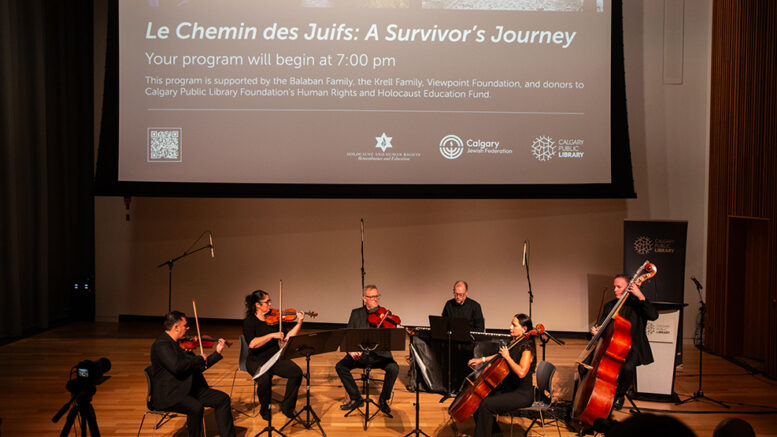
(AJNews) – An International Holocaust Remembrance Day IHRD program on Tuesday, January 27 brought a diverse audience of approximately 300 people to the Central Library with others joining virtually as Calgary Public Library (CPL) and the Holocaust and Human Rights Remembrance and Education Department of Calgary Jewish Federation presented a screening of the documentary film Le Chemin Des Juifs: A Survivor’s Story, directed by Daniel Bhattacharya.
The film, featuring the testimony of Holocaust survivor David Shentow and his wife Rose, was preceded by a chamber concert featuring the Le Chemin Des Juifs Suite, original music that was conceived by Bhattacharya – an accomplished violinist originally from the UK – and composed by Patrick Savage and Holeg Spies. The film was produced by Bhattacharya and Canadian Koa Padolsky.
Following greetings by Heather Robertson, CPL Executive Director, Service Design and Innovation, and Calgary Jewish Federation CEO Rob Nagus, Calgary Mayor Jeromy Farkas – who had proclaimed IHRD at City Hall earlier in the day once again shared an unequivocal message of support for the Jewish community and zero tolerance for antisemitism and racism in Calgary.
The IHRD program – organized by Holocaust and Human Rights Remembrance and Education Coordinator Amy Glassman Boiko – was generously funded by the Balaban family, the Krell family, Viewpoint Foundation, and donors to the Calgary Public Library Foundation’s Human Rights and Holocaust Education Fund.
Le Chemin Des Juifs tells the surprisingly little-known story about Jewish slave labourers deported by the Nazis from Belgium to work camps in Northern France between 1942 and 1944 to do the heavy lifting on the Atlantic Wall, a system of fortifications mandated by Hitler to prevent the allies from launching an attack from Britain on Nazi-occupied Europe.
Bhattacharya told AJNews that the story is largely unknown because of the understandable emphasis on the notorious death camps in Eastern Europe where millions of Jews were murdered.
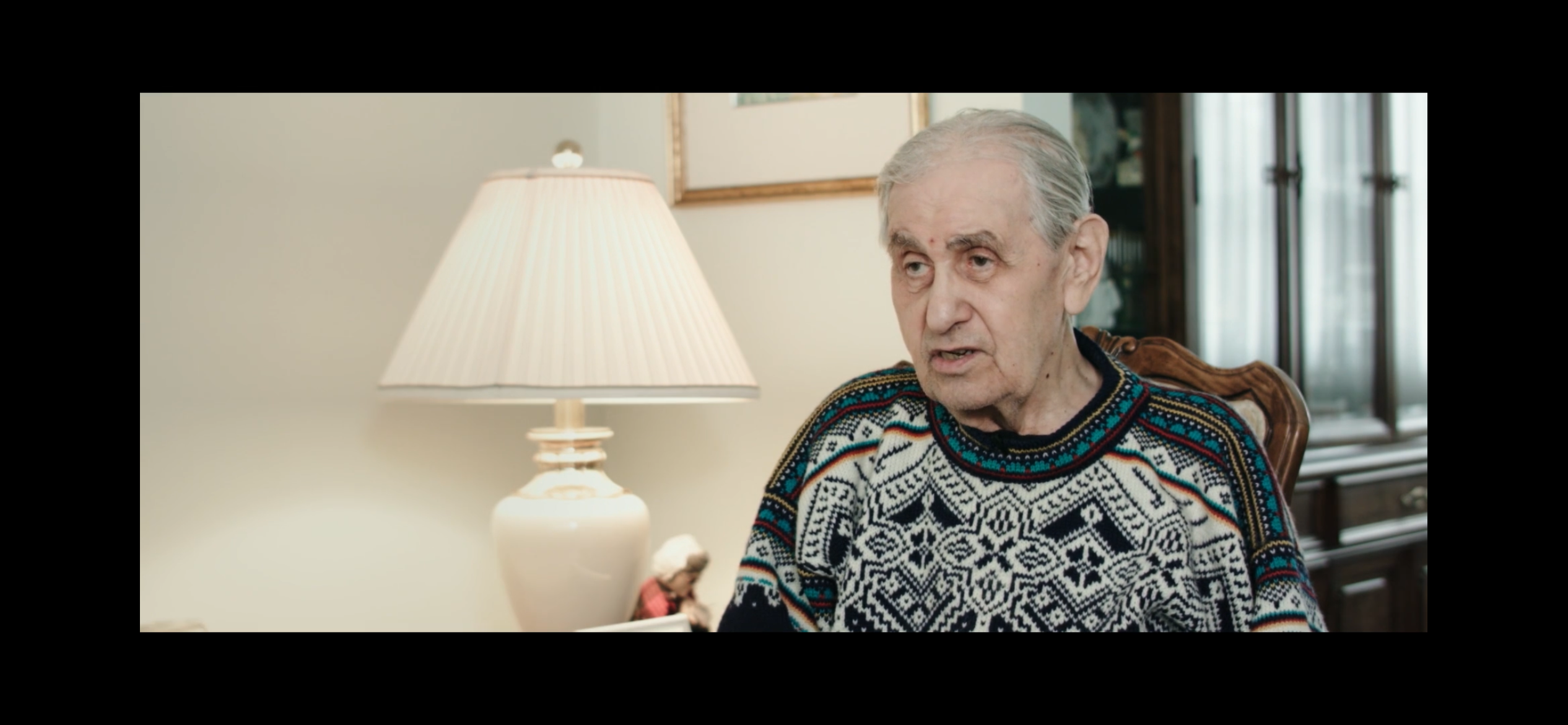
David Shentow. Screenshot from ‘Le Chemin Des Juifs.’ Reprinted with permission of Daniel Bhattacharya.
David Shentow and his father were among 2,200 Jews deported from Belgium between 1942 and 1944 to the work camps, including 1,500 from Antwerp alone, many if not most of them were Jews from Eastern Europe who had fled worsening pogroms there. Shentow did heavy labour at the Lager Tibor camp in Dannes-Camiers, near Calais, for three months.
At the heart of Bhattacharya’s evocative documentary, shot on location in England, Belgium, France and Canada, is the searing testimony of Shentow (né Dydja Krzetowski), a teenager at the time, who, like his fellow prisoners, was forced to perform the dangerous work on starvation rations. They suffered countless other humiliations and privations, including beatings, miserable living conditions and little to no medical attention. Some died while others were murdered.
As Rose Shentow aptly observes in the documentary, the footprints still preserved in the pavement of the Jews’ Road yield wordless testimony of a chilling story. Frozen in time are the imprints of the bare feet of slave labourers, the boots of the German soldiers, and the paws of their Shepherds.
With the Nazi occupation of Antwerp, Jews were subject to racial laws that, among other things, restricted their movements. David Shentow’s family – who had once hoped to reunite with relatives who had settled in New York – could not leave as the Nazi noose tightened.
In August 1942, Shentow and his father were ordered to report to the Antwerp railway station. It was the last time Shentow saw his mother and two sisters. In the film, he recalls, with regret, that he turned around one last time to catch a glimpse of his mom, who was crying…something he had never seen before. That was his last memory of his beloved mother, who – together with Shentow’s two sisters – was later deported and murdered by the Nazis.
This was merely the beginning for Shentow whose road to liberation later wound through Auschwitz and then Warsaw, where he and other Jewish prisoners were forced to clear debris following the Nazi destruction of the Jewish ghetto in the wake of the Warsaw Ghetto uprising.
Shentow later survived a death march, and the Dachau concentration camp, where he was liberated on April 29, 1945, his 20th birthday.
The sole survivor of his immediate family, and one of very few from his large extended family, Shentow was brought to Ottawa in 1949 by an uncle who had preceded him.
In the film Shentow describes his immigration to Canada as the best thing that ever happened to him. Shentow met and married Rose, his wife of 61 years, who infuses Le Chemin Des Juifs with profound insights into her husband and his journey. Together they welcomed two children and, in the fullness of time, grandchildren and great-grandchildren.
Shentow got on with his life, built his four-decade career at Friemans Department Store, and provided for his growing family. He did not speak much about his experiences until Holocaust deniers like Ernst Zundel began to spread their pernicious lies.
Then Shentow felt compelled to share his testimony with high school and university students as well as other groups, among them members of the Canadian Armed Forces.
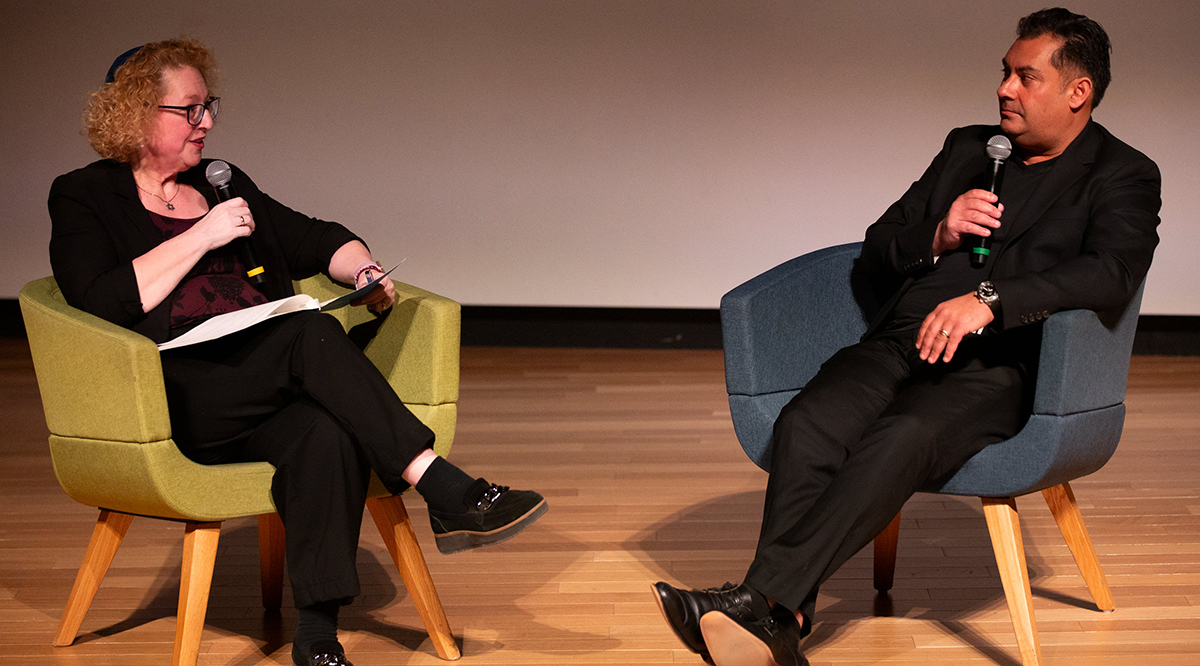
A Q and A session with Director Daniel Bhattacharya was moderated by Rabbi Ilana Krygier Lapides, following the screening of ‘Le Chemin Des Juifs.’ Photo by: christina (plus) nathan photography. Courtesy of Daniel Bhattacharya.
Shentow’s connection with Alberta is not among the topics explored in Le Chemin Des Juifs, though it was touched upon in a Q and A session with Bhattacharya moderated by Rabbi Ilana Krygier Lapides, following the screening. She spoke movingly of the deep bond between her late great-uncle Leon Krygier and Shentow when they met on the ship that brought them to their new lives in Canada following the Shoah.
“They were inseparable,” Rabbi Krygier Lapides said.
Leon had scrounged up enough money to make the journey from France to Calgary to reunite with his fiancée, Annette Groner, but during the voyage, Leon’s wallet was either lost or stolen.
“He was beside himself and had no idea how he would make it from the east coast to Cow Town,” Rabbi Krygier Lapides said.
“David Shentow had $20 to his name, and the ticket to Calgary was $12. He gave it to Leon,” said Krygier Lapides, adding that her uncle paid Shentow back as soon as he could. They remained close friends until Leon Krygier’s passing.
The road Shentow later traveled as a much-sought-after speaker brought him in contact with many more Albertans, most notably Jewish high school students who participated in March of the Living programs in 2006, 2008 and 2010 when Shentow, accompanied by his wife Rose, traveled with the Canadian Coast to Coast contingent of teens to Poland – where he shared his testimony with them at Auschwitz – and then Israel.
In 2009, Calgary Jewish Federation brought Shentow to Calgary as the keynote speaker at the community’s Yom HaShoah program.
Like those audiences, Calgarians who attended the 2026 IHRD program will not soon forget David Shentow’s story as told in his own words with surprising composure, though raw emotion bubbles to the surface, especially when this soft-spoken and gentle man recalls the violence and murders inflicted on others in front of his eyes and the guilt he carried for surviving when so many others did not.
It is impossible to replicate Shentow’s impact second-hand, so those who missed the IHRD program should watch for other opportunities to see Le Chemin Des Juifs and learn of Shentow’s experiences in his own words.
The film will, no doubt, reach additional Alberta audiences now that Daniel Bhattacharya – who moved with his family to Canada in 2021 – lives in the Calgary area. Bhattacharya already has some irons in the fire for screenings that will once again pair his film with live performances of the Le Chemin Des Juifs Suite.
The live performance on IHRD by Bhattacharya (violin), his wife Holly Bhattacharya (violin), Bruce White (viola), Jeremy Young (keyboard), Olena Kilchyk (cello), and Rob Hutchinson (double bass) was a highlight of the evening. Like Daniel Bhattacharya, Bruce White was among the musicians that recorded the suite for the film.
“Each movement [features] a theme from [Le Chemin Des Juifs] …. When we perform the music first, there is an instant connection when people see the film,” said Bhattacharya. “The main thing about music is it’s a communication tool, and it goes beyond words.”
Bhattacharya, who did a post-graduate fellowship in Toronto at the Glen Gould School in 1993-94, has done principal work with the Royal Philharmonic Orchestra and the Royal Scottish National Orchestra and has performed with the London Symphony Orchestra, the BBC Symphony Orchestra and the Vancouver Symphony Orchestra. He currently teaches violin at the Mount Royal University Conservatory and is executive director of ChamberFest West in Calgary.
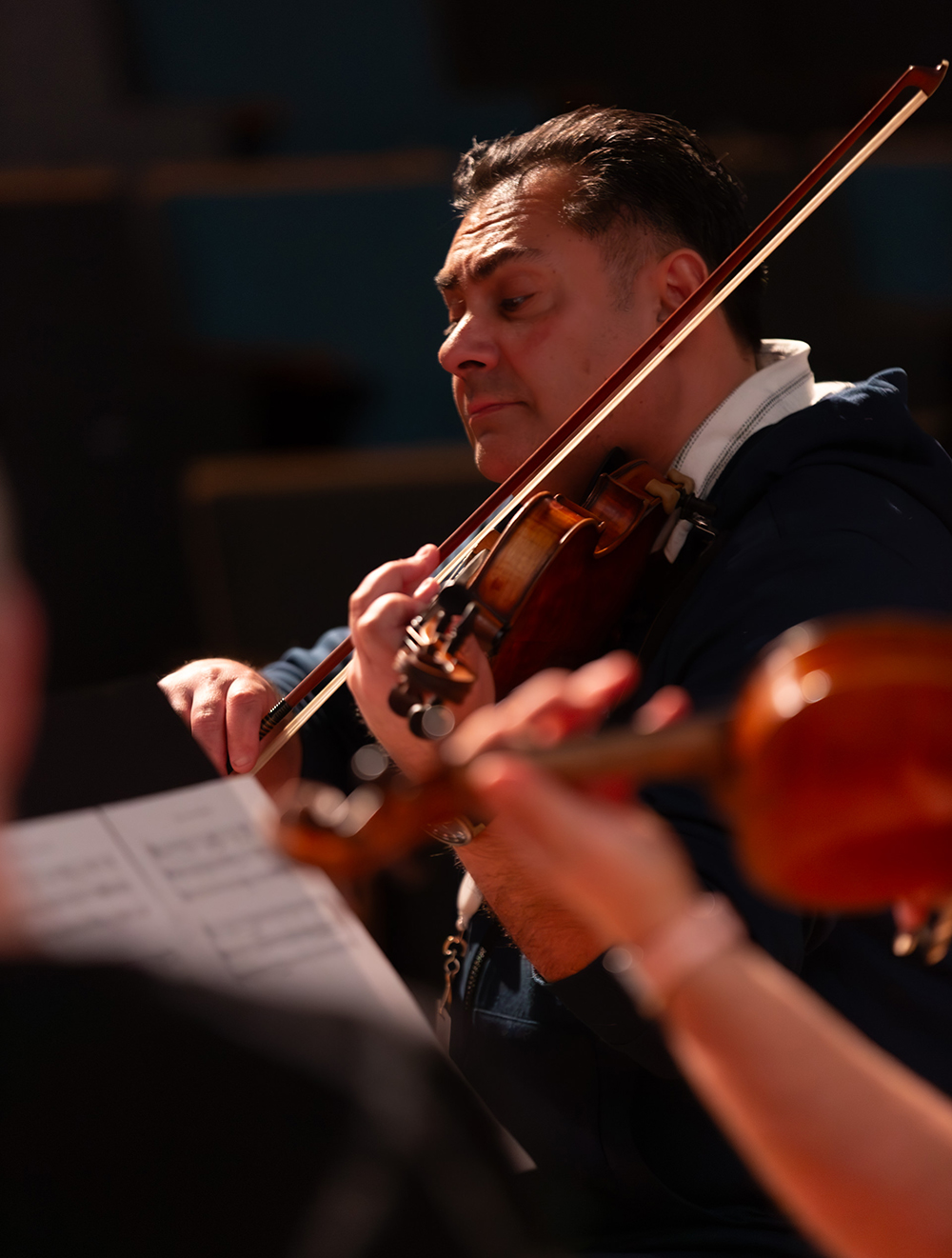
The live performance on IHRD by Director Daniel Bhattacharya (violin) and an ensemble was a highlight of the evening. Photo by: christina (plus) nathan photography.
There is a high probability that everyone who reads these words has heard Bhattacharya’s violin. He is a prolific recording artist who, according to his bio, “has contributed to more than 400 soundtracks, including The Lord of the Rings, Black Panther, Dunkirk, and Wicked,” not to mention Phantom of the Opera, Black Panther, Beauty and the Beast, Les Misérables and a host of Marvel and James Bond films.
An app widely used in the music industry calculates that the music Bhattacharya has recorded for film has been heard by an astonishing 27 billion people…and counting.
Along the way, Bhattacharya felt inspired to contribute to filmmaking from another angle. Some 13 years ago, at the age of 40, Bhattacharya enrolled in film studies at the Brighton Film school while continuing his work as a violinist. He subsequently made a couple of short films which screened in the UK and at a few film festivals abroad. When he met someone who was researching the slave labour camps in Northern France, Bhattacharya decided to make an educational film about The Jews’ Road.
The labour of love ended up being a four-year journey, during which he learned that David Shentow was one of four living survivors from but one train that transported 700 Jewish prisoners to Northern France.
Bhattacharya tried, at first unsuccessfully, to locate Shentow. Then he showed some of his footage to his UK neighbour, Koa Padolsky, a Canadian expat working as a film producer.
“As luck would have had it, she said, ‘Oh yes, my dad knows him,’” chuckled Bhattacharya, adding that Padolsky’s father attended the same Ottawa synagogue as the Shentows.
A week later, Bhattacharya and Padolsky traveled to Ottawa where they interviewed David and Rose.
The film morphed as Shentow’s Holocaust experiences became the focus, beginning with his deportation from Antwerp where his Polish family had moved when Shentow was an infant to escape worsening violence against Jews in Poland.
Fortunately, Bhattacharya completed his rough cut of Le Chemin Des Juifs and was able to share it with the Shentows prior to David’s passing in 2017 at the age of 92.
“He was happy with it,” Bhattacharya says.
Funded by private donors, Le Chemin Des Juifs premiered in 2018 at the Canadian War Museum in Ottawa at an event supported by the Azrieli Foundation. Since then, it has been screened elsewhere in Canada and Europe, Bhattacharya said.
The subject matter is, on multiple levels, personal for Bhattacharya who speaks with pride about his Jewish roots.
“My mom was Jewish and I had a Bar Mitzvah,” said Bhattacharya, whose paternal roots are Indian and Hindu.
Bhattacharya’s maternal grandfather immigrated from Russia to England just after the turn of the 20th Century, enlisted in the RAF during World War II, and was among the liberators of Dachau, where he could only conclude that “…there was no God.”
As a result, Bhattacharya’s mother grew up in a secular household.
Daniel’s Jewish grandmother, who had immigrated from Poland to England around the same time as her husband, came from an Orthodox background and insisted that her grandson have a Bar Mitzvah.
“I wanted it,” recalls Bhattacharya, “because of the family history on that side of the family…it was a blood thing for me.”
His calling as a violinist seems to also be a part of his DNA. His mother was a pianist, and his grandfather was both a violinist and saxophonist who played for the silent movies in London and was among the first musicians to record music for films in the late 1940s. Bhattacharya grew up in a flat above his family’s music shop.
“A lot of [violinists] are Jewish,” he says.
Violin music is front and centre in the playlist of Jewish experience. It is especially fitting that it compliments Shentow’s story. A bio likely used to introduce Shentow at the 2009 Calgary Yom HaShoah program reveals that he took violin lessons as a child, when Antwerp – as Shentow poignantly states in Le Chemin Des Juif – was a “paradise” for his family.
Bhattacharya says he is impressed with local efforts to promote Holocaust education in the schools. “That’s something I really want to push for,” Bhattacharya told AJNews.
“If you go to the interior of BC, there are people who don’t know anything about it,” adds Bhattacharya, who lived in Nelson and worked as executive director and artistic director for Arts Revelstoke prior to relocating to Alberta.
Along the way, he shared Le Chemin Des Juifs with BC audiences.
“We’re trying to get the film seen… and for me, I really want to do it with the [live] music, because it then becomes an experience.”
Bhattacharya says he is keenly interested in learning more about the Jewish experience in Canada and right here in Calgary. He is fascinated by how very interconnected the Jewish community is.
One example is the moment that a mutual friend of his and Rabbi Krygier Lapides – Julie Friedman-Smith – introduced them to one another knowing that they shared an interest in Holocaust remembrance and education.
“It was a total coincidence that each of us had a connection with David Shentow,” Krygier Lapides said.
“It’s all about connections,” says Daniel Bhattacharya. “This is the way the world works. When we packed our bags and moved over here, we knew maybe one person…. In a very short time, we’ve made so many connections.”
Some of those connections led to an unforgettable evening on International Holocaust Remembrance Day when members of the Calgary Jewish community and the community at large had the opportunity to hear the testimony of survivor David Shentow.
May his memory always be for a blessing.

Be the first to comment on "Evocative film ‘Le Chemin des Juifs’ screened at CPL on Holocaust Remembrance Day"