
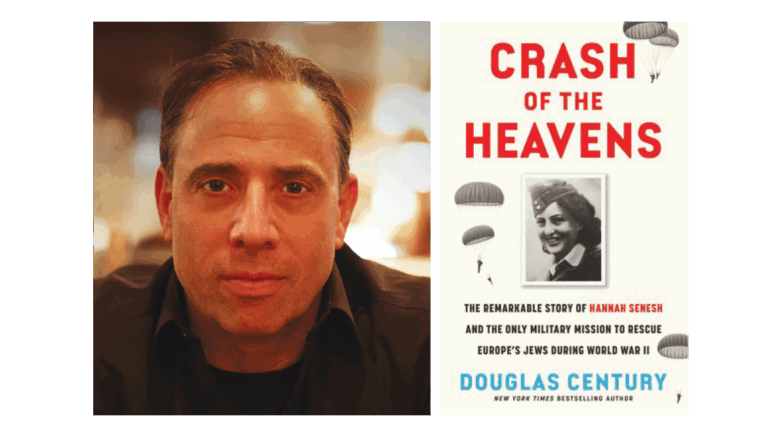

By Mark Cooper
(AJNews) – Long before he was a bestselling author, Douglas Century sat in a 1970s Calgary elementary school classroom learning Yiddish and listening to the vivid details of the Holocaust.
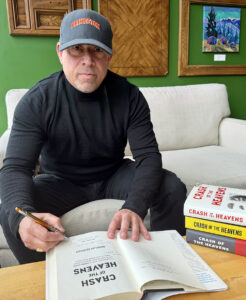
Calgary author Douglas Century with his new book, “Crash of the Heavens: The Remarkable Story of Hannah Senesh.”
He didn’t know it then as a young student at the former I.L. Peretz Yiddish School in Altadore, but while the horrors of the Shoah would haunt him for much of his life, they also sparked a lifelong devotion to the memory of Hannah Senesh.
Decades later, that childhood fascination culminated in his new novel, Crash of the Heavens: The Remarkable Story of Hannah Senesh and the Only Military Mission to Rescue Europe’s Jews During World War II.
The intense creative journey – centred on one of the modern state of Israel’s most prominent early heroines – moved Century back and forth between profound inspiration and emotional devastation.
Researching and writing the book – a finalist for this year’s National Jewish Book Award – meant bouncing between retracing the footsteps of a remarkably brave young woman, and falling into a darkness while documenting the brutal torture she endured.
The anguish did not lift when Century typed the final sentence of this riveting piece of narrative non-fiction. At his agent’s urging, he had purposely avoided writing a traditional Holocaust book, framing it instead as a World War II rescue yarn.
Still, in the process of researching it, there was no escaping the historical tragedy of the Shoah.
So when he emerged from the intensity of the subject matter – the first book in over 30 years about the young headstrong Zionist who gave her life at 23 during the war’s only military rescue mission of Europe’s Jews – he looked around at modern-day North America and found that same ancient hatred waiting for him online and across university campuses.
“It took a lot out of me,” said the youthful 61-year-old born and raised Calgarian, whose parents built a home in Chinook Park in the early 1960s, soon after moving to Canada from the U.S. with Century’s two older brothers.
“You just listen to what people did (to the Jews). And it puts you in a dark place for so long. So one of the hardest things was coming out of this darkness. Because it’s so sad.
“At the same time, I’m coming out of this I’m seeing people accusing Zionists of being Nazis. It just gave me such a depressed view of the world.
“So coming out of that and feeling like it’s happening again…”
Century, who recently moved back permanently to Calgary from New York City with his own 23-year-old daughter Lena, has made his way out of the post-writing funk he was in.
Seeing the book launched, hearing from people he touched by it, and focusing his next work, he admits, was a big part of that.
He’s also stopped “doom scrolling” social media platforms full of antisemitic sentiment.
Childhood lessons spark lifelong literary devotion
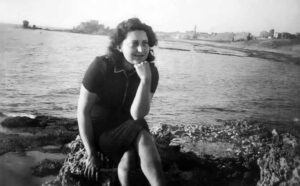
Hannah Senesh in the ruins of the Roman capital of Judea, Caesarea. Reprinted Courtesy “Crash of the Heavens.”
Growing up, his only exposure to antisemitism came from history lessons. Starting at eight years old, his principal – a Holocaust survivor – believed the class of six young children studying in a Yiddish school should be aware of these historical tragedies.
“They didn’t shelter us back then about the Shoah,” he said.
“Learning how gruesome it really was, at a young age, it still scars me. I would have nightmares all the time about running and hiding from the Nazis.”
While he wonders whether the material was age appropriate, he credits his early education for sparking his interest in writing about Senesh.
“I heard this story about a girl who had not talked under torture, parachuted in, wouldn’t give up her codes, wouldn’t betray her people, sentenced to death, wouldn’t beg for a pardon, wouldn’t even wear a blindfold and went to her death at age 23.
“That was an amazing story to hear when you are eight years old but it was also terrifying.”
From Calgary Classrooms to New York Columns
It would be more than 50 years later before he finally wrote Crash of the Heavens.
Writing came naturally to Century. While an honours student at Henry Wise Wood High School, one of his short stories won second prize in an esteemed national student writing competition.
“I had a teacher, who said to me, you’re a talented writer, pursue this.”
His father, J.R. Century, a prominent Calgary petroleum geologist, also strongly encouraged each of his three boys to pursue something culturally.
Writing was a way for young Douglas to get out of taking piano lessons and was seen as an appropriate endeavour by his Dad.
Recognizing that fitting in at school required balancing his academic pursuits with something more popular, Century played varsity soccer. He even managed to steal exams and feed them to the school jocks, maintaining a charade that his top grades didn’t just come to him naturally.
Century, in fact, was one of Alberta’s finest high school students, even scoring 100 per cent on his English 30 final, writing a short story to answer the test questions.
The same creative method worked again to get him admitted to the Ivy League. This time, he gained acceptance into Princeton University’s English/Creative Writing program by submitting an original novella.
After a brief couple of years back home after graduation, reading geological maps to help his Dad find oil, he was lured to New York by a writing professor.
It was then he began monetizing his writing, doing book reviews for the Village Voice, New York Newsday among others.
He’d then transition to writing hundreds of mostly celebrity columns for the New York Times. He has also written for Rolling Stone, Billboard, The Globe and Mail and The Guardian.
In 1998 he was introduced to his agent Sloan Harris, who continues to represent him, and his first non-fiction narrative Street Kingdom was released. The book followed the friendship he had with a 270-pound rapper in a Brooklyn street gang.
His first book exploring Jewish themes was 2006’s Barney Ross: The Life of a Jewish Fighter, a biography of the decorated World War II hero and world champion boxer.
A Modern Tribute Rekindles a Deep Obsession
It wasn’t until 15 years later that he would be overcome by the urge to write about Senesh.
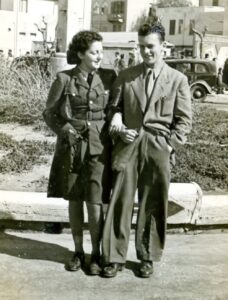
The final photo of Hannah Senesh ever taken in British Mandatory Palestine/Eretz Israel. Reprinted Courtesy “Crash of the Heavens.”
The idea he had for a number of years was solidified when in 2021 he saw a news story highlighting IDF paratroopers and NATO paratroopers recreating Senesh’s jump into Europe on what would have been her 100th birthday. The recreation was called Crash of the Heavens.
“It just dovetailed into my own obsession with her already.”
After an enthusiastic reception from his agent, and with an expedited book advance, he made his way to Israel, spending much of the summer of 2023 interviewing relatives and retracing Hannah’s footsteps.
He’d walk through the ancient ruins of Caesarea where she wrote many of her poems, sometimes sitting and meditating on the same rocks she would sit on. There he would wonder about the emotion she would have felt as one of the pioneers helping to re-establish the ancient Jewish homeland into the modern state of Israel.
“I can’t write about something unless I feel like I know it. So I get utterly obsessed…Once I get onto something, I get tunnel vision. I almost have to go in all of these little rabbit holes and know everything that I can. And that kind of becomes fun.”
In this case, it was also incredibly stressful.
“I said to myself ‘Oh my God, this woman is a legend.’
“There’s been plays, her poems are known around the world. There are 22 editions of her poems.
“And I was just like ‘I can’t get anything wrong!”
What he found out during his time in Israel is there were few who knew more about her than him. Senesh’s nephew David, who ironically spent nearly a decade in Calgary, told him, ‘I never knew my aunt. You probably know more about her than I do.’
“So I came back realizing ‘I know it’. And when I left I thought I needed to learn more and more and more and more.”
Sadly, Century says young Israelis know little about Senesh and the other paratroopers on the mission, something that gave him even more purpose to tell the story well.
To do that, hours were spent researching Hannah’s papers, diaries, that fortuitously had just been donated by Senesh’s family and digitized at the National Library of Israel.
He also spent many research hours at the Military Museums of Calgary, which houses one of North America’s largest non-governmental military archives.
Because the book’s central subjects were women (Hannah and her mother) Century used his own mother Marcia, and daughter Lena as crucial sounding boards.
Current Events Shape a Powerful Historical Tale
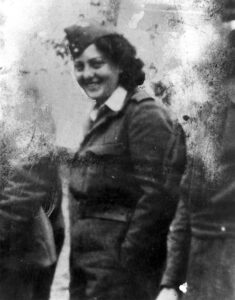
Hannah Senesh, in the uniform of Aircraftwoman Second Class, Women’s Auxiliary Air Force. Reprinted Courtesy “Crash of the Heavens.”
However, no research could have prepared him for the turn his book would need to take after the October 7, 2023 Hamas attacks in Southern Israel. Century felt a chilling modern resonance.
“And then suddenly … I’m trying to fit this book into the narrative of today.
“I had to show the raison d’être of a young Zionist, which I didn’t plan to,” he said.
To ensure the maps in his book were not co-opted by political propaganda, he explicitly used the term ‘British Mandatory Palestine’ to preserve the historical context of a Jewish homeland. Any map also had to say ‘Eretz Israel’.
While he initially felt the rug had been pulled out from under him, the parallels in the book, and the historical context it provides to the modern day antisemitism and anti-Zionism make his work even more important.
The enthusiastic reception to Crash of the Heavens adds to a growing list of awards and accolades for the accomplished author, who has penned five solo works and more than a dozen that he has either co-authored or ghost written. Two have become New York Times bestsellers and another was published in 23 languages.
Reflecting on this book, Century said: “I think I really did my research, I humanized Hannah and some of the others in a way that I hadn’t seen,” he said, noting his work to bring to life the other paratroopers on the mission, as well as never-before seen photographs and poetry.
“The idea of dying for a cause… It was very clear to me that there was a sense of honour.
“But also Hannah could be extremely difficult and obstinate and wouldn’t listen to reason sometimes.
“I feel that she’s (now) a three-dimensional character.”
Sitting in a Calgary Marda Loop coffee shop just minutes from where his Yiddish school once was, Century – who still speaks semi-fluent Yiddish – reflects further on how much his Alberta childhood shaped his career and his latest work.
“The germ of this entire book happened a few blocks from here at this old Peretz school.
“So I credit Calgary a lot with the kind of Jewish experience I had. It gave me a real grounding in the depth of not just the superficial Jewish culture.”
For Century, returning to Calgary brings his journey full circle – not just back to the city of his youth, but back to the very streets where the extraordinary legacy of Hannah Senesh first captured his mind.
Mark Cooper is a Local Journalism Initiative Reporter.

Be the first to comment on "Author Douglas Century turns childhood fascination to literary triumph about Hannah Senesh"