

by Regan Lipes, Local Journalism Initiative Reporter
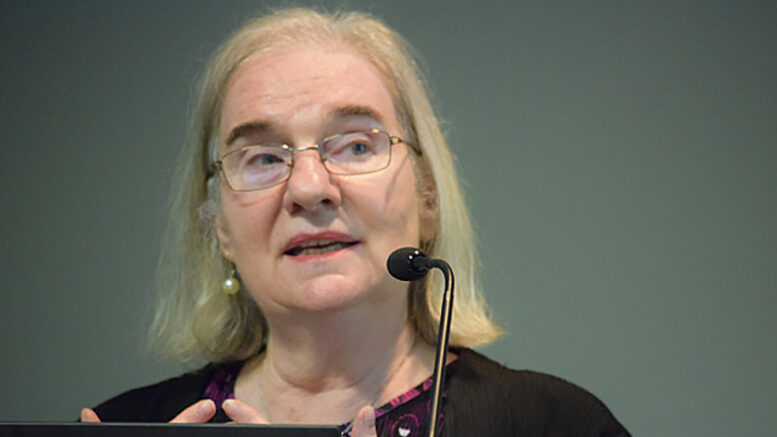
(AJNews) – Lovers of great literature have a unique opportunity in Calgary on April 14 – Yom HaShoah – to hear one of the country’s most important preservers of Yiddish literature, Dr. Goldie Morgentaler, Professor Emerita from the University of Lethbridge. She’ll be speaking at an event titled: The Canadian Afterlife of the Great Yiddish-Language Holocaust Novelist, Chava Rosenfarb, As Told in Letters and Stories.
The lecture is presented in partnership with the University of Calgary’s Centre for Military, Security and Strategic Studies, the University of Calgary Jewish Community and the Jewish Historical Society of Southern Alberta and will be held at The Military Museums.
 The event will be open to registrants from the local Jewish, and scholarly communities for a very special public engagement with Dr. Morgentaler – an acclaimed scholar, translator, and the daughter of Chava Rosenfarb.
Dr. Morgentaler built a robust career teaching the works of Charles Dickens, a very different research area than her current focus. She is a noted translator of her mother’s numerous works and is herself a native Yiddish speaker. “It can be funny sometimes because I don’t even realize that I translate from Yiddish when I say things in English until my husband points it out,” she explained to a class of undergraduate Comparative Literature students at MacEwan University. “My husband will mention something that we need to do, and I’ll reply: ‘But I don’t have when’ because I’m thinking with Yiddish instincts.”
In a recent interview with the Alberta Jewish News, Dr. Morgentaler recalled her mother’s sentiments. “She wanted her works to be read and appreciated by broad audiences. My mother once wrote that no author writes for the inside of their desk drawer, and she was pessimistic about the future of Yiddish.”
Dr. Morgentaler elaborated that her mother was not discouraged for lack of deep love for the Yiddish language, but because of the number of readers her writing could potentially reach. “When people tell me they want to learn Hebrew I say, great, go to Israel – learn Hebrew. But with Yiddish it’s different. If someone tells me they want to learn Yiddish, I have to say, go to Harvard, go to Oxford, go to McGill, but I can’t give them a destination to go live in – just institutions that teach the language still.”
In 2024, Dr. Morgentaler was the recipient of a Canadian Jewish Literary Award in the category of translation for In the Land of the Postscript: The Complete Short Stories of Chava Rosenfarb.
The appearance of Rosenfarb’s short fiction in a single collected volume has made her post-immigration to Canada prose more accessible to a diverse readership.
In a 2025 article by Dr. Regan Lipes, What Yiddish Literature Reveals about Canada’s Diverse Canon and Multilingual Identity, published in The Conversation, it becomes clear that for her audiences, Rosenfarb is not only a Yiddish writer, but a Canadian one as well.
2023 was declared the ‘Year of Chava Rosenfarb’ by the City Council of Lodz, Poland, and a street named in her honour signifies her importance within the Polish literary consciousness. Canada played a significant role in the author’s adult life, and as more North American audiences engage with her work, the impact of Yiddish on the world canon becomes more evident.
For undergraduate Comparative Literature students reading Rosenfarb’s work, it is the consistency of the Canadian backdrop that initially stands out to them. “The stories in the collection are all rooted in Canada,” Dr. Morgentaler emphasized to an audience of MacEwan University students. “These characters were representative of a generation of survivors who were doing everything they could to rebuild their lives.”
One student asked if Rosenfarb’s characters were based on real people, to which Dr. Morgentaler responded: “I think parts of these characters were based on people my mother knew, some to a greater extent than others. The struggles they face, and the challenges they encounter come from seeds of truth, and what my mother and others like her were experiencing in those days of building lives in Montreal.”
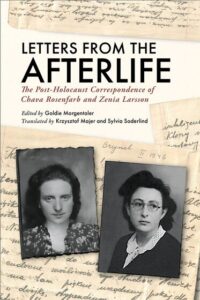
In 2025 Letters from the Afterlife: The Post-Holocaust Correspondence of Chava Rosenfarb and Zenia Larsson, was published. The volume was lovingly edited by Dr. Morgentaler, and the Polish letters meticulously translated by Krzysztof Majer, while Sylvia Söderlind translated Zenia Larsson’s Swedish text into English. Larsson, a childhood companion of Rosenfarb, survived the camps by her friend’s side, and the two remained in contact exchanging letters between Canada and Sweden well into their seventies.
“Polish was their common language,” Dr. Morgentaler explained during her interview with AJNews. “Zenia didn’t speak Yiddish.” The collection paints a touching portrait of two female writers whose bond preceded the Shoah but became impenetrable through their shared survival.
In a January 2025 review in Hadassah Magazine, Rochelle Saidel comments: “I found myself reflecting on the language challenges that accompany displacement. The friends wrote in Polish, the language of their childhood. Rosenfarb would have preferred Yiddish, but Larsson was not fluent; unlike Rosenfarb, she had not attended a Yiddish-speaking school in Poland. Over time, Larsson began losing her Polish as she grew more comfortable in Swedish, and Rosenfarb’s command of Polish also weakened.
This correspondence grew more difficult as the years progressed and their facility with a shared language eroded.” Saidel also notes: “Their lives mirror the broader experiences of many Holocaust survivors. They had to adjust to entirely new circumstances, foreign countries and unfamiliar cultures and customs. Both faced economic hardship in the years immediately after the war. Rosenfarb and her husband initially settled in Brussels before immigrating to Montreal, where her husband, Dr. Henry Morgentaler, restarted his professional path by enrolling in medical school. Rosenfarb continued writing in Yiddish, even as she navigated the daily demands of life in English and French.”
During her visit to Calgary, Dr. Morgentaler will have both these texts available for purchase. “My mother certainly has many other texts I could recommend. The Tree of Life is a three-volume novel after all, so I think I’ll just bring the short stories and letters. It’s quite appropriate too, because all these writings deal with life after the Holocaust,” she added.
Irena Karshenbaum, a Calgary-based writer, cultural producer and historian, has been working to invite Dr. Morgentaler to come and speak for quite some time. Herself a contributor to the AJNews, Karshenbaum noted: “This, of course is about the works of Chava Rosenfarb, but Goldie is the main attraction. Her work as the translator of her mother’s writing has been painstaking and masterful,” she emphasized. “Listening to Goldie is like eating steak and potatoes; it satiates.”
Karshenbaum is a board member with the Jewish Historical Society of Southern which is how she first met Dr. Morgentaler, while conducting an oral history interview with her. Since then, she has been working hard to try to share the works of Chava Rosenfarb, and the scholarly insights of Dr. Morgentaler with wider audiences. This upcoming event has been a longtime in the making and is now blossoming into a community-wide presentation.
Those planning to attend are kindly asked to preregister for the event. This event that coincides with Yom HaShoah is made possible by the Centre for Military, Security, and Strategic Studies at the University of Calgary, the University of Calgary Jewish Community, and the Jewish Historical Society of Southern Alberta. The event is also being graciously supported by the KSW Calgary Holocaust Education and Commemoration Endowment Fund, a part of the Jewish Community Foundation of Calgary.
The lecture is free of charge and includes a kosher reception. Books will be available for purchase. Click here to register.

Be the first to comment on "April 14 in Calgary: Goldie Morgentaler will present on ‘The Canadian Afterlife of the Great Yiddish-Language Holocaust Novelist Chava Rosenfarb ‘"