
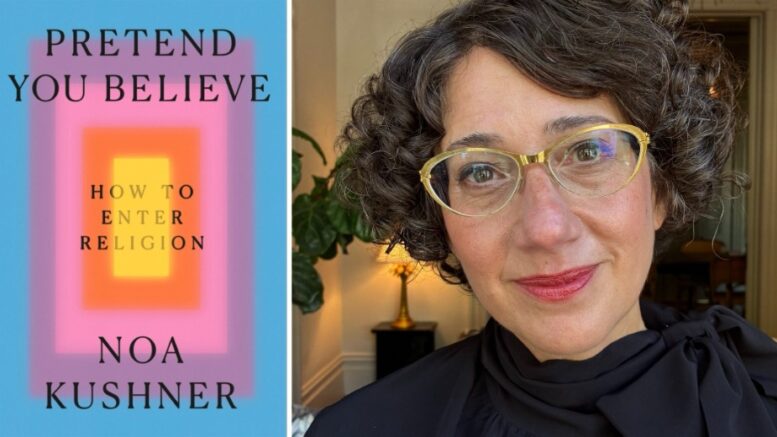

Noa Kushner urges Jews to stop asking what religion can do for them — and start asking what it means to enter into a relationship with God.
by Andrew Silow-Carroll
(JTA) – For many Jews, the High Holidays are an annual encounter with a question they spend much of the rest of the year avoiding: Why have a religious life at all?
These Jews may not be regular synagogue-goers, or particularly sure what they believe, but for a few days each autumn they sit in a sanctuary, open a prayer book and wonder whether they should bother with any of it — especially if they find belief in God difficult, or question why they should believe in the first place.
Rabbi Noa Kushner has a provocative suggestion for those Jews: Stop asking whether you believe in God. Instead, pretend you believe in God, and see what happens.
In her new book, “Pretend You Believe: How to Enter Religion,” Kushner asks readers to bracket their doubts long enough to enter the religious world on its own terms. The goal of “chosen naivete,” she writes, is to “make a dent in your unspoken assumption that religion is vapid, useless, at best decorative, and at worst dangerous and destructive.”
But her idea is not “fake it ‘til you make it.” Her book argues against one of the most familiar ways contemporary Jews talk about religion: as a means to an end, something they do because it gives them community, makes them more ethical, and helps them grow or otherwise improves their lives.
Kushner considers this a “consumer mentality,” and too close to self-help, which she explicitly rejects. “If we always start and end with our personal responsibility and perspective and never with the tradition’s” perspective, she writes, “then the system simply buckles.”
That is the radical claim of “Pretend You Believe”: Judaism is not ultimately a technology for making better people. Ethics matters enormously, Kushner argues, but it cannot be the ultimate purpose of religion. As she puts it in the book, Judaism exists “for the sake of God. To have another end, even one as well regarded and critical as our ethical behavior, is to misunderstand the religious project and our role in it.”
Kushner is the founding rabbi of The Kitchen, an independent Jewish congregation and institute in San Francisco that she launched in 2011. The Kitchen has become known for its embrace of Jewish prayer, ritual and tradition, as well as for bringing Sephardi and Ashkenazi traditions together. Ordained at Hebrew Union College, the Reform seminary, she studied religion at Brown and served as a Hillel rabbi at Stanford. Kushner, 56, is the daughter of Rabbi Lawrence Kushner, the prominent Reform rabbi and author.
I spoke with Kushner in the week before Yom Kippur about God, doubt, the limits of self-help, and what she hopes happens when skeptics decide, at least temporarily, to pretend they believe.
Full confession here: I’m a regular synagogue-goer. Judaism is probably the center of my life, personally and professionally. But when I talk about why I do what I do, my answers are invariably transactional. I go to synagogue for the community. I study Torah to focus my brain on living an ethical life and maybe hone my thinking skills. I mark the Shabbat as a respite from the crazy work week. What I don’t think much about is God. Is it accurate to say that your book seeks to challenge that kind of thinking?
Yes. I heard exactly that over the years. You know: “Don’t worry about the God piece.” And then I eventually came to a point in my rabbinate where I thought, if I as a rabbi can’t advocate for God, who will?
What I’ll say to people [who think as you do] is, you have my bracha, my blessing, no matter what. You have my love, no matter what. However, I think this is worth your consideration.

So let’s consider the person who may be drawn to a congregation like yours, may want to be part of a welcoming congregation and wants to reconnect with Jewish traditions for the sake of family, or history, or guilt. You even write about how doing rituals and observing mitzvot have their own rewards. What does believing in God, or even pretending to believe, add to the equation?
I would start with politely reframing the question.
“What does God add to the equation?” assumes that we are the center of the universe, and God would be there to bolster, affirm or expand on what we already are. But there is another way of thinking, which is quite traditional: We are not the center of the universe, and religion can teach us that move of humility, which changes a great deal.
And we’re so accustomed to entering any experience in what you called a transactional way, or perhaps as a consumer, that we often miss what religion has to offer. Because if you enter religion asking what is there for me, you may indeed miss what’s there altogether.
Religion is there to remember that you are holy, you are capable of saying holy things and doing holy things and responding to the gift of your life given from the One On High. And as my father taught me, something that is holy is infinitely valuable in its own right, and cannot be used for any other purpose.
I know people who aren’t ready to take the literal leap of faith that you describe — that is, to bypass their intellectual doubts to do the stuff of a religious life. How do you convince them?
That’s why the book is called “Pretend You Believe.” You don’t have to have this worked out theologically, intellectually before — as a precursor. Far from it. In classic Jewish terms, it’s what we said at Sinai [when the Israelites accepted the Torah]: “na’aseh v’nishma.” We will do, and then we’ll hear.
In other words, doing precedes understanding.
But it’s a faithful doing. It’s not just, “I’ll try it. I’ll wing it.” It’s doing with a conscience, and integrity. We don’t have to have it all worked out in advance in order to participate. It’s saying, “I’m going to enter this arrangement. I’m not going to say there’s no God or God doesn’t matter or God is off the table. I’m going to leap toward it in my action and see what happens.”
This has helped many, many people avail themselves of other realms in religion. And at the end of the day, religion is related to transcendence.
Do you intend your argument as countercultural? We live in a consumer culture, and plenty of synagogues and Jewish institutions have to compete by convincing current and potential members what they get out of participating.
When people come [to The Kitchen], they’re going to come as consumers. “Is this worth my time? What will I get out of it? Should I pay for it?” That’s how we’re trained to think, and so we try to respond to people on that level when they first arrive.
I compare this to Moshe at the Burning Bush. He didn’t know what he was in for. He was kind of asking those same questions, like, “Can I do this? Is this going to work out?” These are normal first questions. It would be unkind to turn people away just because they have that point of view. That’s how we are literally trained to think, every minute of the day, especially in this country.
But if we leave people there, either as unsatisfied or satisfied customers, then I think we as religious leaders have failed. Our job is to help people see that there’s more here than being an unsatisfied or satisfied customer.
One of the striking things about your book is your discussion of ethics, which seems especially countercultural. You argue against the idea that religion is essentially a practice or philosophy for producing good people, or, as you put it, “religion is not meant solely to cultivate an ethical life.”
First of all, there are religious people who are unethical, and there are ethical people who are not religious. So let’s get that out of the way.
And if somebody is connected to religion in order to bolster their strength and their insistence that the world be a better place, they have my blessing.
I just humbly suggest that religion is not only there to serve ethical ends. Yes, religion without ethics is not only ethically bankrupt; it’s religiously bankrupt. However, there is more there. Otherwise, it is simply communal ethics.
Once you’ve made religion instrumental, you have diminished its ultimacy, and at the end of the day, religion is there not to serve any one end, no matter how ethical or powerful or meaningful. Religion is there to serve God and live in service of heaven, whether we always understand it or not.
Let’s talk about “ultimacy.” As I said, I have a very instrumental way of thinking about Shabbat: It’s a chance to take a break from the work week, unplug from obligations, catch up with friends. But what other vistas does Shabbat open that we’d miss if we only think of it as a day of rest and disconnecting?

I hope Shabbat helps a person rest. But at the end of the day, all of the religious rituals and sources and the tradition are there to help us remember our place in the universe.
That is, we’re not God. And for me to be in a Shabbat is to remember there is a Holy One, and that my job is just to actually be of service. That allows me then to perhaps experience things that I couldn’t anticipate or design.
In your acknowledgements you thank your editor, Ben Hyman, for understanding why you wrote this book. What did he understand that maybe others didn’t?
I tried to sell this book for many years, and everyone wanted me to write a self-help book. They wanted some version of self-help because that’s how we think, and I’m very stubborn, and I said, “No, it’s actually wrong. If you think about this as self-help, you will miss it.”
This is something else. Religion is here to offer us something beyond self-help. If we look at everything through the lens of our own needs — and this really comes from the tradition and from [Abraham Joshua] Heschel — then we will miss great truths, because we can only see so far and only see so much from where we are.
Sometimes we have to grow into another level of understanding, and sometimes the world doesn’t convene around our own particular needs and perspective.
For example, in the book, I talk about crossing the Red Sea. If I am an Israelite, of course I’m thinking of my needs. I’m thinking of running from Pharaoh. That’s a very legitimate thing for me to ask in that moment.
But if I do only that, then I miss the bigger call to bring justice into the world. If instead I imagine God as central, then I see how crossing the sea helps ensure the possibility that righteousness can remain in the world. Religion insists there is a broader vista. Religion is about the grandest and broadest and most ultimate vista beyond our imagining.
We are in the midst of the High Holidays. What might a person in the pews be asking in this period between Rosh Hashanah and Yom Kippur, based on the ideas you explore in your book?
I would say, how is it that I am alive? That I am lucky enough, blessed enough to be alive, and given that I’m alive, what might I do with it? How might I be of service?
And perhaps in addition to that, a person might consider their life vis-a-vis what I call “righteous coordinates” — that is, connected to the people around me, connected to the generations, and connected to the One On High.

Be the first to comment on "A rabbi writes a book on why we need religion. Just don’t call it ‘self-help.’"