

by Tori Greene
(JTA) — After the actress Catherine O’Hara died on January 30, 2026, decided to revisit some of her most vaunted performances, in comedies written by Christopher Guest. There was “Best in Show,” a mockumentary about competitive dog shows (like the ones I used to compete in — more on that later).
There was “Waiting for Guffman,” about a small-town musical.
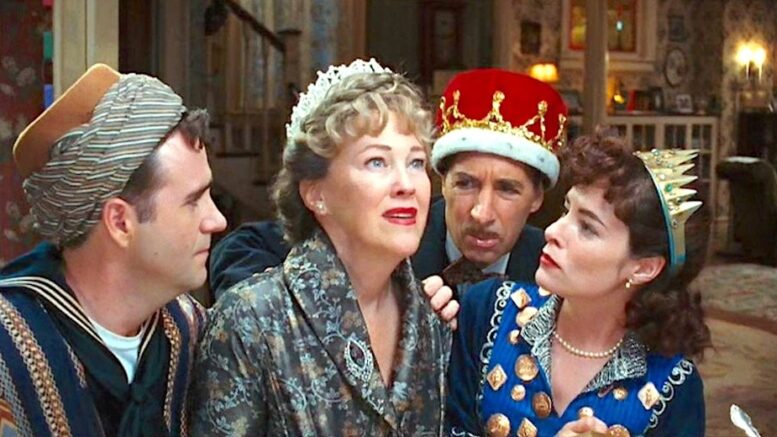
And then there is “For Your Consideration,” the 2006 satire about the making of a Hallmark-style movie. I had never seen the movie, so I was pretty surprised to find out that the film-within-the-film is called “Home for Purim,” a tearjerker about a family gathering for Purim in the 1940s South.
In the mockumentary, rumors start to spread that the characters played by O’Hara, Harry Shearer and Parker Posey might be considered for Academy Awards. Excitement brews, but so does concern. The producers soon inform the writers that the topic is “too Jewish” and suggest that they drop the Purim of it all. One of the producers says, “Turn down the Jewishness so that everyone can enjoy it.” Goodbye, “Home for Purim”; hello, “Home for Thanksgiving.”
In the end, the actors don’t get nominated for their performances, and, in typical Guest fashion, the characters exit stage left after being confronted with disappointment.
There’s a way to watch this movie and not be struck by the seriousness of the idea that Jewish characters are asked to mute their Judaism for the comfort of an audience, which might reflect how many feel about the state of being Jewish in 2026. Antisemitism is out of control, and Jewish safety is at the top of the minds of many.
But I see something different. We don’t know how the film might have turned out as “Home for Purim,” but it clearly lost something when the producers asked to remove its Jewish character. Specificity is what makes satire possible; when identity is flattened, humor loses its tension. The characters begin to lose themselves after the film adjusts in order to be “palatable” to non-Jewish Americans. Without a clear center, exaggeration has nowhere to land. When we lose ourselves, things start to fall apart around us.
Any Jew who loves Purim could quickly recognize that apart from a strange use of Yiddishisms and evoking the names of some of the characters of Purim, “Home for Purim” does not actually feel very connected to the holiday and its themes at all. That was part of the irony — and perhaps what made “Home for Purim” feel like the perfect Purim film.
That’s because, as I’ve studied in rabbinical school, Purim is all about creating a temporary world of absurdity. Megillat Esther, which we are obligated to read or hear twice on Purim, is full of the absurd: It opens with a 180-day-long party; King Ahasuerus bans Vashti from the kingdom out of fear that she will set a precedent that will turn all women against the men; Haman builds a 75-foot- tall gallows (that’s over six stories tall!) by which to kill his Jewish nemesis Mordecai.
When we look at how the absurd functions, it reveals a reversal of power. Esther hid her identity from Ahasuerus as a strategy, but inside, she always knew who her people were. After all, one could imagine that she would not have gone through all of the struggle if not for her connection to this higher purpose of saving her people. In “For Your Consideration,” the characters seem lost when the studio commits its act of cultural erasure. The Purim story, by contrast, suggests that concealment can be strategic, but identity must remain internally intact.
Humor works the same way: It requires enough certainty to risk distortion.
Since Oct. 7, and especially over the last year, I began to see the role humor plays in survival. Living in Israel during wartime, I watched people metabolize fear through jokes, absurdity and relentless irony. As I hid in the bomb shelters during the 12-day war with Iran last year, I felt a sense of fear I’d never felt before and also laughed harder than any other time in my life. The jokes helped us re-organize our fear into something we could carry together. Laughter became a reminder that we weren’t merely alive, but we were living. Although I am now back at home in Los Angeles, I can see the same dynamics reflected during the current war with Iran in the accounts of my friends in Israel.
Now, back to “Best in Show,” which I remember hating as a child. As a competitive dog show participant, I felt the film was an attack on something I held sacred. I couldn’t laugh at it. Perhaps there was also a part of me that was embarrassed by the hobby, since it was so niche, and my insecurity made it impossible to laugh.
Clearly, I didn’t understand satire. Satire exaggerates what already exists, and when you feel uncertain about something you love, exaggeration can feel like exposure. In hindsight, when I think about my younger self, she really couldn’t take a joke at all. It seems countercultural to utilize humor as a tool for resilience, but Jews come from a long tradition of employing laughter and mockery in order to take back our power. So, as I am on the verge of becoming a rabbi, I hope I might inspire others to delve into our rich tradition of laughing at life’s absurdity.
Purim is our chance to embrace the absurd and turn fear into a mockery. Especially now, when the world can feel so heavy, and we might feel powerless, we must tap into the wisdom of Purim: Laughter allows us to take back our power. Laughter doesn’t belittle the fear. It helps us understand that we have the strength to overcome it.
The views and opinions expressed in this article are those of the author and do not necessarily reflect the views of JTA or its parent company, 70 Faces Media.

Be the first to comment on "What the late Catherine O’Hara taught me about Purim and laughter"