

by Ari Sniderman, Local Journalism Initiative Reporter
(AJNews) – As a teacher and student of Jewish History over the last 20 years, I have come across various methods of teaching Holocaust education. A question, whose answer is always evolving, of course, is: What are the best ways to meaningfully integrate the memory of the Holocaust and Jewish identity-building?
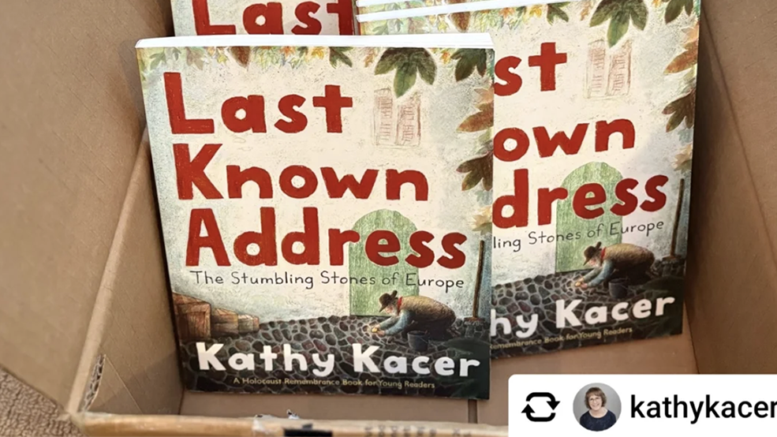
Kathy Kacer’s newest Holocaust education book for young readers, Last Known Address: The Stumbling Stones of Europe, will be an important resource going forward. As I read, I saw meaningful ways of utilizing it for Holocaust education not only in my classroom, but in my home and in the community.
Last Known Address begins by introducing the reader to Gunter Demnig’s thirty-year-old “Stumbling Stones” project. Demnig has been placing plaques in the streets throughout thirty countries in Europe at the last chosen address of over 100,000 victims of the Holocaust. Kacer then presents the stories of thirteen individuals whose plaques can be stumbled upon by visitors and locals navigating the streets, just as the victims whose names they bear had in the good times.
As mentioned, Kacer frames the book as intended for “young readers.” Specifically, the jacket states the intended audience as children between nine and twelve years old. Books suitable for this age bracket include other personal, non-fiction records such as Hannah’s Suitcase and Anne Frank: Diary of a Young Girl. Last Known Address has great value as an abridged anthology. By portraying abridged accounts of multiple individuals, as opposed to a singular account, there is a broader opportunity to pique curiosity and invite further research from readers. I was especially intrigued by the story of Salman Schocken and ended up taking an extra hour to finish the chapter about him!
In presenting their stories, Kacer has the reader connecting deeply to the events. Each chapter introduces an individual by name and location of their stumbling stone (or alternative memorial). Many chapters then include the story of the individual told in narrative, after which a short section details the facts of the victim’s life.
In each chapter, Kacer outlines the family dynamics, passions, and day-to-day lives of the victims that easily places the reader in the shoes of each. She is able to sensitively and respectfully relay each narrative, daring the reader to hope for a positive outcome to each heart-breaking tale.
In creating an incisive reading experience, Kacer is compelled to use terms and write of subjects which are unfamiliar to children being introduced to Holocaust education. This lends an opportunity for parents and teachers to facilitate discussions, concentrating on facts and feelings. Where Kacer gives the hard truths about Auschwitz and its brutality, adults can address the concepts in a safe space.
Educating young people about the Holocaust always boils down to a balance between age-appropriate truth and oversharing to the point of trauma. This is a hard balance to reach in a group as the threshold is deeply individual. One reason this unique anthology works as a meaningful resource is that the different stories offer different types of revelations about the events of the Holocaust.
Through the eyes of Leone Sabatello and Vera Katz Schiff, readers get a disturbing picture of antisemitism stomping into daily life. Readers realize the bravery of the partisans from Max Windmüller. Jan and Amelie Daniels are a Roma couple whose story focuses on the destruction of numerous communities and culture, and Matvey Ajzinberg’s story conveys vivid descriptions of family separation. Holocaust education often focuses on the above themes, so the presentation of them through the anthology is clearly intentional and curated.
In the community, Kacer’s text can be utilized for ceremonies and programming for youth and intercultural exchanges. In my house, I can envision reading Last Known Address with my kids as they begin to approach the appropriate age.
In the classroom, a teacher could read sections of Last Known Address with their class to introduce the Holocaust in general, or to further understanding through the memory of the individuals introduced by Kacer. I have certainly been waiting for a book like this to add to our program. I trust it will find a good home between Anne Frank’s diary and Hannah’s Suitcase in synagogue and school libraries everywhere.

Be the first to comment on "‘Last Known Address’: A valuable resource for Holocaust Education"