

by Jana Zalmanowitz, Local Journalism Initiative Reporter
(AJNews) – While brainstorming with the editors of Alberta Jewish News (AJNews) before last month’s Passover edition, perhaps in an effort to overcome troubled feelings of international news, I joked about the “hard-hitting” local stories I could cover in Calgary. In an equally facetious tone, the editor noted the biggest news out of Edmonton was a local matzah shortage.
“Trust me. I’ve heard,” I told her. “From multiple sources.”
Turns out AJNews had been fielding calls from desperate northern prairie Jews preparing for the seders.
While so much of the world operates on a very short news cycle, the beauty of a monthly publication like AJN is it gives you the opportunity to not just know what’s happening in Jewish Alberta, but to savour the stories. Really mull them over. It’s unlikely I’ll get to cover any monthly breaking news, but you can count on me to mull it over.
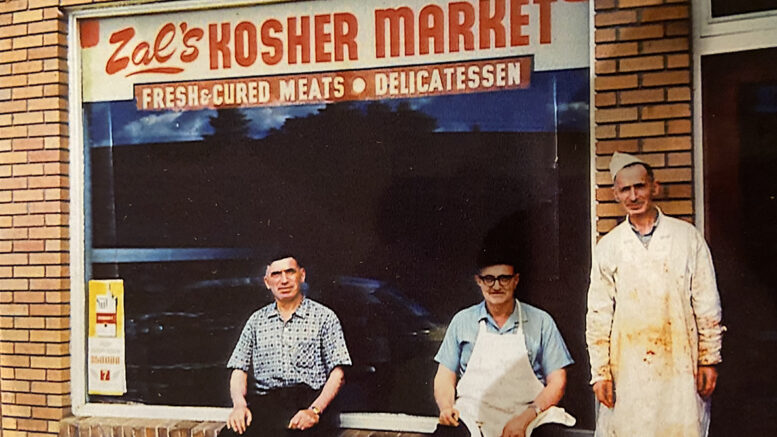
A matzah shortage was unheard of when I grew up. I’m a product of 1980’s Edmonton and the granddaughter of a kosher butcher. For my dad’s family, preparing Zal’s Kosher Market for Passover was equivalent to dressing the window at Macy’s in Herald Square for Christmas. A major cultural event, taken seriously.
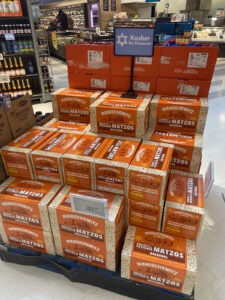
Edmonton shoppers were scrambling but there was an abundant display of matzah at Glenmore Landing Safeway in Calgary the day before Passover.
Over the years, both Edmonton and Calgary have seen fluctuations in the availability of Kosher goods. Local kosher butchers in the Alberta prairies may as well be sitting in an exhibit beside the Little Synagogue on the Prairie in Heritage Park. An ode to kashrut of the past.
Demand for kosher products now relies on good communication and relationships between grocery chains and the Jewish community. This year, we witnessed what happens when circumstances lead to a breakdown in this delicate and unofficial chain of supply and demand.
Speculation is that it began with Edmonton’s long-time kosher partner, Andy’s IGA, closing its doors in 2024 when Andy retired. L’OCA Quality Market stepped into the location with a promise to continue carrying kosher products. When it closed in mid-March, customers were left to count on Brook’s No Frills who had recently expanded their kosher section but were not equipped to be the only provider in the city. Callingwood Safeway has also dabbled in kosher goods for many years, but again, it’s not used to the heavy lifting of being a major kosher hub.
I first heard of the shortage from my mom who received a text from her neighbour. “Do you have any extra matzah? We’re cooking for Passover and can’t find any.” My parents were out of town but, in true neighbourly fashion, she invited them to let themselves into the house and take a couple boxes. It’s a simple vignette in my parents’ lives and a testament to the perks of having nice Jewish neighbours.
The next time the mention of shortage arose was with my brother during a phone call. “Are you ready for Pesach?” I asked him, mostly out of childhood nostalgia and only partially to hear the answer.
“I couldn’t find any matzah,” he told me. He then launched into a tale of his search through Edmonton’s south side No Frills, the city’s current best bet. He spotted a few boxes in someone’s cart and asked where she had found them, hoping to be pointed in the right direction.
She responded with something to the effect of, “There are none left and I’m not sharing mine.”
Don’t worry. He managed to track down a pack of five and overbought for his family of two. (He has extra in case anyone needs, he assured me.)
I next heard about it from my dad who, true to his upbringing, preps for Pesach as a fundamental aspect to his version of spring cleaning. This year, it involved disguising a trip to see his grandchildren as a suspected cover for the opportunity to scour the shelves of all kosher-supporting grocers in Calgary. “There’s no matzah left in Edmonton so I should pick some up here,” he told me as he unveiled his trunk of Manishevitz products.
A phone call with my uncle in Edmonton later that week revealed he was harbouring four unopened boxes of matzah in his basement. He told me if I hear of anyone looking, to let them know they can count on him.
The day before the first seder I took a trip to Glenmore Landing Safeway for a last-minute item. Their kosher aisle at this time of year is a scene reminiscent of the pre-war shtetls of Eastern Europe. Of course, I ran into a fellow Edmontonian transplant. While we caught up, he revealed the purpose of his last-minute grocery shop. “You know,” he said, “There’s no matzah in Edmonton.” I’m aware I told him, mulling over this theme. After his sister considered ordering matzah on Amazon for a substantial mark-up, he came through. We joked about loading up with the abundance available in front of us and establishing an underground matzah economy moving north on the QE2. We didn’t do it but he was generous in stocking up in case he encountered any others in need.
Another honourable matzah shortage mention came from a text I received from a friend in Edmonton showing me a beautiful photo of her Passover table. “Good thing we have friends coming in from Calgary because they’re bringing the matzah,” she added.
I’ve been told this has happened in Calgary before. It’s hard to keep track of demand and maintain the right supply. Populations fluctuate. Adherence to kashrut changes. Businesses come and go. What can we learn from the great Edmonton matzah shortage of 2026?
While I linger over the matzah deficit, now old news by the standards of a 24-hour cycle, I realize it was never really about matzah. It was about texts sent without hesitation, doors unlocked for neighbours, and trunks quietly filled in another city “just in case.” In a place where we don’t always have abundance, we’ve learned to rely on something else: each other.
We are commanded to love our neighbour as ourselves (Ve’ahavta l’rei’akha kamokha), but in Alberta’s Jewish communities, that commandment doesn’t live in scripture alone. It lives in small actions taken every day by its members.
This year it was matzah. Next year it may be Hanukkah candles. Either way, we already know how the story ends in our small communities. Someone will have extra, and someone will share.

Be the first to comment on "Edmonton’s 2026 matzah shortage shows the true meaning of community"