

By David Sklar, Local Journalism Initiative Reporter
(AJNews) – Elon Gilad’s journey into Hebrew etymology began with a decrepit apartment, a Tel Aviv Street sign and an eggplant.
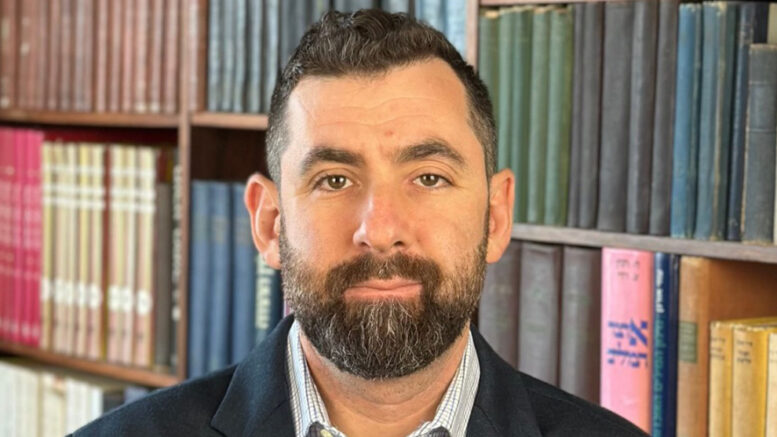
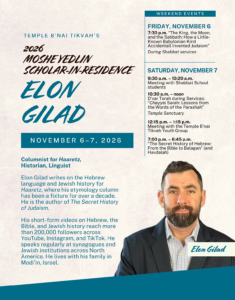
The historian, linguist and Haaretz columnist recently joined the Chai There! podcast ahead of his visit to Temple B’nai Tikvah in Calgary, where he will serve as the 2026 Moshe Yeldin Scholar-in-Residence. The podcast episode will be available later this month.
Gilad recalled moving into an apartment on Luntz Street near Rothschild Boulevard. The place was in such poor condition that he had to install his own toilet, but its location made it worth the trouble. Curious about the person behind the street’s name, Gilad discovered Abraham Luntz, a 19th-century Jerusalem scholar credited with coining hatzil, the modern Hebrew word for eggplant.
“I was mind blown that I’d been using this word my whole life, and suddenly I find out that this guy a hundred years ago just came up with it,” Gilad said.
 After researching Luntz, he became curious about the Hebrew word for tomato. One word led to another, and what began as a hobby eventually became a regular Haaretz column that has run for approximately 13 years.
“Each one of these columns is like a window into an aspect of Jewish history that I wouldn’t otherwise have been privy to,” he explained. “I’m trying to lure in readers and say, ‘You speak this word let me tell you about this word.’ But really, I’m going with them on a journey.”
That journey often leads into the Bible, the Mishnah and the writings of medieval rabbis. Gilad uses words as an entry point, but the stories he uncovers are ultimately about the people who spoke, debated and reshaped Hebrew across generations.
Gilad also challenges the familiar story that Eliezer Ben-Yehuda single-handedly revived the language. Ben-Yehuda was an important catalyst, he said, but Hebrew had never disappeared from Jewish life. Jews continued using it in prayer, books, newspapers and correspondence even when Yiddish, Ladino or Arabic were their everyday spoken languages.
That history helps explain why modern Hebrew carries influences from across the Jewish world. Its structure bears the imprint of Yiddish, while much of its slang comes from Arabic-speaking Jewish communities.
“I think it’s beautiful,” Gilad said. “We come from everywhere.”
Asked which Hebrew word English speakers should adopt, Gilad chose davka, a versatile word inherited through Yiddish and Aramaic. He illustrated its subtle power with a mother-in-law tasting her daughter-in-law’s kugel and declaring it “davka good”, a compliment that also suggests she expected it to be terrible.
“It’s a very subtle word, a very useful word,” he said.
Gilad’s Hebrew-language book, The Secret History of Judaism, traces the development of Jewish holidays. While researching Shabbat, he encountered evidence suggesting that an earlier lunar observance eventually evolved into the weekly day of rest. Such discoveries can provoke resistance, but Gilad believes historical inquiry offers another way into Judaism for people who cannot accept religious texts as literal history.
“I want to keep the traditions, not because Moses brought them down from Mount Sinai, but because we’ve been doing it for hundreds of years—thousands of years—and it won’t stop with me,” he said.
For Gilad, these historical stories can help secular Jews find a meaningful connection to Jewish life without demanding certainty or literal belief. They do not have to replace traditional understandings; they can exist beside them.
His Calgary visit also has a personal Canadian connection. Gilad’s mother grew up in the Montreal area, he holds Canadian citizenship and he spent childhood summers in Montreal. A childhood visit to his aunt in Calgary gave him his first taste of sushi, something that had not yet made its way to Israel.
Rabbi Glickman said Temple B’nai Tikvah is looking forward to Gilad’s visit.
“Gilad is a wonderful and engaging teacher who regularly captivates his reading and listening audiences with fascinating tidbits from Jewish history,” he said. “We here at Temple are excited to welcome him and to learn some of the many lessons he can teach.”
Gilad hopes participants will come away with greater curiosity about Hebrew and a fresh way of approaching Jewish history.
“I’m not trying to replace the way that they see their history and Judaism,” he said. “I’m trying to add another layer, another way to look at who we are.”
Event information (Taking place at Temple B’nai Tikvah in Calgary)
Friday, November 6
- 7:30 p.m. — “The King, the Moon, and the Sabbath: How a Little-Known Babylonian King Accidentally Invented Judaism,” during Shabbat services.
Saturday, November 7
- 9:30–10:20 a.m. — Meeting with Shabbat School students.
- 10:30 a.m.–noon — D’var Torah during services: “Chayei Sarah: Lessons from the Words of the Parashah,” in the Temple sanctuary.
- 12:15–1:15 p.m. — Meeting with the Temple B’nai Tikvah youth group.
- 7:00–8:45 p.m. — “The Secret History of Hebrew: From the Bible to Balagan,” followed by Havdalah

Be the first to comment on "TBT scholar-in-residence Elon Gilad follows Hebrew words into Jewish history"