

by Irena Karshenbaum, Local Journalism Initiative Reporter
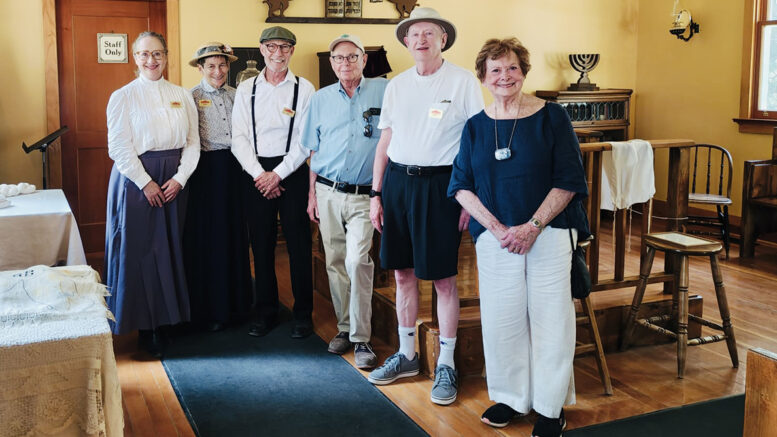
(AJNews) – On Sunday, July 19, 2026, renowned Canadian military historian, frequent commentator about the country’s defence policies, Dr. David Bercuson, who has taught history at the University of Calgary since 1970 and is the founding director of the school’s Centre for Military, Security and Strategic Studies, presented a special talk in the Montefiore Institute (aka the Little Synagogue) at Heritage Park Historical Village. The story extended beyond the professor’s usual subject, focusing on his family’s history entitled, The Bercuson Family in Calgary.
The farmers who homesteaded in the Montefiore Colony – reaching a population of 77 at its peak – where the Montefiore Institute once stood, arrived in the area of eastern Alberta in 1910 from Russia and Romania, as we tell our visitors, but we do not know where exactly they came from.
This is not the case with Dr. Bercuson’s history as the family does know the exact place where they draw their roots, from, Panciu, in the foothills of the eastern Carpathian Mountains, in Romania.
Dr. Bercuson described the region as, “Known for its Romanian wines and had a Jewish population around the turn of the twentieth century of some 677 people.” He explained that, “Although not numerous, the Jews of Panciu were engaged primarily in small scale commerce and lived lives of semi-poverty, but relative safety.”
Dr. Bercuson took the audience through two centuries of history that spanned Europe, North America and Israel as seen through the eyes of his family’s story.
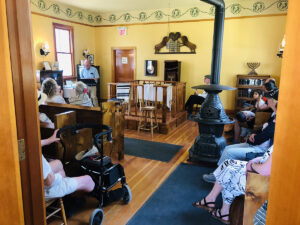
Dr. David Bercuson presenting his talk, The Bercuson Family in Calgary, in the Montefiore Institute at Heritage Park on July 19, 2026. Photo credit: Irena Karshenbaum.
He explained, “The original name of the family was Bercovici, a common name in east central Europe, which means the son of Berco. Berco, or Berish, had been born in Romania about 1835. He was a schochet, as was his son, Gershon, who was born about 1855.”
Jack Bercovici arrived in Calgary with two brothers. Dr. Bercuson admitted the family is not sure which two, possibly Herman and Harry, in 1902 or 1903. One brother and two sisters remained in Romania.
He recounted, “It is said that the three brothers peddled their way behind a push cart to Hamburg, or maybe one of the Black Sea ports, where they purchased passage to Canada aboard a CPR steamship. Why Canada? Why the CPR? That was the time of the great migration of eastern and central European Jews to Wilfred Laurier’s Canada and, of course, to the United States. Steamship ticket brokers fell over themselves to attract customers and the three Bercovici boys sailed for Halifax.”
The fourth brother, Solomon (Dr. Bercuson’s grandfather), he continued, “Followed a year or two after.” Solomon found work at BESCO – the British Empire Steel Corporation – a Nova Scotia steel mill, then became a news clerk with the National Transcontinental Railway, which later was incorporated into the Canadian National Railways. “He sold newspapers, pop, candy bars on the trains running between Halifax and Winnipeg before joining his brothers in Calgary around 1908.”
Dr. Bercuson explained, “Jack was the patriarch of the family.” Jack married Sarah Hart of Calgary in 1906 and the couple had four children: Joe, Passie (who later married Sam Hector), Leonard and Bernard (born in 1916).
Jack opened a dry goods store on 8th Avenue East, in Calgary, and, “At one point had three store fronts very close together, which were operated by him and his brothers. Jack was very active in the small Jewish community, being a founder of the House of Jacob in 1909.”
Jack’s men’s wear store did not survive the Great Depression. Dr. Bercuson described how he has a 1933 ad from the Calgary Herald hanging in his office that announced, “Bercuson Throws Bomb,” which told readers of the store’s bankruptcy sale. “After the bankruptcy, Jack and Sarah left Calgary for Montreal where they stayed for a few years before returning to Calgary. Both are buried in the Erlton Jewish cemetery.”
Bernard, who had attended Western Canada High School, joined the Second Battalion of the Calgary Highlanders on the outbreak of the war. He continued, “Bernard’s mother did not want him to join the RCAF, but join he did, entering the British Commonwealth Air Training Plan. He went through the usual stages of flight training moving to small air bases in Alberta and Saskatchewan. He specialized in radio operations. But as a radio operator on a bomber, he was also trained as an aerial gunner. In the event that one of the three main gunners on the bombers was incapacitated, Bernard was to fill his position and operate one of the bomber’s three-gun turrets.”
On the afternoon of August 16, 1944, Halifax No. MZ899 took off from Yorkshire and in the early morning hours of August 17, 1944, the Halifax bomber, on a night mission to drop sea mines into the Bay of Kiel, was shot down by a German night fighter. Bernard was killed along with six other crew members, Dr. Bercuson described.
He recounted how the four immigrant brothers were not together for long when they first arrived in Calgary. Jack’s younger brother, Herman, married Hattie in Montreal, then returned to Calgary until May 1916, then left for Windsor, Detroit, then Miami. The couple had four children: Gertrude, Jack, Saul and Bernard, who never married and went into the hotel business.
“At one point, he [Bernard] owned two establishments on Miami Beach: the Aztec Vacation Motel and the Singapore Hotel both on Collins Avenue. The last of these was owned in conjunction with a gentleman named, Meyer Lansky, who took his breakfast at the Singapore everyday. He was an avid collector of paintings and pottery including pieces from Pablo Picasso.”
Before the First World War, Solomon moved to Montreal where he worked in a textile factory and where his new wife, Dora, and him had four children: Anne, Joseph (Dr. Bercuson’s father), Bernard (born in 1920), and Norman.
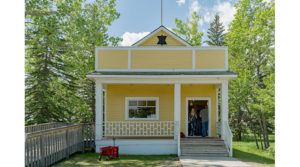
Little Synagogue on the Prairie at Calgary’s Heritage Park. Photo by Tony Wasserman.
“Wherever you find a Bercuson, you will find a Bernard,” he explained. “My second cousin, Ellen Barberie, who did most of the spadework for this family history, believes that this was because the first Bercovici she found in the family tree was Berish Bercovici. For some reason Berish became Bernard in later generations. Thus my uncle in Montreal was Bernard, my cousin in Calgary was Bernard, and the hotel entrepreneur in Miami was Bernard and there was eventually a fourth Bernard.”
He recounted, “My dad went to McGill to study engineering, but never completed the course. He then went to work for RCA Victor in Montreal on Canadian radar during the war, joined the reserve army and married my mother, Sylvia Green, from Brooklyn in August 1942. I was born two days before Japan formally surrendered on September 2, 1945.”
Dr. Bercuson explained how his father’s younger brother, Bernard, joined the Royal Canadian Air Force in October 1940, “He was eventually assigned to No. 25 Operational Training Unit as a Wireless Air Gunner with the rank of Sergeant. These OTUs flew training operations over the UK, but sometimes were sent on bombing missions over the occupied continent. In June 1942, Bernard climbed into a twin engine Wellington for a night mission. His plane was badly shot up by a German night fighter, but just managed to make it back to the UK where it crashed. Three of the crew were killed. Bernard was badly wounded and spent months in a hospital. He returned to Canada with an honourable discharge in 1945.”
Dr. Bercuson continued, “The Bercovici family that remained in Romania, survived the Holocaust because of Marshal Ion Antonescu, the fascist dictator of Romania who was an ally of Adolf Hitler. For some reason, Antonescu, no friend of Jews, allowed the Nazis to do what they pleased with Jews from the newly acquired territories but would not allow them to seize the Jews from old Romania. Thus, Elie Wiesel and his family, who lived near the border with Ukraine, ended up in Auschwitz. The Bercovici clan who lived near the heart of old Romania were not turned over to the Nazis and survived the war.”
After the Communists came to power, he said, “They made it very clear to the Jewish population that had survived the war that Jews – members of the bourgeoise – were not wanted in the new People’s Republic of Romania. And so they fled most to Palestine, walking overland to Burgas, Bulgaria on the Black Sea where the Pan York and the Pan Crescent, two small passenger ships, awaited Jewish refugees from Romania and Bulgaria. They boarded the ships in December 1947, sailed through the Bosphorus and into the Mediterranean, bound for Palestine.”
He concluded, “Our family story fits within the mass migration of Jews from central and eastern Europe. It is the story of a Jewish family in the twentieth century.”
Dr. Bercuson’s talk was part of a series of special events the Synagogue Advisory Committee now presents on a regular basis during the summer season and for Once Upon A Christmas, which in our case is Chanukah.
On May 27, in celebration of Canadian Jewish Heritage Month, we showed the Brazilian documentary, Promised Lands: The Legacy of the Baroness and Baron de Hirsch, to bring awareness to the Jewish farming history of Brazil that was part of a global migration, which included Canada. The farmers in both countries received help from the 19th-century philanthropists, Baron Maurice de Hirsch and his wife, Clara.
On June 28, Rabbi Nisan Andrews, from House of Jacob Mikveh Israel, presented a talk, From Field to Faith: Defining Rest through Labour, discussing the centrality of Shabbat in Judaism. He opened with his profound explanation, “Shabbos is one of the most important ingredients of Jewish survival. It is no exaggeration to say that the Jew has survived two thousand years of persecution and humiliation largely because he had the Sabbath. It was one factor that not only made him survive, but kept him alive, both spiritually and morally. Without the Sabbath, the Jew would have vanished. It has been said that as much as the Jew has kept Shabbos, so has Shabbos kept the Jew. As long as Judaism exists as a vibrant, vital force, the Sabbath is its most outstanding ritual practice.”
On Sunday, August 16, please join us for the last of our special summer programs, the 1916 Montefiore Institute Dedication Ceremony, performed at 11:00 am and 2:00 pm. More info: https://heritagepark.ca/events/montefiore-institute-dedication-ceremony/
With files from Dr. David Bercuson.
Irena Karshenbaum is the founder and served as president of The Little Synagogue on the Prairie Project Society that gifted the 1916 Montefiore Institute to Heritage Park. Today, she volunteers in the exhibit and writes. irenakarshenbaum.com

Be the first to comment on "A tale of three Bernards and the stories we tell in the Little Synagogue on the Prairie"