

(Ottawa, March 5) – The following tracel advisory was issued by the federal government on March 5. Click here for updates.
The situation throughout the Middle East remains unpredictable due to ongoing military activities in the region. The security situation could deteriorate significantly without notice.
On February 28, 2026, the United States and Israel launched joint airstrikes against Iran, with several explosions reported in central Tehran and elsewhere in Iran.
Iran has responded by launching retaliatory strikes against Israel and US-related military installations and other facilities across the region. Given the scale and pace of these exchanges, the conflict may continue for an indeterminate period.
The Government of Canada and its network of missions abroad remain fully engaged and are focused on the safety and security of Canadians in the Middle East.
Information for Canadians in the Middle East
Due to military activity in the Middle East, the Government of Canada continues to update travel advice for destinations in the region. Canadians are advised to avoid all travel to Bahrain, Iran, Iraq, Israel and Palestine, Kuwait, Lebanon, Qatar, Syria, United Arab Emirates and Yemen and to avoid non-essential travel to Jordan, Oman and Saudi Arabia.
Find more advice and information per destination.
There could be disruptions to movement and transportation, including:
- border closures or restrictions
- flight cancellations
- airspace closures
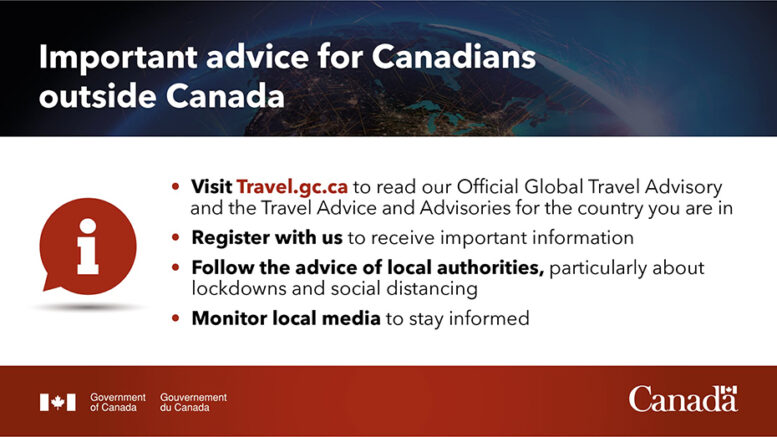
Canadians in the affected regions should:
- be vigilant and follow the instructions of local authorities at all times, including any orders to shelter in place
- ensure that your travel documents and those of your family are up to date
- monitor local and international media to stay informed of the rapidly evolving situation
The Government of Canada cannot guarantee the safety of Canadians abroad.
Travel conditions can change quickly. Airspace, flights and border crossings may close without warning. Always check with airlines and local authorities before attempting to travel.
The Government of Canada issues travel advice and advisories about safety and security conditions abroad to enable travellers to make their own informed decisions regarding destinations, including assessing the security of their travel routes and ensuring that they meet the entry requirements of their destination. The decision to travel is the sole responsibility of the traveller.
Register with us
All Canadians in the region are urged to sign up for the Government of Canada’s Registration of Canadians Abroad service so that they can receive direct, important updates.
If you’re a loved one of a Canadian citizen or permanent resident in the Middle East who cannot register themselves, please do so on their behalf and include their phone number.
Registration can also be completed by contacting Global Affairs Canada’s 24/7 Emergency Watch and Response Centre.
Canadians who are already registered should make sure their registration and contact details are up to date.
Emergency assistance for Canadians in the Middle East
Our ability to provide consular services to Canadians during an active conflict is limited, with priority given to the provision of essential services. If you are in an affected country, prepare contingency plans that don’t rely on the Government of Canada’s assistance for departure. When air travel and/or land crossings are available, information about those will be shared with Canadians who have registered with us.
Canadians requiring emergency consular assistance can contact Global Affairs Canada’s 24/7 Emergency Watch and Response Centre: ME-MO.SOS@international.gc.ca
Canadians can also reach us by:
- calling: +1-613-996-8885 (collect calls are accepted where available)
- texting: +1-613-686-3658
- WhatsApp: +1-613-909-8881
- Signal: +1-613-909-8087
- reaching out to the nearest Canadian office
Travel documents required for travel to Canada
Canadians and permanent residents planning to travel to Canada must ensure they have the valid travel documents to do so, including those for their spouse and dependent children. Those who don’t have valid travel documents to come to Canada must apply for them as soon as possible.
- More information about applying for a new passport abroad
- More information about renewing your permanent resident card outside Canada
More information can be found on the Visit Canada page.

Be the first to comment on "Canada’s response for Canadians in the Middle East"