

By AJNews staff
(AJNews) – To commemorate the eighty-first anniversary of the liberation of Auschwitz-Birkenau and International Holocaust Remembrance Day (IHRD), MacEwan University marked the significant occasion by opening its lecture room doors to students, staff, faculty, and community members to hear about how the next generation of learners will be exposed to topics related to the Shoah in an event titled Looking Forward: The Future of Holocaust Education.
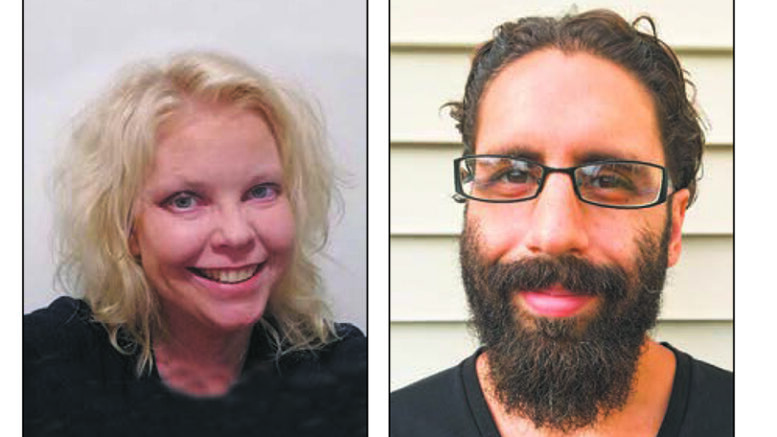
Alberta Jewish News was on the scene as an auditorium in the Robbins Health Learning Centre filled quickly with attendees. In cooperation with the Jewish Federation of Edmonton and The University of Alberta’s Department of History, Classics, and Religions, MacEwan University’s Office of Human Rights was pleased to welcome Dr. Melanie Carina Schmoll direct from Hamburg, Germany. Edmontonians may remember Dr. Schmoll from her visit in November 2025 to the Wirth Institute for Austrian and Central European Studies in honour of Jewish Studies Week. A frequent guest in Alberta because of her research position at the University of Calgary, Dr. Schmoll was joined at the podium on January 29 by Dr. Alexander Warren Marcus the Belzberg Family and Jewish Federation of Edmonton, Assistant Professor of Jewish Studies. This marked both scholars’ first speaking engagements at MacEwan University, but hopefully a prelude of many more to come.
The event was moderated by Dr. Regan Lipes, Assistant Professor of Comparative Literature in the Department of English at MacEwan University. Dr. Lipes, a seasoned contributor to AJNews, has organized Shoah awareness programming at MacEwan for the past two years for IHRD. “I feel strongly that fostering greater understanding around what took place during the Shoah needs to be a focus within education,” she explained. “Denial, distortion, and revisionism are terrifying prospects, and educators have a duty to ensure that students are presented with authentic learning experiences.” She hopes that a lecture to honour IHRD will become an annual MacEwan event. “Last year we were joined by Dr. Joseph Patrouch, a noted historian and professor at the U of A, and we also hosted the Azrieli Foundation’s, Manager of Academic Initiatives, Dr. Carson Phillips.” She noted that there was a modest, but solid turnout in 2025, “But I think that our speakers were so insightful and engaging, that people were really motivated to attend this year’s event.”
Indeed, this seemed to have been the case. By the time the program was ready to commence, people were scrambling for seating, and additional chairs needed to be brought in. In attendance were Dr. Leon Kagan and Dr. Francie Cyngiser, co-chairs of the Jewish Federation of Edmonton’s Holocaust Education Committee, as well as other members of the greater Jewish community. Federation CEO, Stacy Leavitt-Wright, and Associate Director of Holocaust Education and Community Initiatives, Jennifer Magalnick were also present, accompanied by Zion Barany, an archival specialist working with Shoah artifacts, testimonies, and documentation.
In her introductory remarks, Dr. Lipes noted: “Eighty-one years ago, on January 27, 1945, Soviet Red Army soldiers in Poland were met by a sight that would haunt each of them to their dying day. Bodies, barely recognizable as having once been human were heaped in unceremonious and tangled piles of decay. Eighty pounds of eye glasses that belonged to eyes that would never see again, twelve thousand pots and pans that would never cook another meal, forty-four thousand pairs of shoes that would never cradle another set of feet or tread another step, and fifteen thousand four hundred pounds of human hair of all colours, textures, and lengths lay eerily discarded but meticulously inventoried at a sight now synonymous with death – Auschwitz-Birkenau.” She proceeded to respectfully name the other death camps that operated in Poland: Chelmno, Majdanek, Treblinka, Sobibor, and Belzec, before introducing the occasion’s distinguished panelists. Dr. Marcus facilitated an insightful and probative discussion about the trajectory of Shoah education with Dr. Schmoll referencing her book: Hatred of Jews: A Failure of Holocaust Education?. The two examined a diverse sampling of critical topics: educational deficits, adequate training for teachers, the dangers of misinformation, and even multi-disciplinary approaches to increasing Shoah literacy. Looking around the packed auditorium, it was impressive to see a high turnout of student attendees, but what was more notable was how drawn into the topic they all appeared to be.
The scholarly discussion was informative and provocative, punctuated with moments of lightheartedness that helped to soften the seriousness of the topic. Following this, Jennifer Magalnick provided a packed overview of all the initiatives and available Shoah education programming offered by the Federation. Educators in the audience, including professors from MacEwan, U of A, and Concordia University of Edmonton, who were present, may have been surprised at the wealth of resources they are able to access, and inspired to reach out for more information. Many students approached Magalnick for follow-up questions and reading recommendations. One young woman admitted that she would like to know more but was at a loss for where to begin.
What inspired hope amidst the sobering topic was that when the floor was opened for questions, most of the hands that shot into the air belonged to students. One MacEwan student asked about what the panelists thought of fictionalized narratives dealing with the Shoah. Another asked Dr. Schmoll about how to move beyond teaching the Shoah only within history lessons. A third asked about how to make sure that learners are exposed to Jewish studies removed from discussions of the Shoah. There were no simple answers, but the thoughtful questions coming from the university-students was an indication that good work is being undertaken locally to promote Shoah knowledge and literacy. Thanks to a donation from the U of A Department of History, Classics, and Religion, two signed copies of Dr. Schmoll’s books were raffled off, while many more copies sold to audience members eager to understand more. For those who missed their chance to pick up their copy of Hatred of Jews: A Failure of Holocaust Education?, it is available for online purchase.
“We are so grateful to MacEwan University, and their dedicated Office of Human Rights for supporting and hosting this event,” Dr. Lipes stated. “With the help of the Jewish Federation of Edmonton, we were able to bring a highly respected international scholar to MacEwan, and that’s really something exceptional. I’m so proud to be at an institution that values opportunities to provide students with additional scholarly enrichment, and I’m really hopeful that we will be able to build on this success for the future.” When asked about what IHRD programming should strive to do, she answered: “The students who came to hear Dr. Schmoll and Dr. Marcus speak are going to be our next generation of decision makers, community leaders, jurists, and educators. Those of us entrusted to be their teachers now have a responsibility to support them to be global citizens who see the humanity in everyone. My wish is that the next generation will do a better job at combatting hate.”
Those interested in learning more about the educational resources offered by the Jewish Federation of Edmonton should reach out to Jennifer Magalnick and her team at magalj@edjfed.org.

Be the first to comment on "IHRD commemorated at MacEwan University with two engaging speakers"