

By Mark Cooper
(AJNews) After losing three childhood friends to the trigger of a Palestinian suicide bomber, living through the “slow burn” of daily terror threats during the Second Intifada and not knowing whether the bus she was riding on or restaurant she was eating in would be the next target, most would understand if Charlotte Korchak carried some hatred in her heart.
But while the 38-year-old Israeli/American historian and educator is not immune to deep feelings of anger at the horror she and all Israelis endured, she has chosen to channel those feelings in a more constructive and instructive way she feels can best serve the future of Israel and the Jewish people.
It was with these tragic early experiences that began shortly after her family made Aliyah from Los Angeles when she was just nine, that sparked a passion in her to consume every bit of Israeli and Middle Eastern history and to use her vast knowledge to help people around the world better understand the complex nuances of the Israeli-Palestinian conflict.
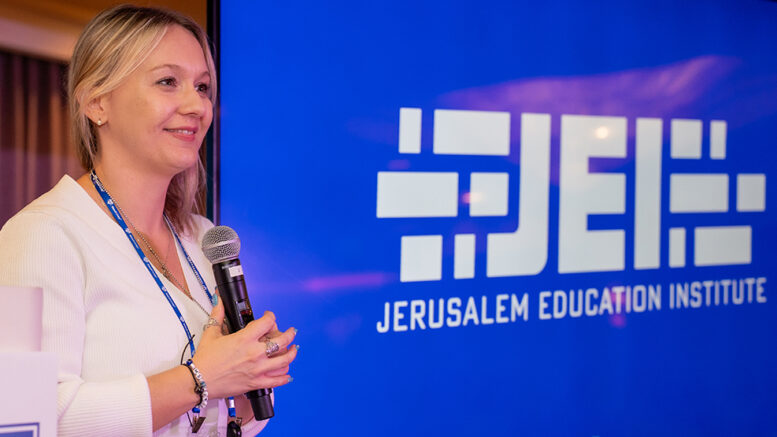
“Most people out there, it’s not that they know and don’t care. It’s that they don’t know and therefore they don’t know to care,” said Korchak, who will be speaking in her role as the Founder and Senior Educator of the Jerusalem Education Institute (JEI) to Calgary and Edmonton audiences in early February at events presented by the Alberta chapter of Friends of JNF Canada.
“If we all see ourselves as educators we can get the average person to understand and to know, and therefore to care.
 “Overall what we’re trying to do is to help people better understand Israel, Zionism, antisemitism and the Jewish people because we’re such believers that the problem in the world today is not hatred but ignorance or misinformation that feeds what appears to be hatred but is actually coming from a place of a lack of understanding, rather than malice,” said Korchak.
She uses an encyclopedic knowledge of history along with her personal experiences living through the Second Intifada where more than 1,000 Israelis were killed – many by a series of Palestinian suicide bombings – to help break down complex ideas into something the average person can digest.
She often speaks about February 16, 2002, the day she learned her friends Rachel Thaler, 16, Nehemia Amar, 15 and Keren Shatsky, 15 fell victim to a suicide bomber while out having pizza on a Saturday night at a mall in the settlement of Karnei Shomron.
So at 14 instead of celebrating her teenage years with her friends, she attended their funerals.
A year later, her parents moved away from Israel.
“There was a lot of angry feelings towards the Palestinians. I wouldn’t say I was somebody who believed in deep reconciliation or anything like that.
“But I was lucky that I got separation from the conflict. I hated that my family moved out of Israel but I do see now that I do look back and reflect that it did enable me to heal a little faster. And I think honestly I got to the place where I started to talk more about it. Because I was teaching all the time and it’s part of my story so I literally talk about it almost every day and that helps with the healing process.”
It also helped her forge a path forward for her education work after the events and aftermath of October 7 Hamas attacks on Southern Israel.
“I feel like the second intifada was the trauma of my generation and October 7 was the trauma of the next generation and there’s no way to compare them. One was a slow burn over multiple years, the fear took over day to day life and you remember those feelings and that kind of trauma that leaves you with.
“October 7 was one big hit in a brutal and unfathomable way.”
She says that in some ways, she is grateful that she went through the second Intifada as the experience helped her filter her emotions into a place that was more productive for her life’s work.
“I wanted to see a better future somehow and end the violence somehow.
“When October 7 happened, of course I was hit like every other Jew and I was so angry in the beginning and I had all of those same feelings. But I think I was able to overcome and move forward faster because I just felt like I didn’t want us to go back to this place of trauma and hatred and hopelessness and an inability to see forward.”
After earning a degree in Middle Eastern History from the University of Southern California, Korchak moved back to Israel on her own at 25.
Encountering anti-Zionism at University, Korchak began what would turn into a career that has taken her to speak at high schools, universities, communities and young professional groups around the world.
A fellowship at StandWithUs in 2010 allowed her to engage with over 50,000 students annually both online and on five different continents for 14 years, working her way up to be the organization’s International Senior Educator.
In 2024, she founded JEI, where she intends to transform Israel education during what she describes as a critical period for the future of not only the Jewish people and Israel but of Western civilization.
She describes the climate of rampant antisemitism and globalized violence such as the Bondi Beach Hanukkah massacre in December as continuing to be very worrying and concerning but believes strongly there is a path forward.
 Her Friends of JNF presentations, February 8 at the Calgary Jewish Community Centre and February 9 at a still-to-be announced Edmonton location will be about how Diaspora Jews and those who care about the preservation of Western values can move forward positively.
“But to do that, we have to understand where we are. And as a historian and as I speak to many of my other friends who are historians and analysts, we all are feeling that so much of what is happening in the world is echoing what was happening in the 1930s and we need to learn from history.
“So it’s not like saying, it’s the 1930s, look at what’s to come. It’s a matter of saying, we could be in the 1930s, how can we prevent the 1940s from unfolding in front of our eyes.”
And that very much includes here in Canada, where she sees disturbing parallels to the climate of antisemitism that was ignored by the Australian government.
“The saddest part, other – of course – than the 15 people killed, was that the community had been screaming that antisemitism was at an all-time high, that things were very dangerous for the Jewish community and they felt completely ignored by the government. Because they were. It hit even harder because as a historian, you learn about the history of antisemitism and how more often than not Jews really tried to put their heads down and tried to ride it out.
“And in this case they didn’t put their heads down and they weren’t trying to ride it out. They were putting their heads up and they were screaming and their screams went completely unheard. It was added insult to injury, the fact that everyone in the community that I know said that it was shocking but it wasn’t surprising.”
She’s heard from Canadian Jews who feel the same way.
Jay Cairns, the executive director of the Alberta chapter of Friends of JNF Canada, said those who come out to see Korchak speak will be impressed by her powerful presentation and the balance and positivity she brings to the discussion.
He said the organization is responding to an identified need to find educators who can help the Jewish community better articulate the Jewish and Israel narrative as post-October 7 has seen a revisionist history of the conflict come forward.
“I am really enthusiastic to bring her here and for her to give us an idea of what the reclamation of our narrative could look like,” said Cairns.
“We want to hear solutions. We want to talk about a future that makes sense and that we can see.
“I think she’ll be able to give us a really good sense of what the temperature is out there … and give us a sense of what resonates with people … what people are digesting and what they aren’t and I think that’s a really critical piece as we move forward.”
Despite a situation that she says remains worrying and acute, Korchak says she is beginning to see signs of optimism.
American universities are waking up to the challenge of foreign funding by bad state actors and more attention is being put to the fact some educators have veered away from education to indoctrination.
She sees a tremendous growth in a willingness and a want to be active amongst Jewish students around the world.
“And then you have the October 8 Jews, so many people who came back to the Jewish community who really felt that this moment impacted them, that it tapped into their Jewish identity and there’s this revival going on within the Jewish community that I find is very positive.”
And after the Bondi tragedy she has seen an awakening from people and an outpouring of support – especially in Australia – by people who saw the attack not only as an attack on Jews but on the western way of life.
“I really do see a lot of hopeful signs and I also see a lot of worrying signs so I’m constantly balancing those two things,” said Korchak.
For more information and to register for Korchak’s Calgary and Edmonton sessions Diaspora, Israel, and the Go Forward go to the events section at friendsofjnfca.org
Mark Cooper is a Local Journalism Initiative Reporter.

Be the first to comment on "Acclaimed educator Charlotte Korchak charts a positive path forward for world Jewry"